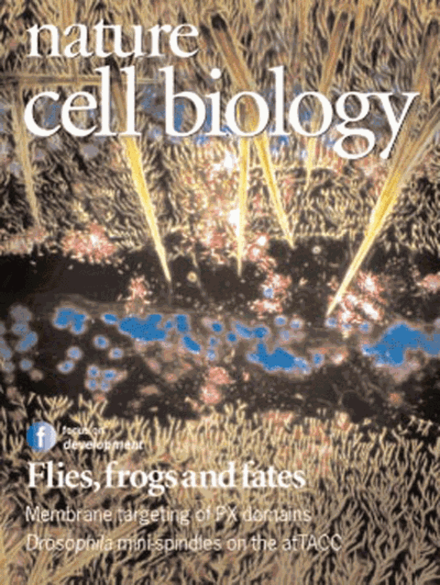
Table of contents
Editorial
focus on development
Developing cell biology - pE149
doi:10.1038/35083094
Full Text - Developing cell biology | PDF (211 KB) - Developing cell biology
Commentaries
focus on development
Morphogens: how big is the big picture? - ppE151 - E154
Peter A. Lawrence
doi:10.1038/35083096
Morphogens are in the front line just now. Here I trace how the concept of a morphogen has evolved over the past 100 years and step a little beyond what we already know.
Full Text - Morphogens: how big is the big picture? | PDF (283 KB) - Morphogens: how big is the big picture?
Straight or split: signals to transcription - ppE155 - E156
Marcel van den Heuvel
doi:10.1038/35083101
Since the discovery of substances in serum media that are able to drive cells into proliferation and/or differentiation, investigators have tried to understand how such signalling molecules can influence cells to change their behaviour. The complex nature of the responses to signals, and the equally complex signalling pathway leading to those responses, have made life difficult for the researcher. However, recent evidence obtained in genetic developmental systems indicates that a multiplicity of downstream events can be accomplished by regulation of the activity of just one transcription factor.
Full Text - Straight or split: signals to transcription | PDF (119 KB) - Straight or split: signals to transcription
News and Views
focus on development
The fatal detachment - ppE157 - E159
Kari Alitalo
doi:10.1038/35083104
No mutation in the fibroblast-growth-factor receptor-4 (FGFR-4) signalling pathway has so far been associated with either heritable human diseases or cancer. A new study now implicates N-CAM–FGFR-4 signalling in the regulation of tumour-cell–matrix adhesion and in the metastatis of pancreatic
-cell tumours.
Full Text - The fatal detachment | PDF (592 KB) - The fatal detachment
PAR-1 helps Wnt to get rid of JNK - pE158
Valerie Depraetere
doi:10.1038/35083107
Full Text - PAR-1 helps Wnt to get rid of JNK | PDF (132 KB) - PAR-1 helps Wnt to get rid of JNK
TACCing down the spindle poles - ppE159 - E161
William E. Theurkauf
doi:10.1038/35083110
Centrosomes define the poles of mitotic spindles, but spindles that lack centrosomes mediate meiotic chromosome segregation in females. Recent studies provide new insight into anastral-spindle assembly, and indicate that a conserved protein complex may be critical to the stability of both the astral- and anastral-spindle pole.
Full Text - TACCing down the spindle poles | PDF (322 KB) - TACCing down the spindle poles
Converging on extension - pE160
Sarah Greaves
doi:10.1038/35083113
Full Text - Converging on extension | PDF (94 KB) - Converging on extension
Pathway specificity for Met signalling - ppE161 - E162
Paolo M. Comoglio
doi:10.1038/35083116
Signals generated by the tyrosine kinase receptor Met elicit a complex biological response including cell dissociation, migration, protection from apoptosis, proliferation and differentiation. Paradoxically, all these are triggered by phosphorylation of a single two-tyrosine motif in the Met receptor tail, docking multiple SH2 signal transducers. The precise amino acid sequence of the motif is an absolute requirement for fulfilling the response, showing that there is specificity in intracellular pathways.
Full Text - Pathway specificity for Met signalling | PDF (1,507 KB) - Pathway specificity for Met signalling
Book Reviews
focus on development
Human cloning and headless frogs - pE163
doi:10.1038/35083119
Full Text - Human cloning and headless frogs | PDF (145 KB) - Human cloning and headless frogs
A passion for development - pE164
doi:10.1038/35083122
Full Text - A passion for development | PDF (171 KB) - A passion for development
Historical Perspective
focus on development
Powerful ideas driven by simple tools: lessons from experimental embryology - ppE165 - E167
Molly Weaver & Brigid Hogan
doi:10.1038/35083125
Abstract - Powerful ideas driven by simple tools: lessons from experimental embryology | Full Text - Powerful ideas driven by simple tools: lessons from experimental embryology | PDF (230 KB) - Powerful ideas driven by simple tools: lessons from experimental embryology
Meeting Report
focus on development
'Super glue' - ppE168 - E170
Vania Braga & Adrian J. Harwood
doi:10.1038/35083128
Abstract - 'Super glue' | Full Text - 'Super glue' | PDF (251 KB) - 'Super glue'
Articles
Phox domain interaction with PtdIns(3)P targets the Vam7 t-SNARE to vacuole membranes - pp613 - 618
Matthew L. Cheever, Trey K. Sato, Tonny de Beer, Tatiana G. Kutateladze, Scott D. Emr & Michael Overduin
doi:10.1038/35083000
Abstract - Phox domain interaction with PtdIns(3)P targets the Vam7 t-SNARE to vacuole membranes | Full Text - Phox domain interaction with PtdIns(3)P targets the Vam7 t-SNARE to vacuole membranes | PDF (1,368 KB) - Phox domain interaction with PtdIns(3)P targets the Vam7 t-SNARE to vacuole membranes
Articles
Mec1p regulates Pds1p levels in S phase: complex coordination of DNA replication and mitosis - pp619 - 627
Duncan J. Clarke, Marisa Segal, Sanne Jensen & Steven I. Reed
doi:10.1038/35083009
Abstract - Mec1p regulates Pds1p levels in S phase: complex coordination of DNA replication and mitosis | Full Text - Mec1p regulates Pds1p levels in S phase: complex coordination of DNA replication and mitosis | PDF (631 KB) - Mec1p regulates Pds1p levels in S phase: complex coordination of DNA replication and mitosis
focus on development
PAR-1 is a Dishevelled-associated kinase and a positive regulator of Wnt signalling - pp628 - 636
Tian-Qiang Sun, Bingwei Lu, Jia-Jia Feng, Christoph Reinhard, Yuh Nung Jan, Wendy J. Fantl & Lewis T. Williams
doi:10.1038/35083016
Abstract - PAR-1 is a Dishevelled-associated kinase and a positive regulator of Wnt signalling | Full Text - PAR-1 is a Dishevelled-associated kinase and a positive regulator of Wnt signalling | PDF (783 KB) - PAR-1 is a Dishevelled-associated kinase and a positive regulator of Wnt signalling | Supplementary information
Msps protein is localized to acentrosomal poles to ensure bipolarity of Drosophila meiotic spindles - pp637 - 642
C. Fiona Cullen & Hiroyuki Ohkura
doi:10.1038/35083025
Abstract - Msps protein is localized to acentrosomal poles to ensure bipolarity of : Drosophila: meiotic spindles | Full Text - Msps protein is localized to acentrosomal poles to ensure bipolarity of Drosophila meiotic spindles | PDF (2,080 KB) - Msps protein is localized to acentrosomal poles to ensure bipolarity of Drosophila meiotic spindles
Msps/XMAP215 interacts with the centrosomal protein D-TACC to regulate microtubule behaviour - pp643 - 649
Michael J. Lee, Fanni Gergely, Kim Jeffers, Sew Yeu Peak-Chew & Jordan W. Raff
doi:10.1038/35083033
Abstract - Msps/XMAP215 interacts with the centrosomal protein D-TACC to regulate microtubule behaviour | Full Text - Msps/XMAP215 interacts with the centrosomal protein D-TACC to regulate microtubule behaviour | PDF (2,261 KB) - Msps/XMAP215 interacts with the centrosomal protein D-TACC to regulate microtubule behaviour | Supplementary information
N-CAM modulates tumour-cell adhesion to matrix by inducing FGF-receptor signalling - pp650 - 657
Ugo Cavallaro, Joachim Niedermeyer, Martin Fuxa & Gerhard Christofori
doi:10.1038/35083041
Abstract - N-CAM modulates tumour-cell adhesion to matrix by inducing FGF-receptor signalling | Full Text - N-CAM modulates tumour-cell adhesion to matrix by inducing FGF-receptor signalling | PDF (2,536 KB) - N-CAM modulates tumour-cell adhesion to matrix by inducing FGF-receptor signalling | Supplementary information
SNX3 regulates endosomal function through its PX-domain-mediated interaction with PtdIns(3)P - pp658 - 666
Yue Xu, Heinz Hortsman, Lifong Seet, Siew Heng Wong & Wanjin Hong
doi:10.1038/35083051
Abstract - SNX3 regulates endosomal function through its PX-domain-mediated interaction with PtdIns(3)P | Full Text - SNX3 regulates endosomal function through its PX-domain-mediated interaction with PtdIns(3)P | PDF (4,648 KB) - SNX3 regulates endosomal function through its PX-domain-mediated interaction with PtdIns(3)P
Acetylation control of the retinoblastoma tumour-suppressor protein - pp667 - 674
Ho Man Chan, Marija Krstic-Demonacos, Linda Smith, Constantinos Demonacos & Nicholas B. La Thangue
doi:10.1038/35083062
Abstract - Acetylation control of the retinoblastoma tumour-suppressor protein | Full Text - Acetylation control of the retinoblastoma tumour-suppressor protein | PDF (492 KB) - Acetylation control of the retinoblastoma tumour-suppressor protein | Supplementary information
Brief Communications
The PX domains of p47phox and p40phox bind to lipid products of PI(3)K - pp675 - 678
Fumihiko Kanai, Hui Liu, Seth J. Field, Hares Akbary, Tsuyoshi Matsuo, Glenn E. Brown, Lewis C. Cantley & Michael B. Yaffe
doi:10.1038/35083070
Abstract - The PX domains of p47phox and p40phox bind to lipid products of PI(3)K | Full Text - The PX domains of p47phox and p40phox bind to lipid products of PI(3)K | PDF (458 KB) - The PX domains of p47phox and p40phox bind to lipid products of PI(3)K | Supplementary information
PtdIns(3)P regulates the neutrophil oxidase complex by binding to the PX domain of p40phox - pp679 - 682
Chris D. Ellson, Stéphanie Gobert-Gosse, Karen E Anderson, Keith Davidson, Hediye Erdjument-Bromage, Paul Tempst, Jan W. Thuring, Matthew A. Cooper, Ze-Yi Lim, Andrew B. Holmes, Piers R. J. Gaffney, John Coadwell, Edwin R. Chilvers, Phill T. Hawkins & Len R. Stephens
doi:10.1038/35083076
Abstract - PtdIns(3)P regulates the neutrophil oxidase complex by binding to the PX domain of p40: phox | Full Text - PtdIns(3)P regulates the neutrophil oxidase complex by binding to the PX domain of p40phox | PDF (293 KB) - PtdIns(3)P regulates the neutrophil oxidase complex by binding to the PX domain of p40phox | Supplementary information
focus on development
Novel mechanism of Wnt signalling inhibition mediated by Dickkopf-1 interaction with LRP6/Arrow - pp683 - 686
Anna Bafico, Guizhong Liu, Abraham Yaniv, Arnona Gazit & Stuart A. Aaronson
doi:10.1038/35083081
Abstract - Novel mechanism of Wnt signalling inhibition mediated by Dickkopf-1 interaction with LRP6/Arrow | Full Text - Novel mechanism of Wnt signalling inhibition mediated by Dickkopf-1 interaction with LRP6/Arrow | PDF (265 KB) - Novel mechanism of Wnt signalling inhibition mediated by Dickkopf-1 interaction with LRP6/Arrow
Yeast Eps15-like endocytic protein, Pan1p, activates the Arp2/3 complex - pp687 - 690
Mara C. Duncan, M. Jamie T. V. Cope, Bruce L. Goode, Beverly Wendland & David G. Drubin
doi:10.1038/35083087
Abstract - Yeast Eps15-like endocytic protein, Pan1p, activates the Arp2/3 complex | Full Text - Yeast Eps15-like endocytic protein, Pan1p, activates the Arp2/3 complex | PDF (288 KB) - Yeast Eps15-like endocytic protein, Pan1p, activates the Arp2/3 complex