Table of contents


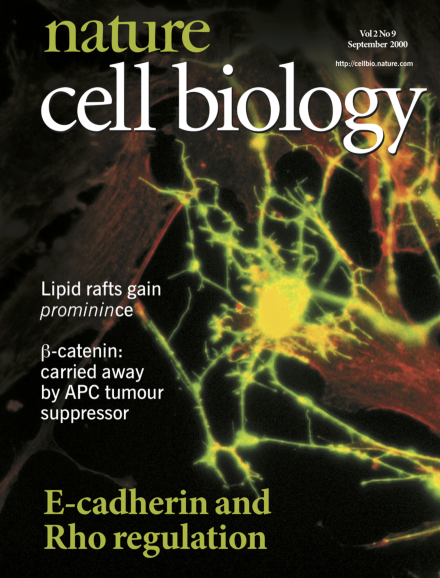
cover image
Top

Editorial

The rewards of a life of commitment to science ppE159 - E160

doi:10.1038/35023636


Top

News and Views

Mdm2–SUMO1: is bigger better? ppE161 - E163

Frauke Melchior & Ludger Hengst

doi:10.1038/35023639

Covalent modification of the oncogene product Mdm2 by the ubiquitin-related protein SUMO1 protects it from ubiquitination and enhances its E3 ligase activity towards p53 in vitro. Disappearance of SUMO-modified Mdm2, which is observed upon radiation, may thus be a prerequisite for DNA-damage-induced accumulation of p53.


Heat-shock proteins as death determinants ppE163 - E165

Steven Xanthoudakis & Donald W. Nicholson

doi:10.1038/35023643

The molecular pathways that mediate apoptosis are tightly regulated by a series of positive and negative signals, the balance of which determines whether or not cells commit suicide. New data from several laboratories now show that heat-shock proteins (HSPs) can influence this process through direct physical interaction with key components of the apoptotic machinery. These reports marry the survival (or death)-endowing properties of HSPs to the cell-death pathway.


Heartfelt crosstalk: desensitization of the GIRK current ppE165 - E167

Lily Yeh Jan & Yuh Nung Jan

doi:10.1038/35023646

Acetylcholine calms the heartbeat by activating Gi-coupled receptors and G-protein-activated inwardly rectifying potassium (GIRK) channels. It also dampens the GIRK current by reducing PIP2 through Gq-coupled receptors. These two types of receptors seem to be engaged in an intriguingly specific form of crosstalk, which leads to desensitization of the GIRK current.


cAMP takes control ppE167 - E168

Steven M. Frisch

doi:10.1038/35023650

Although it has long been appreciated that cAMP-related signalling can control cell growth, the mechanism by which this control is exerted has remained unknown. However, new findings now show how cAMP, acting through protein kinase A (PKA), maintains cells in an anchorage-dependent state by inhibiting mitogen-activated protein kinase (MAPK) signalling through p21-activated kinases (PAKs).


Top

Book Review

Opening the gates to molecular medicine pE169

Blanche Schwappach reviews Ion Channels and Disease — Channelopathies by Frances Ashcroft

doi:10.1038/35023653


Top

Articles

An intact HDM2 RING-finger domain is required for nuclear exclusion of p53 pp563 - 568

Scott D. Boyd, Kenneth Y. Tsai & Tyler Jacks

doi:10.1038/35023500


The MDM2 RING-finger domain is required to promote p53 nuclear export pp569 - 573

Rory K. Geyer, Zhong K. Yu & Carl G. Maki

doi:10.1038/35023507


Pyk2 and FAK regulate neurite outgrowth induced by growth factors and integrins pp574 - 581

Inga Ivankovic-Dikic, Eva Grönroos, Andree Blaukat, Bernd-Uwe Barth & Ivan Dikic

doi:10.1038/35023515


Retention of prominin in microvilli reveals distinct cholesterol-based lipid micro-domains in the apical plasma membrane pp582 - 592

Katja Röper, Denis Corbeil & Wieland B. Huttner

doi:10.1038/35023524


Regulation of anchorage-dependent signal transduction by protein kinase A and p21-activated kinase pp593 - 600

Alan K. Howe & Rudolph L. Juliano

doi:10.1038/35023536

See also: News and Views by Frisch


The DNA repair protein Rad23 is a negative regulator of multi-ubiquitin chain assembly pp601 - 608

Tatiana G. Ortolan, Prasad Tongaonkar, David Lambertson, Li Chen, Cherylene Schauber & Kiran Madura

doi:10.1038/35023547


The Grapes checkpoint coordinates nuclear envelope breakdown and chromosome condensation pp609 - 615

Kristina R. Yu, Robert B. Saint & William Sullivan

doi:10.1038/35023555


Functional localization of single active ion channels on the surface of a living cell pp616 - 619

Yuri E. Korchev, Yuri A. Negulyaev, Christopher R.W. Edwards, Igor Vodyanoy & Max J. Lab

doi:10.1038/35023563


Polarized localization of yeast Pbs2 depends on osmostress, the membrane protein Sho1 and Cdc42 pp620 - 627

Vladimír Reiser, Suhal M. Salah & Gustav Ammerer

doi:10.1038/35023568


Neurodegenerative stimuli induce persistent ADF/cofilin–actin rods that disrupt distal neurite function pp628 - 636

Laurie S. Minamide, Amanda M. Striegl, Judith A. Boyle, Peter J. Meberg & James R. Bamburg

doi:10.1038/35023579


Inhibition of RhoA by p120 catenin pp637 - 644

Panos Z. Anastasiadis, Sun Y. Moon, Molly A. Thoreson, Debbie J. Mariner, Howard C. Crawford, Yi Zheng & Albert B. Reynolds

doi:10.1038/35023588


Hsp27 negatively regulates cell death by interacting with cytochrome c pp645 - 652

Jean-Marie Bruey, Cécile Ducasse, Philippe Bonniaud, Luigi Ravagnan, Santos A. Susin, Chantal Diaz-Latoud, Sandeep Gurbuxani, André-Patrick Arrigo, Guido Kroemer, Eric Solary & Carmen Garrido

doi:10.1038/35023595

See also: News and Views by Xanthoudakis & Nicholson


Top

Brief Communications

Annexation of the interchromosomal space during viral infection pp661 - 665

Karine Monier, Juan Carlos González Armas, Susanne Etteldorf, Peter Ghazal & Kevin F. Sullivan

doi:10.1038/35023615


Mechanical control of cyclic AMP signalling and gene transcription through integrins pp666 - 668

Christian J. Meyer, Francis J. Alenghat, Paul Rim, Jenny Hwai-Jen Fong, Ben Fabry & Donald E. Ingber

doi:10.1038/35023621


Intrinsic lattice formation by the ryanodine receptor calcium-release channel pp669 - 671

Chang Cheng Yin & F. Anthony Lai

doi:10.1038/35023625


Polo-like kinase-1 is a target of the DNA damage checkpoint pp672 - 676

Veronique A. J. Smits, Rob Klompmaker, Lionel Arnaud, Gert Rijksen, Erich A. Nigg & René H. Medema

doi:10.1038/35023629


Top

Correction

Corrections p676

doi:10.1038/35023634


Top

Extra navigation

Subscribe to Nature Cell Biology

Subscribe

Open Innovation Challenges

naturejobs