Table of contents
July 2008, Volume 9 No 7 pp693-819
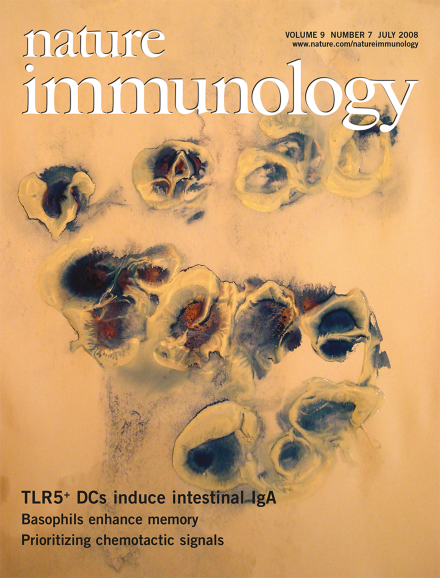
About the coverEditorials
Celebrating great ideas - p693
doi:10.1038/ni0708-693a
This year marks the 100th anniversary of the Nobel Prize in Physiology or Medicine awarded jointly to Paul Ehrlich and Ilya Metchnikov.
Full Text - Celebrating great ideas | PDF (185 KB) - Celebrating great ideas
Science in an open society - p693
doi:10.1038/ni0708-693b
A vibrant and eclectic international immunology meeting recently took place in the Arabian Desert of the United Arab Emirates, in the heart of the Islamic world.
Full Text - Science in an open society | PDF (185 KB) - Science in an open society
Meeting Reports
Metchnikoff's Legacy in 2008 - pp695 - 698
Carl Nathan
doi:10.1038/ni0708-695
This report presents themes highlighted during the eclectic and stimulating Metchnikoff's Legacy in 2008 meeting hosted at the Institut Pasteur in April 2008 in honor of the 100th anniversary of the 1908 Nobel Prize.
Full Text - Metchnikoff's Legacy in 2008 | PDF (447 KB) - Metchnikoff's Legacy in 2008
See also: Historical Commentary by Kaufmann
Immunology in the Arabian desert - pp699 - 703
Basel al-Ramadi, Adrian Hayday & Wilhelm Schwaeble
doi:10.1038/ni0708-699
Increasing evidence suggests that immune mechanisms underlie major inflammatory diseases that show no overt microbial etiology. In this context, a 4-day conference of clinical and nonclinical scientists convened in the United Arab Emirates to consider recent research developments in this fast-moving field.
Full Text - Immunology in the Arabian desert | PDF (467 KB) - Immunology in the Arabian desert
Historical Commentary
Immunology's foundation: the 100-year anniversary of the Nobel Prize to Paul Ehrlich and Elie Metchnikoff - pp705 - 712
Stefan H E Kaufmann
doi:10.1038/ni0708-705
Abstract - | Full Text - Immunology's foundation: the 100-year anniversary of the Nobel Prize to Paul Ehrlich and Elie Metchnikoff | PDF (977 KB) - Immunology's foundation: the 100-year anniversary of the Nobel Prize to Paul Ehrlich and Elie Metchnikoff
See also: Meeting Report by Nathan
News and Views
New dimensions of CIITA - pp713 - 714
Walter Reith & Jeremy M Boss
doi:10.1038/ni0708-713
CIITA encodes the 'master regulator' of the expression of major histocompatibility complex class II genes. A new layer of complexity has been identified in the control of CIITA expression, which involves the formation of a complex three-dimensional chromatin structure promoted by interactions among many distant regulatory elements.
Full Text - New dimensions of CIITA | PDF (227 KB) - New dimensions of CIITA
See also: Article by Ni et al.
Erg in stem cells: a function emerges - pp714 - 716
Ellen V Rothenberg
doi:10.1038/ni0708-714
Transcription factors of the Ets family are important for mammalian development. A genetic screen now finds that the Ets family member Erg is essential for definitive hematopoiesis and adult hematopoietic stem cell function.
Full Text - Erg in stem cells: a function emerges | PDF (196 KB) - Erg in stem cells: a function emerges
See also: Article by Loughran et al.
PTEN gives neutrophils direction - pp716 - 718
Daniel D Billadeau
doi:10.1038/ni0708-716
Neutrophils can respond to many chemotactic signals, but how these cells 'prioritize' such signals to react to invading pathogens has remained unclear. The phosphatase PTEN seems to be critical in directing the migration of neutrophils toward their end target in a complex milieu of competing signals.
Full Text - PTEN gives neutrophils direction | PDF (490 KB) - PTEN gives neutrophils direction
See also: Article by Heit et al.
Nuclear geography and allelic exclusion - pp718 - 720
Cornelis Murre
doi:10.1038/ni0708-718
The mechanisms responsible for establishing allelic exclusion remain enigmatic. New data indicate that stochastic interactions of antigen-receptor alleles with repressive nuclear compartments may contribute to the mechanisms that support allelic exclusion.
Full Text - Nuclear geography and allelic exclusion | PDF (822 KB) - Nuclear geography and allelic exclusion
See also: Article by Schlimgen et al.
Basophils now enhance memory - pp720 - 721
Toshiaki Kawakami
doi:10.1038/ni0708-720
Additional immune functions of basophils have been identified in recent years. Mack and colleagues add to this growing list by showing that basophils enhance humoral memory responses by producing interleukins 4 and 6 in response to specific antigen.
Full Text - Basophils now enhance memory | PDF (282 KB) - Basophils now enhance memory
See also: Article by Denzel et al.
Research Highlights - p723
doi:10.1038/ni0708-723
Full Text - Research Highlights | PDF (118 KB) - Research Highlights
Review
Immunity to malaria: more questions than answers - pp725 - 732
Jean Langhorne, Francis M Ndungu, Anne-Marit Sponaas & Kevin Marsh
doi:10.1038/ni.f.205
Abstract - | Full Text - Immunity to malaria: more questions than answers | PDF (751 KB) - Immunity to malaria: more questions than answers
Articles
Basophils enhance immunological memory responses - pp733 - 742
Andrea Denzel, Ulrich A Maus, Manuel Rodriguez Gomez, Cordula Moll, Marianne Niedermeier, Christine Winter, Regina Maus, Susan Hollingshead, David E Briles, Leoni A Kunz-Schughart, Yvonne Talke & Matthias Mack
doi:10.1038/ni.1621
Basophils are associated mainly with allergy and immune responses to parasites. Mack and colleagues now show that 'antigen-specific' basophils contribute to the humoral memory response by supplying interleukins 4 and 6.
Abstract - | Full Text - Basophils enhance immunological memory responses | PDF (686 KB) - Basophils enhance immunological memory responses | Supplementary information
See also: News and Views by Kawakami
PTEN functions to 'prioritize' chemotactic cues and prevent 'distraction' in migrating neutrophils - pp743 - 752
Bryan Heit, Stephen M Robbins, Charlene M Downey, Zhiwen Guan, Pina Colarusso, B Joan Miller, Frank R Jirik & Paul Kubes
doi:10.1038/ni.1623
Leukocytes sense and move in the direction of chemoattractants. Kubes and colleagues show that the phosphatase PTEN is required by migrating neutrophils to 'prioritize' multiple chemoattractant signals, as are encountered in infected tissues.
Abstract - | Full Text - PTEN functions to 'prioritize' chemotactic cues and prevent 'distraction' in migrating neutrophils | PDF (728 KB) - PTEN functions to 'prioritize' chemotactic cues and prevent 'distraction' in migrating neutrophils | Supplementary information
See also: News and Views by Billadeau
Structure of and influence of a tick complement inhibitor on human complement component 5 - pp753 - 760
Folmer Fredslund, Nick S Laursen, Pietro Roversi, Lasse Jenner, Cristiano L P Oliveira, Jan S Pedersen, Miles A Nunn, Susan M Lea, Richard Discipio, Lars Sottrup-Jensen & Gregers R Andersen
doi:10.1038/ni.1625
Complement 5 (C5) generates the C5a anaphylatoxin and C5b, a component of the membrane attack complex. Andersen and colleagues present the crystal structure of C5 and identify similarities and differences between C5 and other complement proteins.
Abstract - | Full Text - Structure of and influence of a tick complement inhibitor on human complement component 5 | PDF (1,027 KB) - Structure of and influence of a tick complement inhibitor on human complement component 5 | Supplementary information
A Toll-like receptor 2–integrin
3 complex senses bacterial lipopeptides via vitronectin - pp761 - 768
Gisa Gerold, Khalid Abu Ajaj, Michael Bienert, Hans-Jürgen Laws, Arturo Zychlinsky & Juana L de Diego
doi:10.1038/ni.1618
Mechanisms facilitating Toll-like receptor 2 (TLR2) ligand recognition are incompletely understood. De Diego and colleagues show that integrin
3 and the serum protein vitronectin are essential for responsiveness to a panel of TLR2 agonists.
Abstract - | Full Text - A Toll-like receptor 2–integrin
3 complex senses bacterial lipopeptides via vitronectin | PDF (464 KB) - A Toll-like receptor 2–integrin
3 complex senses bacterial lipopeptides via vitronectin | Supplementary information
Regulation of humoral and cellular gut immunity by lamina propria dendritic cells expressing Toll-like receptor 5 - pp769 - 776
Satoshi Uematsu, Kosuke Fujimoto, Myoung Ho Jang, Bo-Gie Yang, Yun-Jae Jung, Mika Nishiyama, Shintaro Sato, Tohru Tsujimura, Masafumi Yamamoto, Yoshifumi Yokota, Hiroshi Kiyono, Masayuki Miyasaka, Ken J Ishii & Shizuo Akira
doi:10.1038/ni.1622
The characteristics of the cell type(s) responsible for initiating protective gut immune responses are not fully defined. Akira and colleagues show that TLR5+ lamina propria dendritic cells trigger, in a retinoic-dependent way, the production of interleukin 17 and immunoglobulin A.
Abstract - | Full Text - Regulation of humoral and cellular gut immunity by lamina propria dendritic cells expressing Toll-like receptor 5 | PDF (611 KB) - Regulation of humoral and cellular gut immunity by lamina propria dendritic cells expressing Toll-like receptor 5 | Supplementary information
An autonomous CDR3
is sufficient for recognition of the nonclassical MHC class I molecules T10 and T22 by 
T cells - pp777 - 784
Erin J Adams, Pavel Strop, Sunny Shin, Yueh-Hsiu Chien & K Christopher Garcia
doi:10.1038/ni.1620
The molecular basis of ligand recognition by 
TCRs remains vague. Adams and colleagues show that the CDR3
loop, when grafted in place of a CDR3
loop, is sufficient to confer 
TCR specificity on an 
TCR.
Abstract - | Full Text - An autonomous CDR3
is sufficient for recognition of the nonclassical MHC class I molecules T10 and T22 by 
T cells | PDF (705 KB) - An autonomous CDR3
is sufficient for recognition of the nonclassical MHC class I molecules T10 and T22 by 
T cells | Supplementary information
The chromatin-remodeling enzyme BRG1 coordinates CIITA induction through many interdependent distal enhancers - pp785 - 793
Zuyao Ni, Mohamed Abou El Hassan, Zhaodong Xu, Tao Yu & Rod Bremner
doi:10.1038/ni.1619
The transcription factor CIITA regulates coordinated MHC class II gene expression. Bremner and colleagues show that the chromatin-remodeling protein BRG1 confers interferon-
responsiveness on the CIITA locus by inducing the formation of chromatin loops.
Abstract - | Full Text - The chromatin-remodeling enzyme BRG1 coordinates CIITA induction through many interdependent distal enhancers | PDF (827 KB) - The chromatin-remodeling enzyme BRG1 coordinates CIITA induction through many interdependent distal enhancers | Supplementary information
See also: News and Views by Reith & Boss
Regulation of Tcrb recombination ordering by c-Fos-dependent RAG deposition - pp794 - 801
Xiaoming Wang, Gang Xiao, Yafeng Zhang, Xiaomin Wen, Xiang Gao, Seiji Okada & Xiaolong Liu
doi:10.1038/ni.1614
Developing thymocytes carry out precise assembly of D-to-J followed by V-to-DJ rearrangements at the Tcrb locus. Liu and colleagues show that the transcription factor Fos directs ordered temporal recombination of D segments.
Abstract - | Full Text - Regulation of Tcrb recombination ordering by c-Fos-dependent RAG deposition | PDF (551 KB) - Regulation of Tcrb recombination ordering by c-Fos-dependent RAG deposition | Supplementary information
Initiation of allelic exclusion by stochastic interaction of Tcrb alleles with repressive nuclear compartments - pp802 - 809
Ryan J Schlimgen, Karen L Reddy, Harinder Singh & Michael S Krangel
doi:10.1038/ni.1624
The influence of repressive nuclear compartments on Tcrb rearrangement remains uncertain. Krangel and colleagues show that frequent stochastic, rather than directed, association of Tcrb alleles with repressive compartments promotes monoallelic recombination at this locus.
Abstract - | Full Text - Initiation of allelic exclusion by stochastic interaction of Tcrb alleles with repressive nuclear compartments | PDF (473 KB) - Initiation of allelic exclusion by stochastic interaction of Tcrb alleles with repressive nuclear compartments | Supplementary information
See also: News and Views by Murre
The transcription factor Erg is essential for definitive hematopoiesis and the function of adult hematopoietic stem cells - pp810 - 819
Stephen J Loughran, Elizabeth A Kruse, Douglas F Hacking, Carolyn A de Graaf, Craig D Hyland, Tracy A Willson, Katya J Henley, Sarah Ellis, Anne K Voss, Donald Metcalf, Douglas J Hilton, Warren S Alexander & Benjamin T Kile
doi:10.1038/ni.1617
Ets family transcription factors function in mammalian development. Kile and colleagues demonstrate that the Ets family member Erg is essential for definitive hematopoiesis and adult hematopoietic stem cell function.
Abstract - | Full Text - The transcription factor Erg is essential for definitive hematopoiesis and the function of adult hematopoietic stem cells | PDF (1,065 KB) - The transcription factor Erg is essential for definitive hematopoiesis and the function of adult hematopoietic stem cells | Supplementary information
See also: News and Views by Rothenberg