Table of contents


Top

Editorial

Attracting women p915

doi:10.1038/ncb0809-915

Women remain underrepresented in senior academic positions, despite similar numbers of male and female graduates. The imbalance is best addressed by focusing on the reasons for divergent career choices.


Top

Book Review

Physical Matryoshka of cell biology p916

Patricia Bassereau & Pierre Nassoy review Physical Biology of the Cell by Rob Phillips, Jane Kondev & Julie Theriot

doi:10.1038/ncb0809-916


Top

News and Views

Homologue pairing: getting it right pp917 - 918

R. Scott Hawley & William D. Gilliland

doi:10.1038/ncb0809-917

In Caernorhabditis elegans, homologue pairing is mediated by specialized regions near one end of each chromosome in conjunction with zinc finger (ZnF)-bearing proteins. Families of repeated sequences that are enriched within these regions have now been identified. By recruiting their cognate ZnF-bearing proteins, these regions promote pairing and synapsis.

See also: Article by Phillips et al.


Axon growth-stimulus package includes local translation pp919 - 921

Ian G. Macara, Hidekazu Iioka & Stavroula Mili

doi:10.1038/ncb0809-919

Translation of localized mRNAs is an important mechanism for controlling spatially discrete cellular processes. The polarity protein Par-3 is locally translated in axons in response to factors such as NGF and netrin-1, and this increased expression is necessary for factor-stimulated axonal outgrowth.

See also: Letter by Hengst et al.


SASPense and DDRama in cancer and ageing pp921 - 923

Marzia Fumagalli & Fabrizio d'Adda di Fagagna

doi:10.1038/ncb0809-921

Senescent cells alter their microenvironment by secreting a growing collection of factors, a phenomenon termed the senescence-associated secretory phenotype (SASP). Cellular senescence is often the result of nuclear DNA damage fuelling a chronic DNA damage response (DDR). Upstream elements of the DDR cascade are necessary for full blown SASP, and additional crosstalk occurs between the DDR and cytokine secretion.

See also: Letter by Rodier et al.


Top

Research Highlights

Research highlights p924

Silvia Grisendi, Nathalie Le Bot, Christina Karlsson Rosenthal & Sowmya Swaminathan

doi:10.1038/ncb0809-924


Top

Articles

Histone levels are regulated by phosphorylation and ubiquitylation-dependent proteolysis pp925 - 933

Rakesh Kumar Singh, Marie-Helene Miquel Kabbaj, Johanna Paik & Akash Gunjan

doi:10.1038/ncb1903

Non-chromatin associated histones are unstable in budding yeast. Tyrosine phosphorylation of histone H3 followed by subsequent ubiquitylation by the ubiquitin conjugating enzymes Ubc4 and Ubc5 and the ubiquitin ligase Tom1 triggers H3 degradation.


Identification of chromosome sequence motifs that mediate meiotic pairing and synapsis in C. elegans pp934 - 942

Carolyn M. Phillips, Xiangdong Meng, Lei Zhang, Jacqueline H. Chretien, Fyodor D. Urnov & Abby F. Dernburg

doi:10.1038/ncb1904

Pairing centres are specialized regions on worm chromosomes that mediate homologous pairing during meiosis. Sequence motifs that recruit proteins involved in pairing have been identified and they are sufficient for chromosome synapsis and segregation during meiosis.

See also: News and Views by Hawley & Gilliland


Top

Letters

A SNAIL1–SMAD3/4 transcriptional repressor complex promotes TGF-beta mediated epithelial–mesenchymal transition pp943 - 950

Theresa Vincent, Etienne P. A. Neve, Jill R. Johnson, Alexander Kukalev, Federico Rojo, Joan Albanell, Kristian Pietras, Ismo Virtanen, Lennart Philipson, Philip L. Leopold, Ronald G. Crystal, Antonio Garcia de Herreros, Aristidis Moustakas, Ralf F. Pettersson & Jonas Fuxe

doi:10.1038/ncb1905

TGF-beta mediates epithelial-mesenchymal transitions (EMT) during tumorigenesis but the molecular mechanisms driving this effect have been unclear. The transcriptional repressor SNAIL1 and the downstream effector of TGF-beta SMAD3/4 cooperate to repress gene expression during TGF-beta-mediated EMT.


A regulatory pathway involving Notch1/beta-catenin/Isl1 determines cardiac progenitor cell fate. pp951 - 957

Chulan Kwon, Li Qian, Paul Cheng, Vishal Nigam, Joshua Arnold & Deepak Srivastava

doi:10.1038/ncb1906

Notch1 inhibits cardiac progenitor cell expansion by preventing the accumulation of phosphorylated beta-catenin, which normally promotes their proliferation. In a feedback loop, Notch1 positively regulates the expression of cardiac transcription factors to induce progenitor cell differentiation, whereas beta-catenin has the reverse effect.


Mitochondrial fission factor Drp1 is essential for embryonic development and synapse formation in mice pp958 - 966

Naotada Ishihara, Masatoshi Nomura, Akihiro Jofuku, Hiroki Kato, Satoshi O. Suzuki, Keiji Masuda, Hidenori Otera, Yae Nakanishi, Ikuya Nonaka, Yu-ichi Goto, Naoko Taguchi, Hidetaka Morinaga, Maki Maeda, Ryoichi Takayanagi, Sadaki Yokota & Katsuyoshi Mihara

doi:10.1038/ncb1907

Mice that lack the fission mitochondrial GTPase Drp1, are shown to die during embryonic development. Although Drp1 is not required for apoptosis, the absence of Drp1 leads to neuronal and synaptic defects due to a failure of elongated mitochondria to reach distal parts of axons.


Prolyl isomerase Pin1 acts as a switch to control the degree of substrate ubiquitylation pp967 - 972

Dirk Siepe & Stefan Jentsch

doi:10.1038/ncb1908

Pin1 regulates protein degradation and is now shown to control the ubiquitylation status of its targets. In yeast, Pin1 decreases the ubiquitylation of the transcription factor Spt23 to activate it, while low Pin1 levels increase its degradation. Similarly, inhibition of Pin1 in mammalian cells increases p53 ubiquitylation and nuclear degradation.


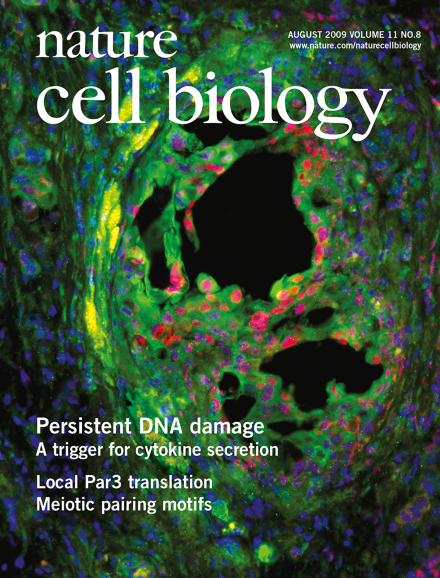
Persistent DNA damage signalling triggers senescence-associated inflammatory cytokine secretion pp973 - 979

Francis Rodier, Jean-Philippe Coppé, Christopher K. Patil, Wieteke A. M. Hoeijmakers, Denise P. Muñoz, Saba R. Raza, Adam Freund, Eric Campeau, Albert R. Davalos & Judith Campisi

doi:10.1038/ncb1909

Persistent DNA damage activation and oncogene-induced senescence stimulate secretion of the inflammatory cytokine IL-6, which is mediated by the damage-response pathway including ATM, NBS1 and CHK2. Tumours with an activated DNA damage response show elevated IL-6 and invasiveness.

See also: News and Views by Fumagalli & d'Adda di Fagagna


The DNA damage response at eroded telomeres and tethering to the nuclear pore complex pp980 - 987

Basheer Khadaroo, M. Teresa Teixeira, Pierre Luciano, Nadine Eckert-Boulet, Susanne M. Germann, Marie Noelle Simon, Irene Gallina, Pauline Abdallah, Eric Gilson, Vincent Géli & Michael Lisby

doi:10.1038/ncb1910

Cells with a single short telomere and lacking telomerase mount a damage response consisting of recruitment of DNA damage checkpoint proteins, Cdc13, RPA and Rad52, many generations before senescence and in addition show tethering of the short telomere to the nuclear pore complex.


A two-step model for senescence triggered by a single critically short telomere pp988 - 993

Pauline Abdallah, Pierre Luciano, Kurt W. Runge, Michael Lisby, Vincent Géli, Eric Gilson & M. Teresa Teixeira

doi:10.1038/ncb1911

Cells with a single short telomere and lacking telomerase continue to divide until they activate a Mec1/ATR-dependent checkpoint, causing senescence.


VHL loss causes spindle misorientation and chromosome instability pp994 - 1001

Claudio R. Thoma, Alberto Toso, Katrin L. Gutbrodt, Sabina P. Reggi, Ian J. Frew, Peter Schraml, Alexander Hergovich, Holger Moch, Patrick Meraldi & Wilhelm Krek

doi:10.1038/ncb1912

The tumour suppressor protein VHL, which is inactivated in hereditary and sporadic forms of renal cell carcinoma, is found at the mitotic spindle in mammalian cells. VHL inactivation leads to unstable astral microtubules and spindle misorientation as well as to reduced levels of Mad2, resulting in spindle checkpoint weakening and genomic instability.


BCOR regulates mesenchymal stem cell function by epigenetic mechanisms pp1002 - 1009

Zhipeng Fan, Takayoshi Yamaza, Janice S. Lee, Jinhua Yu, Songlin Wang, Guoping Fan, Songtao Shi & Cun-Yu Wang

doi:10.1038/ncb1913

Oculo-facio-cardio-dental (OFCD) syndrome is associated with mutations in the co-repressor BCOR. Mesenchymal stem cells from OFCD patients show higher osteo- and dentinogenic potential, partly due to defects in AP-2a expression. BCOR mutations impair the recruitment of the histone demethylase JHDM1B to the AP-2a promoter.


Reversible acetylation of the chromatin remodelling complex NoRC is required for non-coding RNA-dependent silencing pp1010 - 1016

Yonggang Zhou, Kerstin-Maike Schmitz, Christine Mayer, Xuejun Yuan, Asifa Akhtar & Ingrid Grummt

doi:10.1038/ncb1914

The chromatin remodeller NoRC silences rDNA by establishing heterochromatin. TIP5, a subunit of NoRC is acetylated by MOF and deacetylated by SIRT1 at Lys 633. Acetylation decreases TIP5 binding to rDNA promoter-associated RNA, leading to altered heterochromatin formation. TIP5 acetylation can be modified by changes in metabolism.


The CDK4–pRB–E2F1 pathway controls insulin secretion pp1017 - 1023

Jean-Sébastien Annicotte, Emilie Blanchet, Carine Chavey, Irena Iankova, Safia Costes, Said Assou, Jacques Teyssier, Stéphane Dalle, Claude Sardet & Lluis Fajas

doi:10.1038/ncb1915

The Cdk4–pRb–E2F1 pathway is shown to have a role in insulin secretion in b cells by controlling the expression of a subunit of the K+ATP channel through E2F1 binding to its promoter.


Axonal elongation triggered by stimulus-induced local translation of a polarity complex protein pp1024 - 1030

Ulrich Hengst, Alessia Deglincerti, Hyung Joon Kim, Noo Li Jeon & Samie R. Jaffrey

doi:10.1038/ncb1916

During neuronal development, the axonal growth rate is regulated in conjunction with pathfinding. Stimulation of localized mRNA translation of the polarity protein PAR3 by neural growth factor (NGF) and netrin-1 is now shown to be required for axonal outgrowth.

See also: News and Views by Macara et al.


MicroRNA MiR-17 retards tissue growth and represses fibronectin expression pp1031 - 1038

Sze Wan Shan, Daniel Y. Lee, Zhaoqun Deng, Tatiana Shatseva, Zina Jeyapalan, William W. Du, Yaou Zhang, Jim W. Xuan, Siu-Pok Yee, Vinayakumar Siragam & Burton B. Yang

doi:10.1038/ncb1917

MicroRNAs are frequently expressed in clusters, which often prevent the attribution of an individual microRNA to a specific function. Single overexpression of miR17, a microRNA belonging to a six-microRNA cluster, shows it controls heart, spleen and liver development by targeting fibronectin.


Top

Brief Communication

Differential requirements for actin during yeast and mammalian endocytosis pp1039 - 1042

Soheil Aghamohammadzadeh & Kathryn R. Ayscough

doi:10.1038/ncb1918

The actin cytoskleteon is essential for endocytosis in budding yeast but it is less significant in mammalian cells. Actin is shown to be required during plasma membrane invagination in yeast endocytosis due to the turgor pressure that is characteristic of yeast cells


Top

Corrigendum

Corrigendum p1042

doi:10.1038/ncb0809-1042


Top

Erratum

Epidermal growth factor-like domain 7 (EGFL7) modulates Notch signalling and affects neural stem cell renewal p1043

Mirko H.H. Schmidt, Frank Bicker, Iva Nikolic, Jeannette Meister, Tanja Babuke, Srdjan Picuric, Werner Müller-Esterl, Karl H. Plate & Ivan Dikic

doi:10.1038/ncb0809-1043


Top

Extra navigation

Subscribe to Nature Cell Biology

Subscribe

Open Innovation Challenges

naturejobs