Table of contents

ARTICLE NAVIGATION - ISSUE
July 2009, Volume 11 No 7 pp785-914
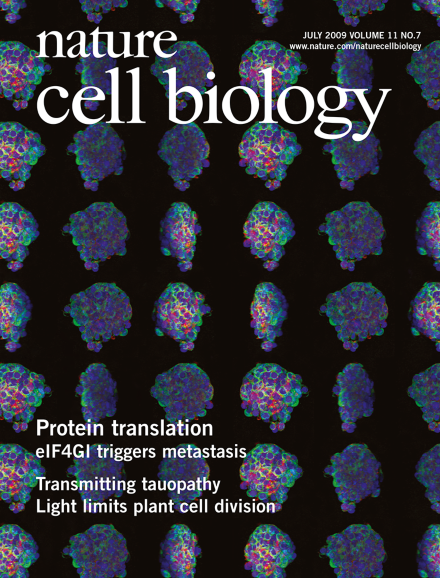
About the coverEditorial
Freedom of scientific expression - p785
doi:10.1038/ncb0709-785
An English High Court judgement highlights the need for reform of a libel law that discourages open scientific discourse.
Full Text - Freedom of scientific expression | PDF (112 KB) - Freedom of scientific expression
Turning Points
Building confidence: the transition from student to professor - p786
Elaine Fuchs
doi:10.1038/ncb0709-786
Full Text - Building confidence: the transition from student to professor | PDF (91 KB) - Building confidence: the transition from student to professor
News and Views
Chromosome congression: on the bi-orient express - pp787 - 789
Emily A. Foley & Tarun M. Kapoor
doi:10.1038/ncb1902
Errors in chromosome–spindle attachments during cell division can lead to an irreversible change in chromosome number. Proper connections between chromosomes and spindle microtubules can be promoted by both chromosome-intrinsic and extrinsic mechanisms during mitosis and meiosis.
Full Text - Chromosome congression: on the bi-orient express | PDF (189 KB) - Chromosome congression: on the bi-orient express
See also: Letter by Cai et al. | Letter by Wignall & Villeneuve
Cavin fever: regulating caveolae - pp789 - 791
Ivan R. Nabi
doi:10.1038/ncb0709-789
SDPR is a new regulator of caveolae biogenesis. SDPR overexpression results in increased caveolae size and leads to the formation of caveolae-derived tubules containing Shiga toxin. SDPR may therefore be a membrane curvature-inducing component of caveolae.
Full Text - Cavin fever: regulating caveolae | PDF (318 KB) - Cavin fever: regulating caveolae
See also: Article by Hansen et al.
Delta traffic takes a sh-Arp turn - pp791 - 793
Eyal D. Schejter
doi:10.1038/ncb0709-791
In the Notch pathway, the transmembrane ligand Delta is internalized and then re-established on the surface of signal-sending cells to allow the productive binding and activation of the Notch receptor on neighbouring cells. Arp2/3-dependent actin polymerization directs Delta trafficking through this circuit.
Full Text - Delta traffic takes a sh-Arp turn | PDF (198 KB) - Delta traffic takes a sh-Arp turn
See also: Article by Rajan et al.
A reader for centromeric chromatin - pp793 - 795
Nikolina Sekulic & Ben E. Black
doi:10.1038/ncb0709-793
For nucleosome-encoded epigenetic information to be transmitted, an epigenetic mark requires a 'reader' for its physical recognition. CENP-N has now been identified as a reader of the centromere-specifying epigenetic mark that is generated by incorporation of the histone H3 variant CENP-A into centromeric nucleosomes.
Full Text - A reader for centromeric chromatin | PDF (415 KB) - A reader for centromeric chromatin
See also: Letter by Carroll et al.
Research Highlights
Research highlights - p796
doi:10.1038/ncb0709-796
Full Text - Research highlights | PDF (94 KB) - Research highlights
Articles
Arabidopsis cortical microtubules position cellulose synthase delivery to the plasma membrane and interact with cellulose synthase trafficking compartments - pp797 - 806
Ryan Gutierrez, Jelmer J. Lindeboom, Alex R. Paredez, Anne Mie C. Emons & David W. Ehrhardt
doi:10.1038/ncb1886
The cortical microtubule array in plants orients nascent cellulose fibrils by organizing cellulose synthase complexes in the plasma membrane. Microtubules are now shown to facilitate the delivery of these complexes to the plasma membrane through their depolymerizing ends.
Abstract - | Full Text - Arabidopsis cortical microtubules position cellulose synthase delivery to the plasma membrane and interact with cellulose synthase trafficking compartments | PDF (4,145 KB) - Arabidopsis cortical microtubules position cellulose synthase delivery to the plasma membrane and interact with cellulose synthase trafficking compartments | Supplementary information
SDPR induces membrane curvature and functions in the formation of caveolae - pp807 - 814
Carsten G. Hansen, Nicholas A. Bright, Gillian Howard & Benjamin J. Nichols
doi:10.1038/ncb1887
Caveolae are plasma membrane invaginations implicated in endocytosis. SDPR is a new component of caveolae that facilitates membrane curvature, caveolae formation and tubulation induced by extracellular ligands such as Shiga toxin B.
Abstract - | Full Text - SDPR induces membrane curvature and functions in the formation of caveolae | PDF (5,419 KB) - SDPR induces membrane curvature and functions in the formation of caveolae | Supplementary information
See also: News and Views by Nabi
The Arp2/3 complex and WASp are required for apical trafficking of Delta into microvilli during cell fate specification of sensory organ precursors - pp815 - 824
Akhila Rajan, An-Chi Tien, Claire M. Haueter, Karen L. Schulze & Hugo J. Bellen
doi:10.1038/ncb1888
Cell fate decisions mediated by Notch signalling generally involve direct cell–cell contact between adjacent cells. A new Arp2/3-dependent actin structure directs the Notch ligand Delta to microvilli in signal-sending cells during sensory organ development in fly.
Abstract - | Full Text - The Arp2/3 complex and WASp are required for apical trafficking of Delta into microvilli during cell fate specification of sensory organ precursors | PDF (10,100 KB) - The Arp2/3 complex and WASp are required for apical trafficking of Delta into microvilli during cell fate specification of sensory organ precursors | Supplementary information
See also: News and Views by Schejter
Letters
CPAP is a cell-cycle regulated protein that controls centriole length - pp825 - 831
Chieh-Ju C. Tang, Ru-Huei Fu, Kuo-Sheng Wu, Wen-Bin Hsu & Tang K. Tang
doi:10.1038/ncb1889
During centriole duplication, a new centriole of defined length forms adjacent to the pre-existing centriole. The centriolar protein CPAP is under tight cell-cycle control and controls centriole length through its intrinsic tubulin-dimer binding activity.
First Paragraph - | Full Text - CPAP is a cell-cycle regulated protein that controls centriole length | PDF (3,114 KB) - CPAP is a cell-cycle regulated protein that controls centriole length | Supplementary information
Chromosome congression in the absence of kinetochore fibres - pp832 - 838
Shang Cai, Christopher B. O'Connell, Alexey Khodjakov & Claire E. Walczak
doi:10.1038/ncb1890
Mitotic chromosome congression is thought to require microtubules attached end-on to kinetochores (K-fibres). In human cells lacking K-fibres, chromosomes congress by the gliding of unattached kinetochores along microtubule bundles, driven by the plus-end kinesin motor CENP-E.
First Paragraph - | Full Text - Chromosome congression in the absence of kinetochore fibres | PDF (2,824 KB) - Chromosome congression in the absence of kinetochore fibres | Supplementary information
See also: News and Views by Foley & Kapoor
Lateral microtubule bundles promote chromosome alignment during acentrosomal oocyte meiosis - pp839 - 844
Sarah M. Wignall & Anne M. Villeneuve
doi:10.1038/ncb1891
Female meiosis occurs without centrosomal microtubule organization. In C. elegans oocytes, microtubule bundles surround homologous bivalent chromosomes. The chromokinesin KPL19 is concentrated in a ring around each bivalent and drives metaphase alignment through a polar ejection force.
First Paragraph - | Full Text - Lateral microtubule bundles promote chromosome alignment during acentrosomal oocyte meiosis | PDF (1,505 KB) - Lateral microtubule bundles promote chromosome alignment during acentrosomal oocyte meiosis | Supplementary information
See also: News and Views by Foley & Kapoor
OsHAL3 mediates a new pathway in the light-regulated growth of rice - pp845 - 851
Shi-Yong Sun, Dai-Yin Chao, Xin-Min Li, Min Shi, Ji-Ping Gao, Mei-Zhen Zhu, Hong-Quan Yang, Sheng Luan & Hong-Xuan Lin
doi:10.1038/ncb1892
Light-regulated growth in plants had been attributed to cell elongation. HAL3-activity is induced by light and it regulates cell division by acting on the HIP1 ubiquitin ligase, independently of its pigment decarboxylase activity.
First Paragraph - | Full Text - OsHAL3 mediates a new pathway in the light-regulated growth of rice | PDF (2,199 KB) - OsHAL3 mediates a new pathway in the light-regulated growth of rice | Supplementary information
Increasing organismal healthspan by enhancing mitochondrial protein quality control - pp852 - 858
Karin Luce & Heinz D. Osiewacz
doi:10.1038/ncb1893
Overexpression of the mitochondrial matrix-localized protease PaLON in Podospora anserina reduces levels of carbonylated and carboxymethylated proteins, resulting in a higher resistance to oxidative stress and an extended life span.
First Paragraph - | Full Text - Increasing organismal healthspan by enhancing mitochondrial protein quality control | PDF (1,372 KB) - Increasing organismal healthspan by enhancing mitochondrial protein quality control | Supplementary information
Cell shape changes indicate a role for extrinsic tensile forces in Drosophila germ-band extension - pp859 - 864
Lucy C. Butler, Guy B. Blanchard, Alexandre J. Kabla, Nicola J. Lawrence, David P. Welchman, L. Mahadevan, Richard J. Adams & Benedicte Sanson
doi:10.1038/ncb1894
Drosophila germ-band extension is thought to rely mainly on cell intercalation events. Quantitative analysis of cell shape changes and movements show that extrinsic tensile forces generated by the invaginating mesoderm drive cell shape changes to participate in this elongation.
First Paragraph - | Full Text - Cell shape changes indicate a role for extrinsic tensile forces in Drosophila germ-band extension | PDF (2,301 KB) - Cell shape changes indicate a role for extrinsic tensile forces in Drosophila germ-band extension | Supplementary information
BRIT1/MCPH1 links chromatin remodelling to DNA damage response - pp865 - 872
Guang Peng, Eun-Kyoung Yim, Hui Dai, Andrew P. Jackson, Ineke van der Burgt, Mei-Ren Pan, Ruozhen Hu, Kaiyi Li & Shiaw-Yih Lin
doi:10.1038/ncb1895
Chromatin decondensation is required for repair factors to access damaged DNA. BRIT1/MCPH1, a damage response protein mutated in microcephaly, recruits the chromatin remodelling complex SWI/SNF to sites of DNA damage after phosphorylation by ATM/ATR. This mechanism is critical for efficient DNA repair and survival.
First Paragraph - | Full Text - BRIT1/MCPH1 links chromatin remodelling to DNA damage response | PDF (3,438 KB) - BRIT1/MCPH1 links chromatin remodelling to DNA damage response | Supplementary information
Epidermal growth factor-like domain 7 (EGFL7) modulates Notch signalling and affects neural stem cell renewal - pp873 - 880
Mirko H.H. Schmidt, Frank Bicker, Iva Nikolic, Jeannette Meister, Tanja Babuke, Srdjan Picuric, Werner Müller-Esterl, Karl H. Plate & Ivan Dikic
doi:10.1038/ncb1896
The secreted factor EGFL7, which is known to regulate cell migration and angiogenesis, is expressed in the brain where it binds receptors of the Notch family. Binding decreases Notch signalling, inhibits self-renewal of neural stem cells in culture and affects proliferation and differentiation of adult neural stem cells.
First Paragraph - | Full Text - Epidermal growth factor-like domain 7 (EGFL7) modulates Notch signalling and affects neural stem cell renewal | PDF (2,581 KB) - Epidermal growth factor-like domain 7 (EGFL7) modulates Notch signalling and affects neural stem cell renewal | Supplementary information
TGF-
activates Akt kinase through a microRNA-dependent amplifying circuit targeting PTEN - pp881 - 889
Mitsuo Kato, Sumanth Putta, Mei Wang, Hang Yuan, Linda Lanting, Indu Nair, Amanda Gunn, Yoshimi Nakagawa, Hitoshi Shimano, Ivan Todorov, John J. Rossi & Rama Natarajan
doi:10.1038/ncb1897
How TGF-
activates Akt in disease situations is unclear. By acting on the promotor of RP23, a non-coding RNA which encodes two microRNAs, TGF-
signalling downregulates the phospatase PTEN, a target of these microRNAs and an inhibitor of Akt signalling.
First Paragraph - | Full Text - TGF-
activates Akt kinase through a microRNA-dependent amplifying circuit targeting PTEN | PDF (1,761 KB) - TGF-
activates Akt kinase through a microRNA-dependent amplifying circuit targeting PTEN | Supplementary information
The tyrosine kinase Stitcher activates Grainy head and epidermal wound healing in Drosophila - pp890 - 895
Shenqiu Wang, Vasilios Tsarouhas, Nikos Xylourgidis, Nafiseh Sabri, Katarína Tiklová, Naumi Nautiyal, Marco Gallio & Christos Samakovlis
doi:10.1038/ncb1898
The wound-healing transcription factor Grainy head upregulates a receptor tyrosine kinase of the Ret-family, Stitcher. Stitcher orchestrates re-epithelialization by triggering rearrangements of the actin cytoskeleton and changes in gene expression through Erk phosphorylation and regulation of Grainy head activity.
First Paragraph - | Full Text - The tyrosine kinase Stitcher activates Grainy head and epidermal wound healing in Drosophila | PDF (3,163 KB) - The tyrosine kinase Stitcher activates Grainy head and epidermal wound healing in Drosophila | Supplementary information
Centromere assembly requires the direct recognition of CENP-A nucleosomes by CENP-N - pp896 - 902
Christopher W. Carroll, Mariana C.C. Silva, Kristina M. Godek, Lars E.T. Jansen & Aaron F. Straight
doi:10.1038/ncb1899
The histone H3 variant CENP-A specifies centromere identity. CENP-N is the first selective binding partner of CENP-A. Inhibition of CENP-N binding to CENP-A or CENP-N depletion prevents the recruitment of the other CENP proteins involved in centromere assembly.
First Paragraph - | Full Text - Centromere assembly requires the direct recognition of CENP-A nucleosomes by CENP-N | PDF (2,463 KB) - Centromere assembly requires the direct recognition of CENP-A nucleosomes by CENP-N | Supplementary information
See also: News and Views by Sekulic & Black
Essential role for eIF4GI overexpression in the pathogenesis of inflammatory breast cancer - pp903 - 908
Deborah Silvera, Rezina Arju, Farbod Darvishian, Paul H. Levine, Ladan Zolfaghari, Judith Goldberg, Tsivia Hochman, Silvia C. Formenti & Robert J. Schneider
doi:10.1038/ncb1900
Inflammatory breast cancer rapidly metastasizes. Overexpression of the translation factor eIF4GI increases translation through the activation of internal ribosome entry sites. Members of the p120 family of catenins are key targets involved in metastasis deregulated in this way.
First Paragraph - | Full Text - Essential role for eIF4GI overexpression in the pathogenesis of inflammatory breast cancer | PDF (1,317 KB) - Essential role for eIF4GI overexpression in the pathogenesis of inflammatory breast cancer | Supplementary information
Transmission and spreading of tauopathy in transgenic mouse brain - pp909 - 913
Florence Clavaguera, Tristan Bolmont, R. Anthony Crowther, Dorothee Abramowski, Stephan Frank, Alphonse Probst, Graham Fraser, Anna K. Stalder, Martin Beibel, Matthias Staufenbiel, Mathias Jucker, Michel Goedert & Markus Tolnay
doi:10.1038/ncb1901
Intracellular tau inclusions, a hallmark of several neurodegenerative diseases, propagate in the brain in an unknown fashion. Brain extracts prepared from mice expressing mutated human tau injected into mice expressing wild-type human tau induce the formation and spread of wild-type human tau inclusions.
First Paragraph - | Full Text - Transmission and spreading of tauopathy in transgenic mouse brain | PDF (1,622 KB) - Transmission and spreading of tauopathy in transgenic mouse brain | Supplementary information
Erratum
p53 controls cancer cell invasion by inducing the MDM2-mediated degradation of Slug - p914
Shu-Ping Wang, Wen-Lung Wang, Yih-Leong Chang, Chen-Tu Wu, Yu-Chih Chao, Shih-Han Kao, Ang Yuan, Chung-Wu Lin, Shuenn-Chen Yang, Wing-Kai Chan, Ker-Chau Li, Tse-Ming Hong & Pan-Chyr Yang
doi:10.1038/ncb0709-914
Full Text - p53 controls cancer cell invasion by inducing the MDM2-mediated degradation of Slug | PDF (302 KB) - p53 controls cancer cell invasion by inducing the MDM2-mediated degradation of Slug