In this issue - pv
doi:10.1038/nchembio0207-v
doi:10.1038/nchembio0207-69
The aging of the professoriate has raised questions about how to support productive faculty members late in their careers while integrating the vitality of youthful scientists.
Full Text - The ivory tower grays | PDF (357 KB) - The ivory tower grays
Eric T Kool & Marcey L Waters
doi:10.1038/nchembio0207-70
Model systems have evolved with the times, making use of modern biological methods and incorporating biological complexity. This evolution has increased the relevance of models as tools for studying biology.
Full Text - The model student: what chemical model systems can teach us about biology | PDF (576 KB) - The model student: what chemical model systems can teach us about biology
Jeremy E Turnbull & Robert A Field
doi:10.1038/nchembio0207-74
The nascent field of glycomics is currently undergoing rapid development, largely as a result of advances in technologies for analyzing glycan structure, unraveling glycan-protein interactions and establishing the functional significance of glycans. A meeting was held in November 2006 to explore the challenges and opportunities ahead for this emerging 'omics' domain.
Full Text - Emerging glycomics technologies | PDF (420 KB) - Emerging glycomics technologies
Joanne Kotz
doi:10.1038/nchembio0207-79
By highlighting the central importance of molecules in life and technology, Molecular Frontiers seeks to increase the interest of young people in science and to identify the potential roles of chemistry and other molecular sciences in addressing global challenges.
Full Text - Molecular Frontiers | PDF (347 KB) - Molecular Frontiers
James P Snyder
doi:10.1038/nchembio0207-81
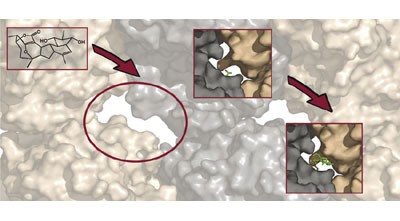
Cyclostreptin, a natural product, cell toxin and covalent modifier of microtubules, has been shown to bind irreversibly to a previously unidentified site on the outer wall of microtubules. The exterior low-affinity location seems to be a way-station for microtubule-stabilizing agents traveling to the high-affinity site in the microtubule interior.
Full Text - The microtubule-pore gatekeeper | PDF (2,662 KB) - The microtubule-pore gatekeeper
See also: Article by Buey et al.
Gordana Apic & Robert B Russell
doi:10.1038/nchembio0207-83
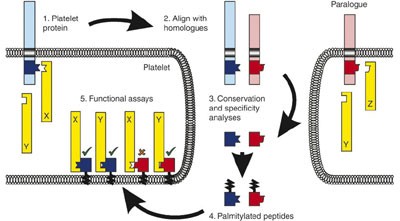
Short peptide segments are increasingly found to have critical roles in biological processes but are often difficult to discover. Bioactive peptides can be quickly found through computational approaches, including a new method that has identified several peptides active against platelet function.
Full Text - A shortcut to peptides to modulate platelets | PDF (782 KB) - A shortcut to peptides to modulate platelets
See also: Letter by Edwards et al.
Doug A Brooks
doi:10.1038/nchembio0207-84
Pharmacological chaperones are small molecules that interact with a protein to enhance folding and stability. Understanding the chemistry underlying the interaction of pharmacological chaperones with their target proteins will facilitate the design of more efficient drugs with greater therapeutic potential.
Full Text - Getting into the fold | PDF (1,006 KB) - Getting into the fold
See also: Letter by Lieberman et al.
Emily Flashman & Christopher J Schofield
doi:10.1038/nchembio0207-86
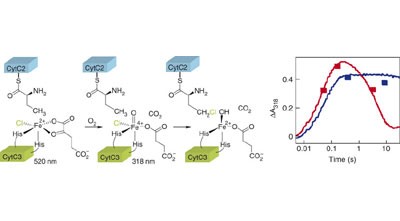
The iron(II)- and 2-oxoglutarate-dependent oxygenases catalyze varied oxidative reactions. Spectroscopic analyses on the catalytic cycle of the chlorinating enzyme CytC3 reveal the presence of chloride–iron(IV)–oxo complexes, expanding the scope of chemistry known to be catalyzed by non-heme iron-oxo species.
Full Text - The most versatile of all reactive intermediates? | PDF (761 KB) - The most versatile of all reactive intermediates?
See also: Letter by Galoni
et al.
Florenz Sasse & Dirk Menche
doi:10.1038/nchembio0207-87
The tubulysins inhibit tubulin polymerization, which makes them potent antiproliferative agents and promising lead candidates for the development of new anticancer drugs. The first total synthesis of the most potent member of the tubulysin family, tubulysin D, has been accomplished in a highly convergent manner using an innovative synthetic strategy.
Full Text - Success in tubulysin D synthesis | PDF (850 KB) - Success in tubulysin D synthesis
Jennifer F Kugel & James A Goodrich
doi:10.1038/nchembio0207-89
The bacterial transcriptional repressor 6S RNA mimics the DNA contained in a melted promoter and forms specific interactions with the active site of RNA polymerase. A new study shows that, surprisingly, 6S RNA acts as a template for the synthesis of small RNAs, which liberates the polymerase from 6S RNA. Hence, the transcriptional repressor 6S RNA serves as a template for the synthesis of its own de-repressive RNA.
Full Text - An RNA transcriptional regulator templates its own regulatory RNA | PDF (723 KB) - An RNA transcriptional regulator templates its own regulatory RNA
doi:10.1038/nchembio0207-91
Full Text - Research Highlights | PDF (394 KB) - Research Highlights
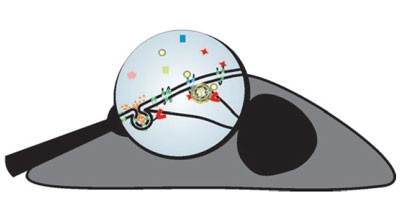
Jyoti K Jaiswal & Sanford M Simon
doi:10.1038/nchembio855

Abstract - Imaging single events at the cell membrane | Full Text - Imaging single events at the cell membrane | PDF (752 KB) - Imaging single events at the cell membrane
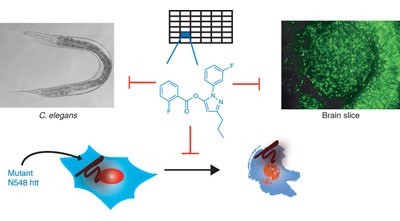
Hemant Varma, Cindy Voisine, C Todd DeMarco, Elena Cattaneo, Donald C Lo, Anne C Hart & Brent R Stockwell
doi:10.1038/nchembio852

Abstract - Selective inhibitors of death in mutant huntingtin cells | Full Text - Selective inhibitors of death in mutant huntingtin cells | PDF (545 KB) - Selective inhibitors of death in mutant huntingtin cells | Supplementary information | Chemical compounds
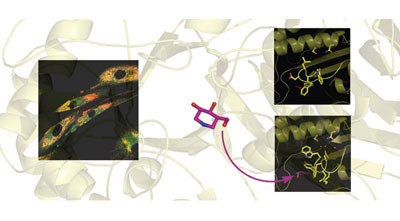
-glucosidase with pharmacological chaperone provides insight into Gaucher disease - pp101 - 107Raquel L Lieberman, Brandon A Wustman, Pedro Huertas, Allan C Powe, Jr, Corey W Pine, Richie Khanna, Michael G Schlossmacher, Dagmar Ringe & Gregory A Petsko
doi:10.1038/nchembio850

First Paragraph - Structure of acid [beta]-glucosidase with pharmacological chaperone provides insight into Gaucher disease | Full Text - Structure of acid
-glucosidase with pharmacological chaperone provides insight into Gaucher disease | PDF (889 KB) - Structure of acid
-glucosidase with pharmacological chaperone provides insight into Gaucher disease | Supplementary information | Chemical compounds
See also: News and Views by Brooks
Richard J Edwards, Niamh Moran, Marc Devocelle, Aoife Kiernan, Gerardene Meade, William Signac, Martina Foy, Stephen D E Park, Eimear Dunne, Dermot Kenny & Denis C Shields
doi:10.1038/nchembio854

First Paragraph - Bioinformatic discovery of novel bioactive peptides | Full Text - Bioinformatic discovery of novel bioactive peptides | PDF (602 KB) - Bioinformatic discovery of novel bioactive peptides | Supplementary information
See also: News and Views by Apic & Russell
Danica P Galoni
,
Eric W Barr,
Christopher T Walsh,
J Martin Bollinger, Jr
&
Carsten Krebs
doi:10.1038/nchembio856

First Paragraph - Two interconverting Fe(: IV: ) intermediates in aliphatic chlorination by the halogenase CytC3 | Full Text - Two interconverting Fe(IV) intermediates in aliphatic chlorination by the halogenase CytC3 | PDF (515 KB) - Two interconverting Fe(IV) intermediates in aliphatic chlorination by the halogenase CytC3 | Supplementary information | Chemical compounds
See also: News and Views by Flashman & Schofield
Rubén M Buey, Enrique Calvo, Isabel Barasoain, Oriol Pineda, Michael C Edler, Ruth Matesanz, Gemma Cerezo, Christopher D Vanderwal, Billy W Day, Erik J Sorensen, Juan Antonio López, José Manuel Andreu, Ernest Hamel & J Fernando Díaz
doi:10.1038/nchembio853

Abstract - Cyclostreptin binds covalently to microtubule pores and lumenal taxoid binding sites | Full Text - Cyclostreptin binds covalently to microtubule pores and lumenal taxoid binding sites | PDF (763 KB) - Cyclostreptin binds covalently to microtubule pores and lumenal taxoid binding sites | Supplementary information | Chemical compounds
See also: News and Views by Snyder
Jaejoon Won, Mina Kim, Nuri Kim, Jin Hee Ahn, Woo Gil Lee, Sung Soo Kim, Ki-Young Chang, Yong-Weon Yi & Tae Kook Kim
doi:10.1038/nchembio0207-126a
Full Text - Corrigendum: Small molecule–based reversible reprogramming of cellular lifespan | PDF (321 KB) - Corrigendum: Small molecule–based reversible reprogramming of cellular lifespan
Ian Collins & Paul Workman
doi:10.1038/nchembio0207-126b
Full Text - Corrigendum: New approaches to molecular cancer therapeutics | PDF (321 KB) - Corrigendum: New approaches to molecular cancer therapeutics
The analysis of adaptation with a population is a frequently encountered computational modeling scen...
The Seeker is looking for novel approaches to protecting maize from insect damage. This Challenge re...