Table of contents
Editorial
NIF wakes up - p177
doi:10.1038/nphoton.2009.30
The first step towards the goal of nuclear fusion triggered by laser beams has been taken with the construction and test firing of the National Ignition Facility in the United States.
Correspondence
A bright future for synchrotron imaging - p179
C. Petibois, G. Déléris, M. Piccinini, M. Cestelli-Guidi & A. Marcelli
doi:10.1038/nphoton.2009.31
Full Text - A bright future for synchrotron imaging | PDF (107 KB) - A bright future for synchrotron imaging
Commentary
Prospects for LED lighting - pp180 - 182
Siddha Pimputkar, James S. Speck, Steven P. DenBaars & Shuji Nakamura
doi:10.1038/nphoton.2009.32
More than one-fifth of US electricity is used to power artificial lighting. Light-emitting diodes based on group III/nitride semiconductors are bringing about a revolution in energy-efficient lighting.
Full Text - Prospects for LED lighting | PDF (532 KB) - Prospects for LED lighting
Out of the lab
A new twist to tuning lasers - pp183 - 184
Duncan Graham-Rowe
doi:10.1038/nphoton.2009.33
Self-organizing liquid crystals could spawn a new breed of extremely useful and cheap tunable lasers. Such lasers may ultimately prove to be useful for creating flat-screen displays with better colours, enhanced sensors and compact medical instruments. Duncan Graham-Rowe takes a closer look.
Full Text - A new twist to tuning lasers | PDF (281 KB) - A new twist to tuning lasers
Research Highlights
Our choice from the latest literature - pp186 - 187
doi:10.1038/nphoton.2009.34
Full Text - Our choice from the latest literature | PDF (232 KB) - Our choice from the latest literature
News and Views
Data storage: Heat-assisted magnetic recording - pp189 - 190
Liang Pan & David B. Bogy
doi:10.1038/nphoton.2009.40
By using light to assist the recording process, hard disk drive capacity could potentially be increased by two orders of magnitude. The idea is to heat the magnetic medium locally, thus temporarily lowering its resistance to magnetic polarization.
Full Text - Data storageHeat-assisted magnetic recording | PDF (169 KB) - Data storageHeat-assisted magnetic recording
Nonlinear optics: Silicon gets the green light - pp190 - 192
Toshihiko Baba
doi:10.1038/nphoton.2009.39
Third-harmonic generation enhanced by slow-light pulses in a photonic crystal waveguide offers a way to generate green light emission from silicon.
Full Text - Nonlinear opticsSilicon gets the green light | PDF (574 KB) - Nonlinear opticsSilicon gets the green light
Nanophotonics: Nanoscale colour detector - p192
Rachel Won
doi:10.1038/nphoton.2009.35
Full Text - NanophotonicsNanoscale colour detector | PDF (243 KB) - NanophotonicsNanoscale colour detector
Silicon photonics: Slot machine - pp193 - 194
Tom Baehr-Jones & Michael Hochberg
doi:10.1038/nphoton.2009.37
Ultrafast all-optical computation with silicon photonic devices is still a dream. New research, which combines organic nonlinear polymers with silicon waveguides, is now bringing that dream closer to reality.
Full Text - Silicon photonicsSlot machine | PDF (119 KB) - Silicon photonicsSlot machine
Photovoltaics: Solar-assisted cars - p195
David Pile
doi:10.1038/nphoton.2009.36
Full Text - PhotovoltaicsSolar-assisted cars | PDF (126 KB) - PhotovoltaicsSolar-assisted cars
Image transmission: Looking into a self-distorting world - pp195 - 197
Mordechai Segev & Demetrios N. Christodoulides
doi:10.1038/nphoton.2009.38
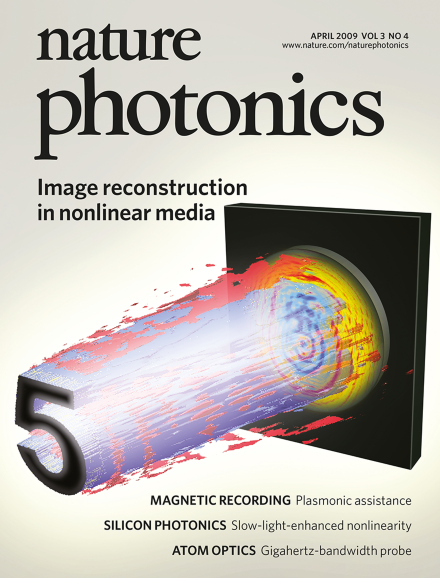
Imaging through linear media is straightforward, but light beams propagating through nonlinear media become heavily distorted, rendering all usual imaging techniques practically useless. Now, scientists have found a way to recover images transmitted through nonlinear media — by using back-propagation simulations.
Full Text - Image transmissionLooking into a self-distorting world | PDF (254 KB) - Image transmissionLooking into a self-distorting world
Magneto-optics: Hot atoms rotate light rapidly - pp197 - 199
Robert Löw & Tilman Pfau
doi:10.1038/nphoton.2009.41
The ability to harness the Faraday effect on a short timescale in an ensemble of hot atoms may prove useful as a read-out tool for quantum information based on microscale vapour cells.
Full Text - Magneto-opticsHot atoms rotate light rapidly | PDF (825 KB) - Magneto-opticsHot atoms rotate light rapidly
Progress Article
Optomechanics of deformable optical cavities - pp201 - 205
Ivan Favero & Khaled Karrai
doi:10.1038/nphoton.2009.42
Resonant optical cavities such as Fabry–Perot resonators or whispering-gallery structures are subject to radiation pressure pushing their reflecting 'walls' apart. Deformable optical cavities yield to this pressure, but in doing so they in turn affect the stored optical energy, resulting in an optical back-action. For such cavities the optics and the mechanics become strongly coupled, making them fascinating systems in which to explore theories of measurements at the quantum limit. Here we provide a summary of the current state of optomechanics of deformable optical cavities, identifying some of the most important recent developments in the field.
Full Text - Optomechanics of deformable optical cavities | PDF (645 KB) - Optomechanics of deformable optical cavities
Letters
Green light emission in silicon through slow-light enhanced third-harmonic generation in photonic-crystal waveguides - pp206 - 210
B. Corcoran, C. Monat, C. Grillet, D. J. Moss, B. J. Eggleton, T. P. White, L. O'Faolain & T. F. Krauss
doi:10.1038/nphoton.2009.28
The use of slow light for enhancing a nonlinear optical process in a two-dimensional silicon photonic-crystal waveguide is demonstrated. More specifically, green emission by third-harmonic generation is obtained, highlighting yet another functionality of silicon photonics chips.
Abstract - | Full Text - Green light emission in silicon through slow-light enhanced third-harmonic generation in photonic-crystal waveguides | PDF (488 KB) - Green light emission in silicon through slow-light enhanced third-harmonic generation in photonic-crystal waveguides
Subject Categories: Lasers, LEDs and light sources | Fundamental optical physics | Nonlinear optics
See also: News and Views by Baba
Imaging through nonlinear media using digital holography - pp211 - 215
Christopher Barsi, Wenjie Wan & Jason W. Fleischer
doi:10.1038/nphoton.2009.29
Imaging through a nonlinear medium can be difficult because signals distort as they propagate through it owing to intensity-dependent phase changes. Here, digital reconstruction of optical spatial beams propagating in a nonlinear medium is presented, which could help the understanding of coupled-wave dynamics and suggest new image-processing techniques.
Abstract - | Full Text - Imaging through nonlinear media using digital holography | PDF (1,006 KB) - Imaging through nonlinear media using digital holography
Subject Categories: Imaging and sensing | Fundamental optical physics
All-optical high-speed signal processing with silicon–organic hybrid slot waveguides - pp216 - 219
C. Koos, P. Vorreau, T. Vallaitis, P. Dumon, W. Bogaerts, R. Baets, B. Esembeson, I. Biaggio, T. Michinobu, F. Diederich, W. Freude & J. Leuthold
doi:10.1038/nphoton.2009.25
A silicon–organic hybrid slot waveguide with a strong optical nonlinearity is demonstrated to perform ultrafast all-optical demultiplexing of high-bit-rate data streams. The approach could form the basis of compact high-speed optical processing units for future communication networks.
Abstract - | Full Text - All-optical high-speed signal processing with silicon–organic hybrid slot waveguides | PDF (717 KB) - All-optical high-speed signal processing with silicon–organic hybrid slot waveguides
Subject Categories: Nonlinear optics | Fibre optics and optical communications
See also: News and Views by Baehr-Jones & Hochberg
Articles
Heat-assisted magnetic recording by a near-field transducer with efficient optical energy transfer - pp220 - 224
W. A. Challener, Chubing Peng, A. V. Itagi, D. Karns, Wei Peng, Yingguo Peng, XiaoMin Yang, Xiaobin Zhu, N. J. Gokemeijer, Y.-T. Hsia, G. Ju, Robert E. Rottmayer, Michael A. Seigler & E. C. Gage
doi:10.1038/nphoton.2009.26
Using a near-field transducer with efficient optical energy transfer, researchers demonstrate proof-of-principle heat-assisted magnetic recording with multi-track data density of
375 Tb m-2.
Abstract - | Full Text - Heat-assisted magnetic recording by a near-field transducer with efficient optical energy transfer | PDF (952 KB) - Heat-assisted magnetic recording by a near-field transducer with efficient optical energy transfer | Supplementary information
Subject Categories: Optical data storage | Nanophotonics | Plasmonics
See also: News and Views by Pan & Bogy
A gigahertz-bandwidth atomic probe based on the slow-light Faraday effect - pp225 - 229
Paul Siddons, Nia C. Bell, Yifei Cai, Charles S. Adams & Ifan G. Hughes
doi:10.1038/nphoton.2009.27
By applying a magnetic field to an atomic vapour, it is shown that the large bandwidth of off-resonance slow-light media can be combined with the Faraday effect to realize a high-bandwidth dispersive probe for atomic systems. This will open up the possibility of probing atomic dynamics on a nanosecond timescale.
Abstract - | Full Text - A gigahertz-bandwidth atomic probe based on the slow-light Faraday effect | PDF (731 KB) - A gigahertz-bandwidth atomic probe based on the slow-light Faraday effect
Subject Categories: Imaging and sensing | Fundamental optical physics
See also: News and Views by Löw & Pfau
Product Focus
Ultrashort pulse characterization - pp230 - 232
Neil Savage
doi:10.1038/nphoton.2009.43
Pulse measurement equipment is now easier to use than ever before, with many devices offering easy-to-align solutions and plug-and-play computer operation, reports Neil Savage.
Full Text - Ultrashort pulse characterization | PDF (245 KB) - Ultrashort pulse characterization
Interview
Practical plasmonics - p236
Interview with Edward Gage, William Challener & Mark Re
doi:10.1038/nphoton.2009.44
Magnetic hard disk technology is approaching its limits. Nature Photonics spoke to William Challener, Ed Gage and Mark Re from Seagate about their demonstration of heat-assisted magnetic recording.
Full Text - Practical plasmonics | PDF (141 KB) - Practical plasmonics