Table of contents


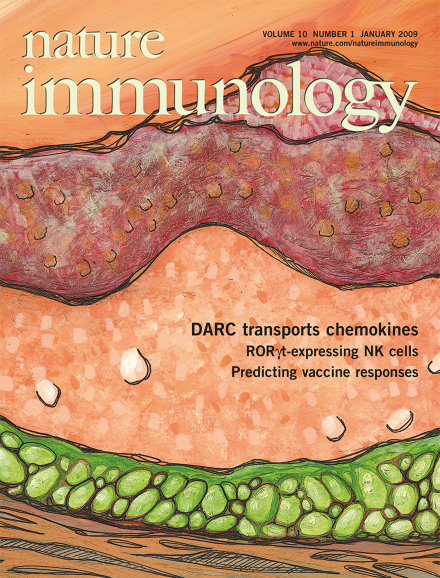
cover image
Top

Editorial

New challenges for a new leader p1

doi:10.1038/ni0109-1

Will the ongoing financial crisis prevent Barack Obama from increasing funding for the biomedical sciences?


Top

Essay

Signaling to gene expression: calcium, calcineurin and NFAT pp3 - 5

Anjana Rao

doi:10.1038/ni0109-3

Anjana Rao recounts the contributions of two talented and productive postdoctoral fellows who purified and characterized the transcription factor NFAT.


Top

Meeting Report

'Toll2008' outgrows its name pp7 - 10

Cherilyn M Sirois, Veit Hornung & Eicke Latz

doi:10.1038/ni0109-7

On 24–27 September 2008, members of the scientific community gathered to discuss advances in innate immunity at the 'Toll meeting' in Cascais, Portugal. Before long, attendees noticed that 'Toll2008' might be a misnomer.


Top

News and Views

Spotlight on IL-22-producing NK cell receptor–expressing mucosal lymphocytes pp11 - 12

Karl-Johan Malmberg & Hans-Gustaf Ljunggren

doi:10.1038/ni0109-11

New findings show that a subpopulation of mucosal RORgammat+ cells expresses natural killer cell receptors and produces interleukin 22. These innate immune cells may be pivotal in maintaining mucosal homeostasis.

See also: Article by Cupedo et al. | Article by Luci et al. | Article by Sanos et al.


From immunity to tolerance through HDAC pp13 - 14

Katia Georgopoulos

doi:10.1038/ni0109-13

Regulation of expression of the gene encoding interleukin 10 by the histone deacetylase HDAC11 emphasizes the ability of an antigen-presenting cell to induce immunity or tolerance in CD4+ T cells.

See also: Article by Villagra et al.


Rules to 'prime' by pp14 - 16

Paul G Thomas & Peter C Doherty

doi:10.1038/ni0109-14

A systems biology approach provides correlates of successful vaccination, which allows a new method for measuring early vaccine efficiency and suggests hypotheses for the mechanisms that underlie immunogenicity.

See also: Resources by Querec et al.


A new function for the RNA-editing enzyme ADAR1 pp16 - 18

Hisashi Iizasa & Kazuko Nishikura

doi:10.1038/ni0109-16

ADAR1 catalyzes the deamination of adenosine to inosine in double-stranded RNA. This RNA-editing enzyme is now shown to be involved in hematopoiesis, where it acts to suppress interferon signaling and to block premature apoptosis.

See also: Article by Hartner et al.


Research Highlights p19

doi:10.1038/ni0109-19


Top

Review

Calcium signaling in immune cells pp21 - 27

Monika Vig & Jean-Pierre Kinet

doi:10.1038/ni.f.220


Top

Articles

Coregulation of CD8+ T cell exhaustion by multiple inhibitory receptors during chronic viral infection pp29 - 37

Shawn D Blackburn, Haina Shin, W Nicholas Haining, Tao Zou, Creg J Workman, Antonio Polley, Michael R Betts, Gordon J Freeman, Dario A A Vignali & E John Wherry

doi:10.1038/ni.1679

Chronic infection can lead to T cell exhaustion. Wherry and colleagues demonstrate that a hierarchy of inhibitory receptors coregulate CD8+ T cell exhaustion during chronic viral infection.


Proteolysis of NF-kappaB1 p105 is essential for T cell antigen receptor–induced proliferation pp38 - 47

Srividya Sriskantharajah, Monica P Belich, Stamatia Papoutsopoulou, Julia Janzen, Victor Tybulewicz, Benedict Seddon & Steven C Ley

doi:10.1038/ni.1685

The functional importance of TCR-induced degradation of p105 NF-kappaB is unclear. Ley and colleagues now show it is required for regulatory and memory T cell differentiation and for mature T cell function.


The surface protein TIGIT suppresses T cell activation by promoting the generation of mature immunoregulatory dendritic cells pp48 - 57

Xin Yu, Kristin Harden, Lino C Gonzalez, Michelle Francesco, Eugene Chiang, Bryan Irving, Irene Tom, Sinisa Ivelja, Canio J Refino, Hilary Clark, Dan Eaton & Jane L Grogan

doi:10.1038/ni.1674

Dendritic cells (DCs) can promote or inhibit T cell responses. Grogan and colleagues show that the T cell protein TIGIT, by engaging poliovirus receptor on DCs, promotes DC interleukin 10 production, which inhibits T cell activation.


Cortical sinus probing, S1P1-dependent entry and flow-based capture of egressing T cells pp58 - 65

Irina L Grigorova, Susan R Schwab, Tri Giang Phan, Trung H M Pham, Takaharu Okada & Jason G Cyster

doi:10.1038/ni.1682

Lymphocytes exit lymph nodes and return to the bloodstream through the efferent lymphatics. Cyster and colleagues show that lymphocytes exit into cortical sinuses by a pathway dependent on sphingosine 1-phosphate receptor type 1.


Human fetal lymphoid tissue–inducer cells are interleukin 17–producing precursors to RORC+ CD127+ natural killer–like cells pp66 - 74

Tom Cupedo, Natasha K Crellin, Natalie Papazian, Elwin J Rombouts, Kees Weijer, Jane L Grogan, Willem E Fibbe, Jan J Cornelissen & Hergen Spits

doi:10.1038/ni.1668

Mouse lymphoid tissue–inducer (LTi) cells require the transcription factor RORgammat. Cupedo's group identifies RORgammat+ human LTi cell equivalents as committed natural killer cell precursors, and teams led by Vivier and Diefenbach describe RORgammat-expressing interleukin 22–producing natural killer cells in mouse gut.

See also: News and Views by Malmberg & Ljunggren | Article by Luci et al. | Article by Sanos et al.


Influence of the transcription factor RORbold gammat on the development of NKp46+ cell populations in gut and skin pp75 - 82

Carmelo Luci, Ana Reynders, Ivaylo I Ivanov, Celine Cognet, Laurent Chiche, Lionel Chasson, Jean Hardwigsen, Esperanza Anguiano, Jacques Banchereau, Damien Chaussabel, Marc Dalod, Dan R Littman, Eric Vivier & Elena Tomasello

doi:10.1038/ni.1681

Mouse lymphoid tissue–inducer (LTi) cells require the transcription factor RORgammat. Cupedo's group identifies RORgammat+ human LTi cell equivalents as committed natural killer cell precursors, and teams led by Vivier and Diefenbach describe RORgammat-expressing interleukin 22–producing natural killer cells in mouse gut.

See also: News and Views by Malmberg & Ljunggren | Article by Cupedo et al. | Article by Sanos et al.


RORbold gammat and commensal microflora are required for the differentiation of mucosal interleukin 22–producing NKp46+ cells pp83 - 91

Stephanie L Sanos, Viet L Bui, Arthur Mortha, Karin Oberle, Charlotte Heners, Caroline Johner & Andreas Diefenbach

doi:10.1038/ni.1684

Mouse lymphoid tissue–inducer (LTi) cells require the transcription factor RORgammat. Cupedo's group identifies RORgammat+ human LTi cell equivalents as committed natural killer cell precursors, and teams led by Vivier and Diefenbach describe RORgammat-expressing interleukin 22–producing natural killer cells in mouse gut.

See also: News and Views by Malmberg & Ljunggren | Article by Cupedo et al. | Article by Luci et al.


The histone deacetylase HDAC11 regulates the expression of interleukin 10 and immune tolerance pp92 - 100

Alejandro Villagra, Fengdong Cheng, Hong-Wei Wang, Ildelfonso Suarez, Michelle Glozak, Michelle Maurin, Danny Nguyen, Kenneth L Wright, Peter W Atadja, Kapil Bhalla, Javier Pinilla-Ibarz, Edward Seto & Eduardo M Sotomayor

doi:10.1038/ni.1673

Interleukin 10 dampens inflammation and prevents excessive tissue damage during immune responses. Sotomayor and colleagues show that the histone deacetylase HDAC11 negatively regulates expression of the gene encoding interleukin 10 and immune tolerance.

See also: News and Views by Georgopoulos


The Duffy antigen receptor for chemokines transports chemokines and supports their promigratory activity pp101 - 108

Monika Pruenster, Liesbeth Mudde, Paula Bombosi, Svetla Dimitrova, Marion Zsak, Jim Middleton, Ann Richmond, Gerard J Graham, Stephan Segerer, Robert J B Nibbs & Antal Rot

doi:10.1038/ni.1675

Nonsignaling chemokine receptors are thought to function as chemokine 'decoys'. Rot and colleagues now show that the nonsignaling chemokine receptor DARC functions to unidirectionally transport inflammatory chemokines toward apical endothelial surfaces.


ADAR1 is essential for the maintenance of hematopoiesis and suppression of interferon signaling pp109 - 115

Jochen C Hartner, Carl R Walkley, Jun Lu & Stuart H Orkin

doi:10.1038/ni.1680

ADAR1 is an adenosine deaminase that acts on double-stranded RNA. Orkin and colleagues show that ADAR1 protects hematopoietic stem cells from interferon-induced insult and is needed to maintain long-term hematopoiesis.

See also: News and Views by Iizasa & Nishikura


Top

Resources

Systems biology approach predicts immunogenicity of the yellow fever vaccine in humans pp116 - 125

Troy D Querec, Rama S Akondy, Eva K Lee, Weiping Cao, Helder I Nakaya, Dirk Teuwen, Ali Pirani, Kim Gernert, Jiusheng Deng, Bruz Marzolf, Kathleen Kennedy, Haiyan Wu, Soumaya Bennouna, Herold Oluoch, Joseph Miller, Ricardo Z Vencio, Mark Mulligan, Alan Aderem, Rafi Ahmed & Bali Pulendran

doi:10.1038/ni.1688

A major challenge for vaccinologists is to understand vaccine immunogenicity. Pulendran and colleagues use systems biology to determine gene 'signatures' that predict CD8+ T cell and antibody responses to the yellow fever vaccine.

See also: News and Views by Thomas & Doherty


Top

Extra navigation

Subscribe to Nature Immunology

Subscribe

Open Innovation Challenges

naturejobs

ADVERTISEMENT