Table of contents


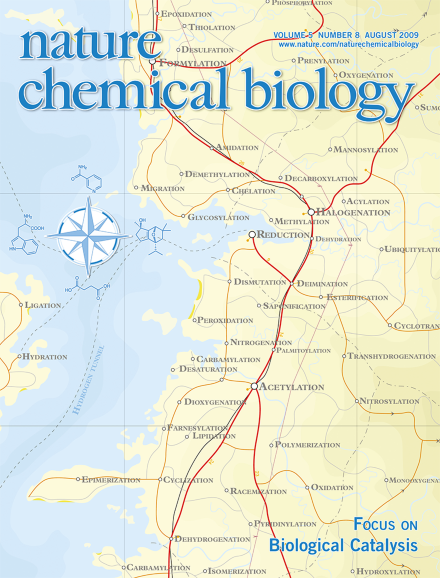
Focus on Biological Catalysis

Top

In This Issue

Focus on biological catalysis

In this issue pv

doi:10.1038/nchembio0809-v


Top

Editorial

Focus on biological catalysis

Closing in on catalysis p515

doi:10.1038/nchembio0809-515

Building on a century of enzymology research and new genome-wide insights into enzyme families, increased interdisciplinary communication and a broad vision will advance our understanding of biological catalysts and enhance our ability to manipulate them.


Top

Commentaries

Focus on biological catalysis

The far reaches of enzymology pp516 - 520

Jesse G Zalatan & Daniel Herschlag

doi:10.1038/nchembio0809-516

The scope of enzymology has expanded rapidly over the last century, from an early focus on the chemical and catalytic mechanisms of individual enzymes to more recent efforts to understand enzyme action in the context of dynamic, functional biological systems consisting of many interacting enzymes and proteins. Continuing progress in probing the link between molecular structure and function now promises to pave the way for a deeper understanding of the evolution and behavior of the complex biological systems that govern cellular behavior.


Focus on biological catalysis

Missing in action: enzyme functional annotations in biological databases pp521 - 525

Nicholas Furnham, John S Garavelli, Rolf Apweiler & Janet M Thornton

doi:10.1038/nchembio0809-521

Annotations of enzyme function provide critical starting points for generating and testing biological hypotheses, but the quality of functional annotations is hindered by uncertain assignments for uncharacterized sequences and by the relative sparseness of validated experimental data. Given the relentless increase in genomic data, new thinking and validation methods are urgently needed to provide high confidence in enzyme functional assignments.


Focus on biological catalysis

Finding better protein engineering strategies pp526 - 529

Romas J Kazlauskas & Uwe T Bornscheuer

doi:10.1038/nchembio0809-526

Protein improvement strategies today involve widely varying combinations of rational design with random mutagenesis and screening. To make further progress—defined as making subsequent protein engineering problems easier to solve—protein engineers must critically compare these strategies and eliminate less effective ones.


Top

Meeting Report

Focus on biological catalysis

Vitamins and cofactors: highlights of ESBOC 2009 pp530 - 533

Edward McDonald

doi:10.1038/nchembio0809-530

The 2009 ESBOC meeting covered advances in synthesis, biosynthesis and biological mechanisms of vitamins and cofactors. Recent exciting developments in the field include the development of 'green' chemistry for manufacture of vitamins, the discovery that some vitamins act directly to regulate gene expression via riboswitches, and initial attempts to exploit the potential of vitamin analogs as therapeutic drugs.


Top

Elements

Focus on biological catalysis

Perry Frey p534

Catherine Goodman

doi:10.1038/nchembio0809-534

A passion for novel chemistry and experimental surprises has led Perry Frey through 40 years of inspiring enzymology research.


Top

News and Views

A metabolic network described in absolute terms pp535 - 536

Dietmar Schomburg

doi:10.1038/nchembio0809-535

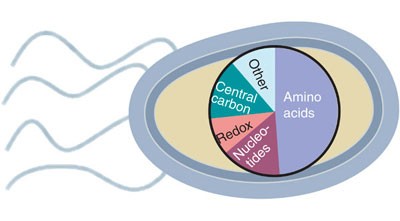
The parallel determination of more than 100 absolute intracellular metabolite concentrations by isotope-labeled HPLC-MS allowed a comprehensive analysis of the cellular state, its metabolic capacities and modes of regulation. Among other findings, it became obvious that for most enzymes the concentrations were above the Km values, which indicates a trend toward saturation of most enzyme active sites.

See also: Article by Bennett et al.


Staring off into chemical space pp536 - 537

John J Irwin

doi:10.1038/nchembio0809-536

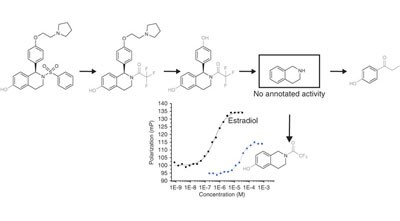
New software to browse chemical space, with structures organized by rings, will enable chemical insight.

See also: Brief Communication by Wetzel et al. | Article by Renner et al.


How evolving enzymes can beat the heat and avoid defeat pp538 - 539

Ichiro Matsumura & Andrei A Ivanov

doi:10.1038/nchembio0809-538

Random mutations usually destabilize protein tertiary structure. Overexpression of the chaperonin GroEL/GroES protects evolving proteins from the destabilizing effects of adaptive mutations and improves the quantity and quality of enzyme variants with modified function.


Research highlights pp540 - 541

doi:10.1038/nchembio0809-540


Top

Perspectives

Focus on biological catalysis

A 21st century revisionist's view at a turning point in enzymology pp543 - 550

Zachary D Nagel & Judith P Klinman

doi:10.1038/nchembio.204


Focus on biological catalysis

Enzymatic transition states and dynamic motion in barrier crossing pp551 - 558

Steven D Schwartz & Vern L Schramm

doi:10.1038/nchembio.202


Top

Brief Communications

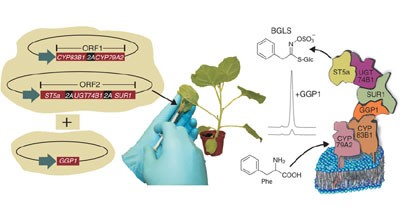
Glucosinolate engineering identifies a bold gamma-glutamyl peptidase pp575 - 577

Fernando Geu-Flores, Morten Thrane Nielsen, Majse Nafisi, Morten Emil Møldrup, Carl Erik Olsen, Mohammed Saddik Motawia & Barbara Ann Halkier

doi:10.1038/nchembio.185

no alt info

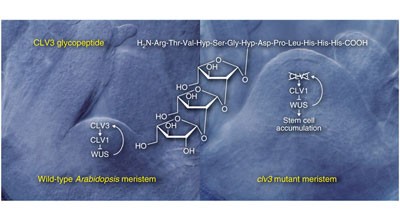
A glycopeptide regulating stem cell fate in Arabidopsis thaliana pp578 - 580

Kentaro Ohyama, Hidefumi Shinohara, Mari Ogawa-Ohnishi & Yoshikatsu Matsubayashi

doi:10.1038/nchembio.182

no alt info

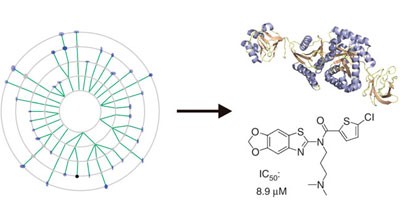
Interactive exploration of chemical space with Scaffold Hunter pp581 - 583

Stefan Wetzel, Karsten Klein, Steffen Renner, Daniel Rauh, Tudor I Oprea, Petra Mutzel & Herbert Waldmann

doi:10.1038/nchembio.187

no alt info

See also: News and Views by Irwin


Top

Articles

Bioactivity-guided mapping and navigation of chemical space pp585 - 592

Steffen Renner, Willem A L van Otterlo, Marta Dominguez Seoane, Sabine Möcklinghoff, Bettina Hofmann, Stefan Wetzel, Ansgar Schuffenhauer, Peter Ertl, Tudor I Oprea, Dieter Steinhilber, Luc Brunsveld, Daniel Rauh & Herbert Waldmann

doi:10.1038/nchembio.188

no alt info

See also: News and Views by Irwin


Absolute metabolite concentrations and implied enzyme active site occupancy in Escherichia coli pp593 - 599

Bryson D Bennett, Elizabeth H Kimball, Melissa Gao, Robin Osterhout, Stephen J Van Dien & Joshua D Rabinowitz

doi:10.1038/nchembio.186

no alt info

See also: News and Views by Schomburg


Top

Erratum

Erratum: A crowdsourcing evaluation of the NIH chemical probes p600

Tudor I Oprea, Cristian G Bologa, Scott Boyer, Ramona F Curpan, Robert C Glen, Andrew L Hopkins, Christopher A Lipinski, Garland R Marshall, Yvonne C Martin, Liliana Ostopovici-Halip, Gilbert Rishton, Oleg Ursu, Roy J Vaz, Chris Waller, Herbert Waldmann & Larry A Sklar

doi:10.1038/nchembio0809-600


Top

Extra navigation

Subscribe to Nature Chemical Biology

Subscribe

Open Innovation Challenges