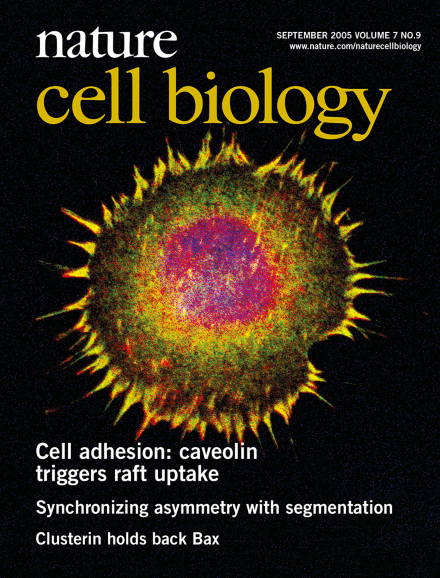
Table of contents


Top

Editorials

Embryonic stem cell development(s) p845

doi:10.1038/ncb0905-845a


The web as originally intended p845

doi:10.1038/ncb0905-845b


Top

Historical Perspective

The lysosome turns fifty pp847 - 849

Christian de Duve

doi:10.1038/ncb0905-847


Top

Book Review

Seeing nuclear complexity p850

Tom Misteli reviews Visions of the Cell Nucleus by Peter Hemmerich & Stephan Diekmann

doi:10.1038/ncb0905-850


Top

News and Views

Signalling for secretion pp851 - 853

Yashoda Ghanekar & Martin Lowe

doi:10.1038/ncb0905-851

How proteins exit the Golgi apparatus on their way to the plasma membrane is poorly understood. Protein kinase D (PKD) is known to regulate this process, but its downstream targets have remained elusive. New work now identifies a previously known player in Golgi dynamics — phosphatidylinositol 4-kinase IIIbeta — as a physiological PKD substrate.

See also: Letter by Hausser et al.


Mitochondrial wrinkles: the first signs of ageing? p853

Myrto Raftopoulou

doi:10.1038/ncb0905-853


No strain, no gain pp854 - 856

Kathleen M. Trybus

doi:10.1038/ncb0905-854

Myosin-V transports intracellular cargo along an actin filament, using a 'hand-over-hand' mechanism that moves it forward in 36-nm steps before dissociating. To achieve long run lengths, the stepping of the two myosin heads must be coordinated. Recent evidence favours the idea that this coordination is achieved by intramolecular strain between the heads, so that myosin prefers to pick up its trailing head first to search for a new actin-binding site, and move cargo forward on the actin.

See also: Article by Veigel et al.


Filling the Rab GAP pp856 - 857

Suzanne Pfeffer

doi:10.1038/ncb0905-856

The human genome encodes at least 70 Rab GTPases and more than 50 putative Rab GTPase-activating proteins (GAPs). An elegant scheme to rapidly identify the Rab target for each of these GAPs has led to the identification of a potent Rab GAP for Rab5.

See also: Letter by Haas et al.


The hand that rocks the spindle pp858 - 859

Chay T. Kuo & Yuh-Nung Jan

doi:10.1038/ncb0905-858

Asymmetric cell division is a fundamental process by which cells give rise to progenies with different fates. Although this mechanism is well studied in the worm and fly, mammalian asymmetric cell division is poorly understood. The finding that Gbetagamma and AGS3 can control mitotic spindle orientation and progenitor cell fates during mouse cortical development suggests evolutionarily conserved roles in asymmetric cell division.


Top

Articles

Load-dependent kinetics of myosin-V can explain its high processivity pp861 - 869

Claudia Veigel, Stephan Schmitz, Fei Wang & James R. Sellers

doi:10.1038/ncb1287


PDGFRbeta+ perivascular progenitor cells in tumours regulate pericyte differentiation and vascular survival pp870 - 879

Steven Song, Andrew J. Ewald, William Stallcup, Zena Werb & Gabriele Bergers

doi:10.1038/ncb1288


Top

Letters

Protein kinase D regulates vesicular transport by phosphorylating and activating phosphatidylinositol-4 kinase IIIbeta at the Golgi complex pp880 - 886

Angelika Hausser, Peter Storz, Susanne Märtens, Gisela Link, Alex Toker & Klaus Pfizenmaier

doi:10.1038/ncb1289


A GTPase-activating protein controls Rab5 function in endocytic trafficking pp887 - 893

Alexander K. Haas, Evelyn Fuchs, Robert Kopajtich & Francis A. Barr

doi:10.1038/ncb1290


Phospho-caveolin-1 mediates integrin-regulated membrane domain internalization pp901 - 908

Miguel A. del Pozo, Nagaraj Balasubramanian, Nazilla B. Alderson, William B. Kiosses, Araceli Grande-García, Richard G. W. Anderson & Martin A. Schwartz

doi:10.1038/ncb1293


Clusterin inhibits apoptosis by interacting with activated Bax pp909 - 915

Honglai Zhang, Jin Koo Kim, Chris A. Edwards, Zhaohui Xu, Russell Taichman & Cun-Yu Wang

doi:10.1038/ncb1291


Top

Brief Communications

Directionality of F-actin cables changes during the fission yeast cell cycle pp916 - 917

Tomoko Kamasaki, Ritsuko Arai, Masako Osumi & Issei Mabuchi

doi:10.1038/ncb1295


terra is a left–right asymmetry gene required for left–right synchronization of the segmentation clock pp918 - 920

Leonor Saúde, Raquel Lourenço, Alexandre Gonçalves & Isabel Palmeirim

doi:10.1038/ncb1294


Distinct roles of IkappaB proteins in regulating constitutive NF-kappaB activity pp921 - 923

Vinay Tergaonkar, Ricardo G Correa, Masahito Ikawa & Inder M Verma

doi:10.1038/ncb1296


Top

Extra navigation

Subscribe to Nature Cell Biology

Subscribe

Open Innovation Challenges

naturejobs