Table of contents
May 2009, Volume 11 No 5 pp509-666
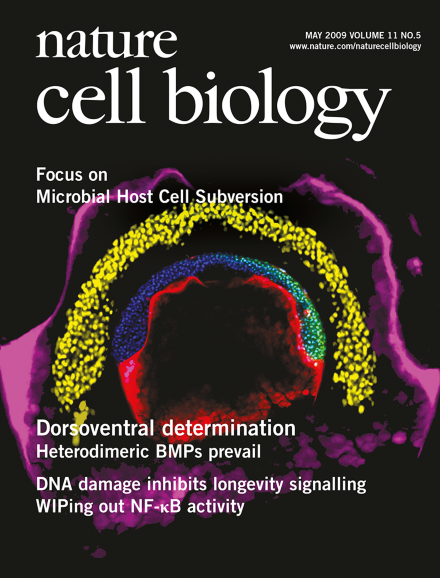
About the coverFocus
FOCUS ON Microbial host cell subversion
Nature Cell Biology and Nature Reviews Microbiology present a set of specially commissioned articles that highlight recent progress in our understanding of how microorganisms exploit the cell biology of their host.
Editorials
Focus on Microbial host cell subversion
Genetic privacy and piracy - p509
doi:10.1038/ncb0509-509a
On the eve of a decision on a new gene diagnostics law in Germany, the debate about risks and benefits, although important, must not derail essential legislation.
Full Text - Genetic privacy and piracy | PDF (129 KB) - Genetic privacy and piracy
Focus on Microbial host cell subversion
Focus on host subversion - p509
doi:10.1038/ncb0509-509b
A collection of seven reviews surveys how microorganisms subvert host cell biology.
Full Text - Focus on host subversion | PDF (129 KB) - Focus on host subversion
Reviews
Focus on Microbial host cell subversion
Virus entry by macropinocytosis - pp510 - 520
Jason Mercer & Ari Helenius
doi:10.1038/ncb0509-510
Viruses rely on cellular functions for their life cycle and have co-opted a number of endocytic pathways to reach a suitable cellular niche. Several viruses stimulate macropinocytosis, a mechanism for cellular fluid uptake. Mercer and Helenius review the molecular processes involved in this new mode of viral entry.
Abstract - | Full Text - Virus entry by macropinocytosis | PDF (1,305 KB) - Virus entry by macropinocytosis
Focus on Microbial host cell subversion
Targeting of immune signalling networks by bacterial pathogens - pp521 - 526
Igor E. Brodsky & Ruslan Medzhitov
doi:10.1038/ncb0509-521
Recent advances in our understanding of the interplay between pathogen virulence factors and host defence signalling pathways point to the emergence of common themes. Acute pathogenic infections often target signalling hubs resulting in global disruption of the host immune response, whereas persistent pathogens manipulate the host immune response by preferentially targeting signalling network nodes.
Abstract - | Full Text - Targeting of immune signalling networks by bacterial pathogens | PDF (374 KB) - Targeting of immune signalling networks by bacterial pathogens
Focus on Microbial host cell subversion
Viral avoidance and exploitation of the ubiquitin system - pp527 - 534
Felix Randow & Paul J. Lehner
doi:10.1038/ncb0509-527
The ubiquitin-proteasome pathway regulates multiple fundamental cellular processes and as such is an attractive target for subversion by pathogens. The review by Randow and Lehner discusses the various means used by viruses to subvert the ubiquitin-proteasome pathway that ultimately enable viral replication, viral exit from cells, immune evasion and viral propagation.
Abstract - | Full Text - Viral avoidance and exploitation of the ubiquitin system | PDF (708 KB) - Viral avoidance and exploitation of the ubiquitin system | Supplementary information
Turning Points
From cell differentiation to the cell cycle: how failing in biochemistry led to success in morphology - p535
Yoshio Masui
doi:10.1038/ncb0509-535
Full Text - From cell differentiation to the cell cycle: how failing in biochemistry led to success in morphology | PDF (112 KB) - From cell differentiation to the cell cycle: how failing in biochemistry led to success in morphology
News and Views
Breaking a temporal barrier: signalling crosstalk regulates the initiation of border cell migration - pp536 - 538
Dorothea Godt & Ulrich Tepass
doi:10.1038/ncb0509-536
Correct timing of developmental events is crucial for generating a normal organism. During oogenesis in Drosophila melanogaster, migration of border cells occurs in a defined temporal window and requires Jak/Stat and steroid hormone signalling. The initiation of border-cell migration is now shown to be timed by Jak/Stat-mediated downregulation of the BTB domain transcriptional regulator Abrupt, which acts as a negative regulator of steroid hormone signalling.
Full Text - Breaking a temporal barrier: signalling crosstalk regulates the initiation of border cell migration | PDF (194 KB) - Breaking a temporal barrier: signalling crosstalk regulates the initiation of border cell migration
See also: Article by Jang et al.
Smurf1 zaps the talin head - pp538 - 540
David R. Critchley
doi:10.1038/ncb0509-538
Focal adhesion turnover is essential for cell migration. New results show that the talin head liberated from talin by calpain II cleavage has a key role in these events, and that its levels are tightly regulated by Smurf1-mediated ubiquitylation counteracted by Cdk5-mediated phosphorylation.
Full Text - Smurf1 zaps the talin head | PDF (263 KB) - Smurf1 zaps the talin head
See also: Letter by Huang et al.
SCAI blocks MAL-evolent effects on cancer cell invasion - pp540 - 542
Rudy Juliano
doi:10.1038/ncb0509-540
SCAI is a newly discovered protein that reduces cancer cell invasiveness. SCAI inhibits the MAL/SRF transcriptional activator complex that is downstream of Rho GTPase and actin, resulting in reduced expression of
1-integrins and loss of invasive potential.
Full Text - SCAI blocks MAL-evolent effects on cancer cell invasion | PDF (273 KB) - SCAI blocks MAL-evolent effects on cancer cell invasion
See also: Article by Brandt et al.
Research Highlights
Research highlights - p543
doi:10.1038/ncb0509-543
Full Text - Research highlights | PDF (110 KB) - Research highlights
Articles
Protein kinase D1 regulates cofilin-mediated F-actin reorganization and cell motility through slingshot - pp545 - 556
Tim Eiseler, Heike Döppler, Irene K. Yan, Kanae Kitatani, Kensaku Mizuno & Peter Storz
doi:10.1038/ncb1861
The actin severing factor cofilin is activated by the slingshot phosphatases. Phosphorylation of slingshot 1L by protein kinase D is found to block the association of slingshot 1L with actin, thereby inhibiting cofilin activation and directed cell migration.
Abstract - | Full Text - Protein kinase D1 regulates cofilin-mediated F-actin reorganization and cell motility through slingshot | PDF (2,838 KB) - Protein kinase D1 regulates cofilin-mediated F-actin reorganization and cell motility through slingshot | Supplementary information
SCAI acts as a suppressor of cancer cell invasion through the transcriptional control of
1-integrin - pp557 - 568
Dominique T. Brandt, Christian Baarlink, Thomas M. Kitzing, Elisabeth Kremmer, Johanna Ivaska, Peter Nollau & Robert Grosse
doi:10.1038/ncb1862
SCAI is novel protein that inhibits the transcription factor MAL and represses the expression of
1-integrin. Reduced SCAI levels also correlate with increased invasive cell migration.
Abstract - | Full Text - SCAI acts as a suppressor of cancer cell invasion through the transcriptional control of
1-integrin | PDF (3,036 KB) - SCAI acts as a suppressor of cancer cell invasion through the transcriptional control of
1-integrin | Supplementary information
See also: News and Views by Juliano
Border-cell migration requires integration of spatial and temporal signals by the BTB protein Abrupt - pp569 - 579
Anna C.-C. Jang, Yu-Chiuan Chang, Jianwu Bai & Denise Montell
doi:10.1038/ncb1863
How temporal signals from the steroid hormone ecdysone are integrated with JAK/STAT-mediated spatial control of Drosophila border-cell migration has been unclear. JAK/STAT represses Abrupt, which in turn attenuates ecdysone signalling by interacting with the ecdysone receptor coactivator Taiman.
Abstract - | Full Text - Border-cell migration requires integration of spatial and temporal signals by the BTB protein Abrupt | PDF (2,671 KB) - Border-cell migration requires integration of spatial and temporal signals by the BTB protein Abrupt | Supplementary information
See also: News and Views by Godt & Tepass
KRAB-type zinc-finger protein Apak specifically regulates p53-dependent apoptosis - pp580 - 591
Chunyan Tian, Guichun Xing, Ping Xie, Kefeng Lu, Jing Nie, Jian Wang, Li Li, Mei Gao, Lingqiang Zhang & Fuchu He
doi:10.1038/ncb1864
The tumour suppressor p53 can mediate both cell-cycle arrest and apoptosis. Apak binds and acetylates p53 by recruiting KAP-1 and HDAC1 to specifically suppress p53 regulated pro-apoptotic genes. Stress-induced phosphorylation of Apak by ATM relieves this inhibition.
Abstract - | Full Text - KRAB-type zinc-finger protein Apak specifically regulates p53-dependent apoptosis | PDF (3,167 KB) - KRAB-type zinc-finger protein Apak specifically regulates p53-dependent apoptosis | Supplementary information
RAD18 transmits DNA damage signalling to elicit homologous recombination repair - pp592 - 603
Jun Huang, Michael S. Y. Huen, Hongtae Kim, Charles Chung Yun Leung, J N Mark Glover, Xiaochun Yu & Junjie Chen
doi:10.1038/ncb1865
The ubquitin ligase Rad18 is a central mediator of cell cycle checkpoint activation by DNA damage. Now Rad18 turns out to directly regulate homologous recombination repair by interacting with Rad51C
Abstract - | Full Text - RAD18 transmits DNA damage signalling to elicit homologous recombination repair | PDF (5,384 KB) - RAD18 transmits DNA damage signalling to elicit homologous recombination repair | Supplementary information
Persistent transcription-blocking DNA lesions trigger somatic growth attenuation associated with longevity - pp604 - 615
George A. Garinis, Lieneke M. Uittenboogaard, Heike Stachelscheid, Maria Fousteri, Wilfred van Ijcken, Timo M. Breit, Harry van Steeg, Leon H. F. Mullenders, Gijsbertus T. J. van der Horst, Jens C. Brüning, Carien M. Niessen, Jan H. J. Hoeijmakers & Björn Schumacher
doi:10.1038/ncb1866
The 'somatic growth axis' involving IGF-1 and growth hormone is implicated in longevity. Persistent transcription-blocking DNA damage attenuates growth hormone and IGF-1 receptor expression and precipitates other ageing associated transcriptional changes, as well as inhibiting somatic growth.
Abstract - | Full Text - Persistent transcription-blocking DNA lesions trigger somatic growth attenuation associated with longevity | PDF (2,370 KB) - Persistent transcription-blocking DNA lesions trigger somatic growth attenuation associated with longevity | Supplementary information
Letters
Telomere recombination requires the MUS81 endonuclease - pp616 - 623
Sicong Zeng, Tao Xiang, Tej K. Pandita, Ignacio Gonzalez-Suarez, Susana Gonzalo, Curtis C. Harris & Qin Yang
doi:10.1038/ncb1867
Telomerase-negative cells maintain their telomeres through an alternative pathway that involves DNA recombination after replication. In this pathway, the recombination endonuclease MUS81 is found to regulate telomeric recombination and maintains the length of telomeres by interacting with the telomere binding protein TRF2.
First Paragraph - | Full Text - Telomere recombination requires the MUS81 endonuclease | PDF (2,282 KB) - Telomere recombination requires the MUS81 endonuclease | Supplementary information
Talin phosphorylation by Cdk5 regulates Smurf1-mediated talin head ubiquitylation and cell migration - pp624 - 630
Cai Huang, Zenon Rajfur, Nima Yousefi, Zaozao Chen, Ken Jacobson & Mark H. Ginsberg
doi:10.1038/ncb1868
Talins are essential for integrin activation, focal adhesion formation and mesenchymal cell migration. The E3 ubiquitin ligase Smurf1 regulates talin head degradation and Cdk5-mediated phosphorylation of the head prevents Smurf1 action on talin.
First Paragraph - | Full Text - Talin phosphorylation by Cdk5 regulates Smurf1-mediated talin head ubiquitylation and cell migration | PDF (2,560 KB) - Talin phosphorylation by Cdk5 regulates Smurf1-mediated talin head ubiquitylation and cell migration | Supplementary information
See also: News and Views by Critchley
Production of offspring from a germline stem cell line derived from neonatal ovaries - pp631 - 636
Kang Zou, Zhe Yuan, Zhaojuan Yang, Huacheng Luo, Kejing Sun, Li Zhou, Jie Xiang, Lingjun Shi, Qingsheng Yu, Yong Zhang, Ruoyu Hou & Ji Wu
doi:10.1038/ncb1869
It has been controversial whether female germline stem cells (FGSCs) are present in postnatal mammalian ovaries. Cells from a line derived from FGSCs isolated from adult mice that were transplanted into ovaries of infertile animals underwent oogenesis and generated offspring.
First Paragraph - | Full Text - Production of offspring from a germline stem cell line derived from neonatal ovaries | PDF (2,160 KB) - Production of offspring from a germline stem cell line derived from neonatal ovaries | Supplementary information
Bone morphogenetic protein heterodimers assemble heteromeric type I receptor complexes to pattern the dorsoventral axis - pp637 - 643
Shawn C. Little & Mary C. Mullins
doi:10.1038/ncb1870
Bone morphogenetic proteins (BMPs) regulate zebrafish dorsoventral patterning through two distinct receptor complexes. Surprisingly, BMPs function as an obligate heterodimer of BMP-2 and -7, while BMP homodimers are inactive.
First Paragraph - | Full Text - Bone morphogenetic protein heterodimers assemble heteromeric type I receptor complexes to pattern the dorsoventral axis | PDF (1,970 KB) - Bone morphogenetic protein heterodimers assemble heteromeric type I receptor complexes to pattern the dorsoventral axis | Supplementary information
PP1-mediated dephosphorylation of phosphoproteins at mitotic exit is controlled by inhibitor-1 and PP1 phosphorylation - pp644 - 651
Judy Qiju Wu, Jessie Yanxiang Guo, Wanli Tang, Chih-Sheng Yang, Christopher D. Freel, Chen Chen, Angus C. Nairn & Sally Kornbluth
doi:10.1038/ncb1871
Mitotic exit occurs when Cdc2 kinase activity drops and its substrates are dephosphorylated. Protein phosphatase-1 is responsible for this dephosphorylation and its activity is restrained during mitosis by Cdc2 phosphorylation and binding of Inhibitor-1, while auto-dephoshorylation at the Cdc2 site ensures its timely activation.
First Paragraph - | Full Text - PP1-mediated dephosphorylation of phosphoproteins at mitotic exit is controlled by inhibitor-1 and PP1 phosphorylation | PDF (1,489 KB) - PP1-mediated dephosphorylation of phosphoproteins at mitotic exit is controlled by inhibitor-1 and PP1 phosphorylation | Supplementary information
Arginine methylation of Piwi proteins catalysed by dPRMT5 is required for Ago3 and Aub stability - pp652 - 658
Yohei Kirino, Namwoo Kim, Mariàngels de Planell-Saguer, Eugene Khandros, Stephanie Chiorean, Peter S. Klein, Isidore Rigoutsos, Thomas A. Jongens & Zissimos Mourelatos
doi:10.1038/ncb1872
First Paragraph - | Full Text - Arginine methylation of Piwi proteins catalysed by dPRMT5 is required for Ago3 and Aub stability | PDF (1,938 KB) - Arginine methylation of Piwi proteins catalysed by dPRMT5 is required for Ago3 and Aub stability | Supplementary information
WIP1 phosphatase is a negative regulator of NF-
B signalling - pp659 - 666
Joanne Chew, Subhra Biswas, Sathyavageeswaran Shreeram, Mahathir Humaidi, Ee Tsin Wong, Manprit Kaur Dhillion, Hsiangling Teo, Amit Hazra, Cheok Chit Fang, Eduardo López-Collazo, Dmitry V. Bulavin & Vinay Tergaonkar
doi:10.1038/ncb1873
NF-
B activity is positively regulated through phosphorylation, but how activation is reversed has been unclear. A genome-wide siRNA screen reveals that the phosphatase WIP1 dephosphorylates the NF-
B subunit p65 at Ser 536, a phospho-residue critical for transcriptional regulation.
First Paragraph - | Full Text - WIP1 phosphatase is a negative regulator of NF-
B signalling | PDF (1,636 KB) - WIP1 phosphatase is a negative regulator of NF-
B signalling | Supplementary information