Table of contents


Top

Editorial

Credit where credit is due p1

doi:10.1038/ncb0109-1

Citations are an important component in the assessment of academic performance. Yet, the growing literature, combined with format constraints of journals, encourage citation of reviews in preference to primary research. This diverts academic credit from the discoverer.


Top

Book Review

TGF-beta signalling unfolds p2

Stefano Piccolo reviews The TGF-beta family by Rik Derynck & Kohei Miyazono

doi:10.1038/ncb0109-2


Top

Meeting Report

Shaping embryos in Barcelona pp3 - 6

Michel Labouesse & Lilianna Solnica-Krezel

doi:10.1038/ncb0109-3


Top

News and Views

Membrane repair redux: redox of MG53 pp7 - 9

Paul McNeil

doi:10.1038/ncb0109-7

Most cells can rapidly repair extensive tears in their plasma membrane, a response dependent on extracellular calcium. Entry of extracellular oxidants through a membrane disruption oxidizes and thus activates a newly discovered membrane repair protein, MG53, in skeletal muscle cells.

See also: Article by Cai et al.


Undressing a cellular corset: septins exposed pp9 - 10

Melissa C. Srougi & Keith Burridge

doi:10.1038/ncb0109-9

Septins comprise a conserved family of cytoskeletal proteins distinct from the microfilament, microtubule and intermediate filament systems. They are GTPases that have been implicated in a number of cellular processes ranging from mitosis to vesicular trafficking. A new study identifies a previously undefined role for septins as cellular 'corsets', modulating cell shape and providing cortical rigidity in T cells that allows for their controlled migration.

See also: Article by Tooley et al.


Ran out of the nucleus for apoptosis pp11 - 12

Andrew Wilde & Yixian Zheng

doi:10.1038/ncb0109-11

Induction of apoptosis causes active dissipation of the RanGTP gradient across an intact nuclear envelope by immobilizing RCC1, the guanine nucleotide exchange factor for RanGTPase, on chromatin. The subsequent reduction in nuclear trafficking prevents the movement of NF-kappaB into the nucleus, thereby allowing apoptosis to proceed.

See also: Article by Wong et al.


sFRPs: a declaration of (Wnt) independence p13

Elisha Nathan & Eldad Tzahor

doi:10.1038/ncb0109-13

Secreted Frizzled-related proteins (sFRPs) are signalling molecules well-known as antagonists of the Wnt pathway, but recent studies indicate that they may have additional functions unrelated to Wnt. A new study demonstrates that mammalian sFRP2 can act as an enhancer of collagen processing in vitro and in vivo, augmenting myocardial injury-driven fibrosis. These findings underscore the biological versatility of sFRP family members.

See also: Article by Kobayashi et al.


Top

Research Highlights

Research highlights p15

Silvia Grisendi, Nathalie Le Bot, Christina Karlsson Rosenthal & Sowmya Swaminathan

doi:10.1038/ncb0109-15


Top

Articles

Amoeboid T lymphocytes require the septin cytoskeleton for cortical integrity and persistent motility pp17 - 26

Aaron J. Tooley, Julia Gilden, Jordan Jacobelli, Peter Beemiller, William S. Trimble, Makoto Kinoshita & Matthew F. Krummel

doi:10.1038/ncb1808

Septins are cytoskeletal proteins that form a ring at the cytokinetic furrow. Now an analogous 'molecular corset' of septins is found to be required for T lymphocyte migration.

See also: News and Views by Srougi & Burridge


Genome stability is ensured by temporal control of kinetochore–microtubule dynamics pp27 - 35

Samuel F. Bakhoum, Sarah L. Thompson, Amity L. Manning & Duane A. Compton

doi:10.1038/ncb1809

Incorrectly oriented chromosomes in mitosis can lead to chromosome instability and aneuploidy. The kinesins Kif2b and MCAK stimulate kinetochore-microtubule dynamics to correct mis-orientations.


Apoptotic histone modification inhibits nuclear transport by regulating RCC1 pp36 - 45

Chi-Hang Wong, Hei Chan, Chin-Yee Ho, Soak-Kuan Lai, Kheng-Sze Chan, Cheng-Gee Koh & Hoi-Yeung Li

doi:10.1038/ncb1810

The guanine nucleotide exchange factor for Ran, RCC1, dynamically binds chromatin. During apoptosis, caspase-mediated activation of Mst1 induces histone H2B phosphorylation, which immobilizes RCC1 on the chromatin, leading to a reduction in nuclear RanGTP.

See also: News and Views by Wilde & Zheng


Secreted Frizzled-related protein 2 is a procollagen C proteinase enhancer with a role in fibrosis associated with myocardial infarction pp46 - 55

Koichi Kobayashi, Min Luo, Yue Zhang, David C. Wilkes, Gaoxiang Ge, Thomas Grieskamp, Chikaomi Yamada, Ting-Chun Liu, Guorui Huang, Craig T. Basson, Andreas Kispert, Daniel S. Greenspan & Thomas N. Sato

doi:10.1038/ncb1811

Secreted frizzled-related proteins (sFRPs) were reported to antagonise Chordin processing by Sizzled, a tolloid-like metalloproteinase in Xenopus and zebrafish. Surprisingly, mammalian sFRP2 enhances the activity of tolloid-like metalloproteinases on procollagen C to modulate fibrosis associated with cardiac injury.

See also: News and Views by Nathan & Tzahor


MG53 nucleates assembly of cell membrane repair machinery pp56 - 64

Chuanxi Cai, Haruko Masumiya, Noah Weisleder, Noriyuki Matsuda, Miyuki Nishi, Moonsun Hwang, Jae-Kyun Ko, Peihui Lin, Angela Thornton, Xiaoli Zhao, Zui Pan, Shinji Komazaki, Marco Brotto, Hiroshi Takeshima & Jianjie Ma

doi:10.1038/ncb1812

A phosphatidylserine-binding protein, MG53, is shown to participate in membrane repair. MG53 recruits vesicles to the repair site in an oxidation dependent manner and MG53-null mice develop progressive myopathy associated with defective membrane repair.

See also: News and Views by McNeil


Top

Letters

Midbody ring disposal by autophagy is a post-abscission event of cytokinesis pp65 - 70

Christian Pohl & Stefan Jentsch

doi:10.1038/ncb1813

The midbody ring connects two dividing cells at the end of cytokinesis. Depletion of autophagy components or inhibition of lysosomal function result in accumulation of midbody rings.


Regulation of cytokinesis by Rho GTPase flux pp71 - 77

Ann L. Miller & William M. Bement

doi:10.1038/ncb1814

In cytokinesis, formation of the contractile ring depends on localized activation of RhoA at the cell equator. This study demonstrates that GAP activity of MgcRacGAP is necessary throughout cytokinesis to maintain a focused zone of Rho activity.


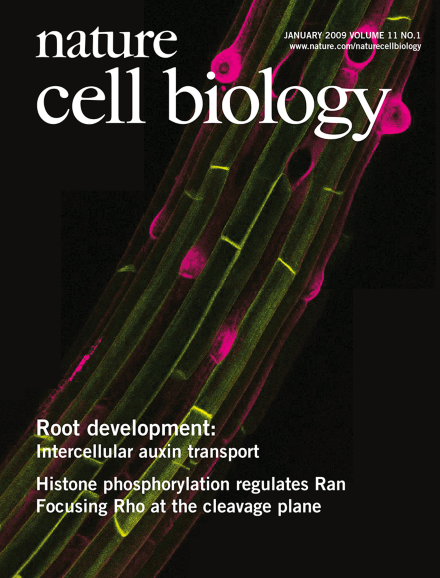
Auxin transport through non-hair cells sustains root-hair development pp78 - 84

Angharad R. Jones, Eric M. Kramer, Kirsten Knox, Ranjan Swarup, Malcolm J. Bennett, Colin M. Lazarus, H. M. Ottoline Leyser & Claire S. Grierson

doi:10.1038/ncb1815

As the root develops, auxin transport through non-hair cells sustains root-hair outgrowth. Mathematical modelling and experimental data reveal that auxin is transported through canals across the non-hair cells.


An inducible autoregulatory loop between HIPK2 and Siah2 at the apex of the hypoxic response pp85 - 91

Marco A. Calzado, Laureano de la Vega, Andreas Möller, David D. L. Bowtell & M. Lienhard Schmitz

doi:10.1038/ncb1816

The ubiquitin ligase Siah2 targets HIPK2 kinase for degradation during hypoxia. During normoxia, however, the kinase is stable, as phosphorylation of Siah2 by HIPK2 weakens the interaction.


Activation of ATM depends on chromatin interactions occurring before induction of DNA damage pp92 - 96

Yong-Chul Kim, Gabi Gerlitz, Takashi Furusawa, Frédéric Catez, Andre Nussenzweig, Kyu-Seon Oh, Kenneth H. Kraemer, Yosef Shiloh & Michael Bustin

doi:10.1038/ncb1817

Doubled-stranded DNA breaks activate ATM kinase, precipitating a DNA damage response. The nucleosome-binding protein HMGN1 governs ATM activation by inducing H3K14 acetylation, which regulates chromatin binding of ATM both before and after DSB formation.


Essential role of Pin1 in the regulation of TRF1 stability and telomere maintenance pp97 - 105

Tae Ho Lee, Adrian Tun-Kyi, Rong Shi, Jormay Lim, Christina Soohoo, Greg Finn, Martin Balastik, Lucia Pastorino, Gerburg Wulf, Xiao Zhen Zhou & Kun Ping Lu

doi:10.1038/ncb1818

The prolyl isomerase Pin1 acts in various cellular processes. It has now been implicated in telomere maintenance by regulating the stability of the telomere binding protein TRF1.


Top

Brief Communication

Regulation of ERK activity duration by Sprouty contributes to dorsoventral patterning pp106 - 109

Hiroshi Hanafusa, Kunihiro Matsumoto & Eisuke Nishida

doi:10.1038/ncb1820


Top

Erratum

X-linked and cellular IAPs modulate the stability of C-RAF kinase and cell motility p110

Taner Dogan, Gregory S. Harms, Mirko Hekman, Christiaan Karreman, Tripat Kaur Oberoi, Emad S. Alnemri, Ulf R. Rapp & Krishnaraj Rajalingam

doi:10.1038/ncb0109-110


Top

Extra navigation

Subscribe to Nature Cell Biology

Subscribe

Open Innovation Challenges