Table of contents
Volume 462 Number 7272 pp389-534
In this issue (26 November 2009)
Also this week
(this content only available online) indicates content that is available online only
Editorials
Democratic fallacy p389
Japan's effort to make budget allocations by public hearing could be good for the country and for science, but not as currently planned.
doi:10.1038/462389a
Conservative vacuum p389
Britain's main opposition party needs policies for research and for universities.
doi:10.1038/462389b
Getting what you pay for p390
The US Food and Drug Administration cannot fulfil its mandate without a serious funding boost.
doi:10.1038/462390a
Research Highlights
Atmospheric physics: Greased lightning p392
doi:10.1038/462392a
Palaeontology: Mammoth fungal trail p392
doi:10.1038/462392b
Chemistry: Get into the groove p392
doi:10.1038/462392c
Developmental biology: Down the tube p392
doi:10.1038/462392d
Astronomy: Galaxies aglow p392
doi:10.1038/462392e
Cancer biology: Dicer blocker p392
doi:10.1038/462392f
Developmental biology: To be or not to be sperm? p393
doi:10.1038/462393a
Neuroscience: Rats versus mice p393
doi:10.1038/462393b
Materials: Healed steel p393
doi:10.1038/462393c
Meteorology: Can't beat the heat p393
doi:10.1038/462393d
News
News briefing: 26 November 2009 p394
The week in science.
doi:10.1038/462394a
UK physics council sees grim future p396
Second financial crisis in two years leaves researchers questioning the council's long-term viability.
Geoff Brumfiel
doi:10.1038/462396a
Storm clouds gather over leaked climate e-mails p397
British climate centre reeling over Internet posting of sensitive material.
Quirin Schiermeier
doi:10.1038/462397a
Indian neutrino lab site rejected p397
Nilgiri location threatens important elephant habitat.
K. S. Jayaraman
doi:10.1038/462397b
Flu-virus prevalence comes under scrutiny p398
Projects to monitor antibodies seek true extent of H1N1 infection.
Declan Butler
doi:10.1038/462398a
Japan sets sights on solar power from space p398
Researchers aim to launch full-scale system by 2030.
David Cyranoski
doi:10.1038/462398b
Icelandic genomics firm goes bankrupt p401
deCODE's demise leaves fate of its valuable genetic database unclear.
Erika Check Hayden
doi:10.1038/462401a
Famous brain set to go under the knife p403
Slices from the brain of H.M., a key patient in pioneering memory studies, will be immortalized online.
Lizzie Buchen
doi:10.1038/462403a
Mexico's transgenic maize under fire p404
Experimental planting scheme has insufficient controls to prevent gene flow to native crops, critcs say.
Rex Dalton
doi:10.1038/462404a
Correction p404
doi:10.1038/462404b
News Features
The FDA: A tough tonic p406
The new head of the US Food and Drug Administration has inherited an agency battered by crises. Meredith Wadman asks whether Peggy Hamburg can concoct a cure.
doi:10.1038/462406a
Computational biology: Biological logic p408
An intuitive approach to computer modelling could reveal paths to discovery, finds Lucas Laursen.
doi:10.1038/462408a
Correspondence
The road ahead for brain-circuit reconstruction p411
Kevan A. C. Martin
doi:10.1038/462411a
Darwin respected by his religious contemporaries p411
R. J. Berry
doi:10.1038/462411b
Why some relatives object to organ donation p411
David J. Hill
doi:10.1038/462411c
Brazil's system stops its natural wealth helping science p411
Sergio U. Dani
doi:10.1038/462411d
Opinion
International spaces promote peace p412
Lessons are still being learnt from the Antarctic Treaty, adopted 50 years ago this week. It set a visionary precedent for governing regions and resources beyond national jurisdictions, says Paul Arthur Berkman.
Paul Arthur Berkman
doi:10.1038/462412a
Books and Arts
Some will go far to catch a falling star p414
Henner Busemann enjoys a hymn to the passionate collectors who fuelled the science of meteorites.
Henner Busemann reviews The Fallen Sky: An Intimate History of Shooting Stars by Christopher Cokinos
doi:10.1038/462414a
A wake-up call to educators p415
Devorah Bennu reviews Crossing the Finish Line: Completing College at America's Public Universities by William G. Bowen, Matthew M. Chingos & Michael S. McPherson
doi:10.1038/462415a
Quantum objects on show p416
Philip Ball reviews Worlds Within Worlds: Quantum Objects by Julian Voss-Andreae
doi:10.1038/462416a
News and Views
Biodiversity: Skates on thin ice p417
The common skate is not at all common: this large marine fish has 'critically endangered' status. That it turns out to be not one species, but two, is a sharp reminder that good taxonomy must underpin conservation.
Nicholas K. Dulvy & John D. Reynolds
doi:10.1038/462417a
Immunology: A helpers' guide to infection p418
Killer T cells were thought to patrol the body unhindered, freely gaining access to sites of infection. But it seems that, at least in some body tissues, helper T cells must pave the way for killer T-cell entry.
Thomas Gebhardt & Francis R. Carbone
doi:10.1038/462418a
See also: Editor's summary
Solid-state physics: Silicon spintronics warms up p419
Electrical injection and detection of spin-polarized electrons in a silicon chip have now been demonstrated at room temperature, paving the way to the development of low-power semiconductor spintronics circuitry.
Michael E. Flatté
doi:10.1038/462419a
See also: Editor's summary
Structural biology: Highly charged meetings p420
When it comes to proteins and their environments, opposites repel. So how is the highly charged, polar helix of a transmembrane ion channel accommodated by a non-polar membrane? Easily, if the charges are buried.
Anthony G. Lee
doi:10.1038/462420a
See also: Editor's summary
Astrophysics: Assortment in the Galaxy p421
Observations of star clusters in the Milky Way defy the view that the constituents of these systems are almost invariably chemically alike. The outlying clusters could be the tattered relics of once larger systems.
Judith G. Cohen
doi:10.1038/462421a
See also: Editor's summary
50 & 100 years ago p422
doi:10.1038/462422a
Obituary: Paul C. Zamecnik (1912–2009) p423
Trailblazer in the study of protein synthesis.
Thoru Pederson
doi:10.1038/462423a
Insight: Biomaterials -
Insight: Biomaterials
Biomaterials p425
Rosamund Daw & Stefano Tonzani
doi:10.1038/462425a
Inspiration and application in the evolution of biomaterials p426
Nathaniel Huebsch & David J. Mooney
doi:10.1038/nature08601
Abstract | Full Text | PDF (3,088K)
Designing materials to direct stem-cell fate p433
Matthias P. Lutolf, Penney M. Gilbert & Helen M. Blau
doi:10.1038/nature08602
Abstract | Full Text | PDF (6,946K)
Biomaterial systems for mechanosensing and actuation p442
Peter Fratzl & Friedrich G. Barth
doi:10.1038/nature08603
Abstract | Full Text | PDF (1,999K)
Materials engineering for immunomodulation p449
Jeffrey A. Hubbell, Susan N. Thomas & Melody A. Swartz
doi:10.1038/nature08604
Abstract | Full Text | PDF (3,460K)
Drivers of biodiagnostic development p461
David A. Giljohann & Chad A. Mirkin
doi:10.1038/nature08605
Abstract | Full Text | PDF (2,512K)
Articles
Structure of the formate transporter FocA reveals a pentameric aquaporin-like channel p467
The formate–nitrite transporter family, of which FocA is a representative member, is known to transport short-chain acids in bacteria, archaea, fungi, algae and parasites; however, the structure and transport mechanism of these transporters remain unknown. Here, study of the crystal structure of Escherichia coli FocA reveals that the overall structure of FocA closely resembles that of aquaporin, suggesting that it is in fact a channel, rather than a transporter.
Yi Wang, Yongjian Huang, Jiawei Wang, Chao Cheng, Weijiao Huang, Peilong Lu, Ya-Nan Xu, Pengye Wang, Nieng Yan & Yigong Shi
doi:10.1038/nature08610
Abstract | Full Text | PDF (1,375K) | Supplementary information
See also: Editor's summary
Structure and hydration of membranes embedded with voltage-sensing domains p473
Despite the growing number of X-ray crystal structures of membrane proteins, direct structural information about proteins in their native membrane environment remains scarce. Neutron diffraction, solid-state nuclear magnetic resonance spectroscopy and molecular dynamics simulations are now used to investigate the structure and hydration of bilayer membranes containing S1–S4 voltage-sensing domains.
Dmitriy Krepkiy, Mihaela Mihailescu, J. Alfredo Freites, Eric V. Schow, David L. Worcester, Klaus Gawrisch, Douglas J. Tobias, Stephen H. White & Kenton J. Swartz
doi:10.1038/nature08542
Abstract | Full Text | PDF (1,429K) | Supplementary information
See also: Editor's summary | News and Views by Lee
Letters
Enrichment by supernovae in globular clusters with multiple populations p480
The globular star clusters
Centauri and M 22 are thought to be the remaining cores of disrupted dwarf galaxies, but they are viewed as exceptional. Here, calcium abundances for seven globular clusters are reported and compared to
Centauri. The results lead the authors to conclude that these globular clusters are also probably the relics of more massive primeval dwarf galaxies that merged and disrupted to form the proto-Galaxy.
Jae-Woo Lee, Young-Woon Kang, Jina Lee & Young-Wook Lee
doi:10.1038/nature08565
First paragraph | Full Text | PDF (800K) | Supplementary information
See also: Editor's summary | News and Views by Cohen
The cluster Terzan 5 as a remnant of a primordial building block of the Galactic bulge p483
Centauri is the only globular star cluster in the Galactic halo known to have multiple stellar populations with a significant spread in iron abundance and age. But now Terzan 5, a globular-cluster-like system in the Galactic bulge, is reported to have two stellar populations with different iron contents and ages. So Terzan 5 could be the surviving remnant of one of the primordial building blocks which are thought to merge and form galaxy bulges.
F. R. Ferraro, E. Dalessandro, A. Mucciarelli, G. Beccari, R. M. Rich, L. Origlia, B. Lanzoni, R. T. Rood, E. Valenti, M. Bellazzini, S. M. Ransom & G. Cocozza
doi:10.1038/nature08581
First paragraph | Full Text | PDF (1,609K) | Supplementary information
See also: Editor's summary | News and Views by Cohen
Two-dimensional normal-state quantum oscillations in a superconducting heterostructure p487
Heavily doped semiconductors, which can exhibit superconductivity, and low-dimensional superconducting thin films are currently limited by interface scattering, electronic or atomic-scale disorder. Here, the fabrication of a high-quality superconducting layer within a thin-film heterostructure based on SrTiO3 is reported. By selectively doping a narrow region of SrTiO3 a two-dimensional superconductor is formed that should provide a model system in which to explore the quantum transport and interplay of both superconducting and normal electrons.
Y. Kozuka, M. Kim, C. Bell, B. G. Kim, Y. Hikita & H. Y. Hwang
doi:10.1038/nature08566
First paragraph | Full Text | PDF (473K) | Supplementary information
See also: Editor's summary
Electrical creation of spin polarization in silicon at room temperature p491
Spintronics aims to represent digital information using spin orientation rather than electron charge, ideally at room temperature and in silicon, which is already ubiquitous in present-day technologies. But so far successful control of spin has only been achieved for electrons and at low temperatures. Now room-temperature injection, manipulation and detection of spin polarization of both electrons and their positively charged counterparts (holes) brings the realization of silicon spintronic devices closer.
Saroj P. Dash, Sandeep Sharma, Ram S. Patel, Michel P. de Jong & Ron Jansen
doi:10.1038/nature08570
First paragraph | Full Text | PDF (642K) | Supplementary information
See also: Editor's summary | News and Views by Flatté
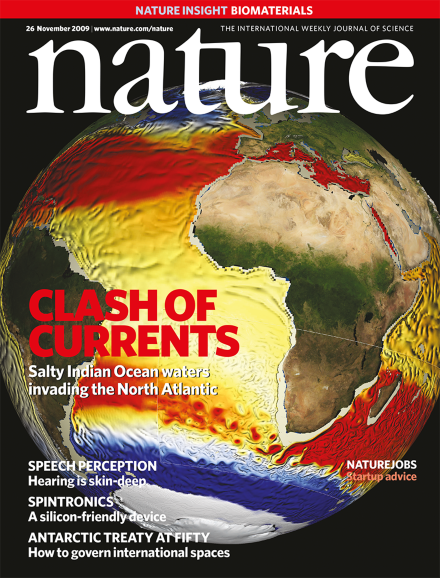
Increase in Agulhas leakage due to poleward shift of Southern Hemisphere westerlies p495
The Agulhas leakage allows the transport of warm and salty Indian Ocean waters into the Atlantic Ocean and provides the main source of heat and salt for the surface branch of the Atlantic meridional overturning circulation. The results of a high-resolution ocean general circulation model now show that the transport of Indian Ocean waters into the South Atlantic via the Agulhas leakage has increased during the past decades in response to a change in wind forcing.
A. Biastoch, C. W. Böning, F. U. Schwarzkopf & J. R. E. Lutjeharms
doi:10.1038/nature08519
First paragraph | Full Text | PDF (1,126K) | Supplementary information
See also: Editor's summary
Convective upwelling in the mantle beneath the Gulf of California p499
The Gulf of California is a part of the world's seafloor-spreading system surrounded by enough seismometers to provide sufficiently high horizontal resolution to address the long-standing debate about the relative importance of dynamic and passive upwelling in the shallow mantle beneath spreading centres. Here, Rayleigh-wave tomography is used to image the shear velocity in the upper 200 kilometres or so of the mantle; the results suggest areas of dynamic upwelling.
Yun Wang, Donald W. Forsyth & Brian Savage
doi:10.1038/nature08552
First paragraph | Full Text | PDF (354K) | Supplementary information
See also: Editor's summary
Aero-tactile integration in speech perception p502
Auditory perception can be enhanced or interfered with by visual information from a speaker's face, but previous studies looking at whether tactile information influences speech perception have been limited. Here, by applying inaudible air puffs on participants' skin and thereby mimicking the tiny bursts of aspiration produced by certain speech sounds, it is found that syllables are more likely to be heard as aspirated, demonstrating that tactile information is also integrated in auditory perception.
Bryan Gick & Donald Derrick
doi:10.1038/nature08572
First paragraph | Full Text | PDF (240K) | Supplementary information
See also: Editor's summary
Central control of fever and female body temperature by RANKL/RANK p505
Receptor-activator of NF-
B ligand (RANKL) and its receptor RANK are known to be essential regulators of bone remodelling, lymph node organogenesis and formation of a lactating mammary gland, but the functional relevance of their expression in the brain has been unclear. RANKL and RANK are now reported to have an essential role in the brain, with the central injection of RANKL into mice and rats triggering severe fever, and a further potential role in the control of thermoregulation in females.
Reiko Hanada, Andreas Leibbrandt, Toshikatsu Hanada, Shiho Kitaoka, Tomoyuki Furuyashiki, Hiroaki Fujihara, Jean Trichereau, Magdalena Paolino, Fatimunnisa Qadri, Ralph Plehm, Steffen Klaere, Vukoslav Komnenovic, Hiromitsu Mimata, Hironobu Yoshimatsu, Naoyuki Takahashi, Arndt von Haeseler, Michael Bader, Sara Sebnem Kilic, Yoichi Ueta, Christian Pifl, Shuh Narumiya & Josef M. Penninger
doi:10.1038/nature08596
First paragraph | Full Text | PDF (492K) | Supplementary information
See also: Editor's summary
CD8+ T lymphocyte mobilization to virus-infected tissue requires CD4+ T-cell help p510
CD4+ T helper cells provide critical signals for the generation of cytotoxic CD8+ T lymphocyte (CTL) responses in vivo as well as promoting protective CD8+ memory T-cell development. However, the role of CD4 help in the control of CTL responses at the effector stage is unknown. Here, fully helped effector CTLs are shown to rely on CD4+ T cells to provide the necessary cue for entry into infected tissue.
Yusuke Nakanishi, Bao Lu, Craig Gerard & Akiko Iwasaki
doi:10.1038/nature08511
First paragraph | Full Text | PDF (442K) | Supplementary information
See also: Editor's summary | News and Views by Gebhardt & Carbone
Host plant genome overcomes the lack of a bacterial gene for symbiotic nitrogen fixation p514
Homocitrate is an essential component of the enzyme nitrogenase, which is required for nitrogen fixation. However, the NifV gene, which encodes homocitrate synthase, is not present in most rhizobial species that require symbiotic association with legumes to perform efficient nitrogen fixation. The FEN1 gene of a model legume, Lotus japonicus, is now shown to overcome the lack of NifV in rhizobia for symbiotic nitrogen fixation.
Tsuneo Hakoyama, Kaori Niimi, Hirokazu Watanabe, Ryohei Tabata, Junichi Matsubara, Shusei Sato, Yasukazu Nakamura, Satoshi Tabata, Li Jichun, Tsuyoshi Matsumoto, Kazuyuki Tatsumi, Mika Nomura, Shigeyuki Tajima, Masumi Ishizaka, Koji Yano, Haruko Imaizumi-Anraku, Masayoshi Kawaguchi, Hiroshi Kouchi & Norio Suganuma
doi:10.1038/nature08594
First paragraph | Full Text | PDF (667K) | Supplementary information
See also: Editor's summary
An ancient light-harvesting protein is critical for the regulation of algal photosynthesis p518
Although light is needed for photosynthesis, it can also cause severe oxidative damage. For this reason, protective mechanisms involving feedback-regulated de-excitation of chlorophyll molecules in photosystem II (qE) have evolved. In contrast to flowering plants, little is known about the qE mechanism of eukaryotic algae. Here, a qE-deficient mutant green alga is shown to lack two of the three genes encoding LHCSR, an ancient member of the light-harvesting complex superfamily.
Graham Peers, Thuy B. Truong, Elisabeth Ostendorf, Andreas Busch, Dafna Elrad, Arthur R. Grossman, Michael Hippler & Krishna K. Niyogi
doi:10.1038/nature08587
First paragraph | Full Text | PDF (393K) | Supplementary information
See also: Editor's summary
Innate immune and chemically triggered oxidative stress modifies translational fidelity p522
Accurate transfer RNA (tRNA) aminoacylation is necessary for translational fidelity; however, the accuracy of tRNA aminoacylation in vivo is uncertain. In mammalian cells, approximately 1% of methionine residues used in protein synthesis are now shown to be aminoacylated to non-methionyl-tRNAs. Furthermore, misacylation of methionine increases up to tenfold upon exposing cells to viruses, toll-like receptor ligands or oxidative stress.
Nir Netzer, Jeffrey M. Goodenbour, Alexandre David, Kimberly A. Dittmar, Richard B. Jones, Jeffrey R. Schneider, David Boone, Eva M. Eves, Marsha R. Rosner, James S. Gibbs, Alan Embry, Brian Dolan, Suman Das, Heather D. Hickman, Peter Berglund, Jack R. Bennink, Jonathan W. Yewdell & Tao Pan
doi:10.1038/nature08576
First paragraph | Full Text | PDF (1,344K) | Supplementary information
See also: Editor's summary
Naturejobs
Careers Q&ARichard Olds p529
Next February, Richard Olds will begin his tenure as dean of the planned new medical school at the University of California, Riverside. The school is due to open in 2012.
Virginia Gewin
doi:10.1038/nj7272-529a
Postdoc journal
Sharing ideas and data p529
It's a win-win situation.
Bryan Venters
doi:10.1038/nj7272-529b
In Brief
NIH asked to probe ethics p529
Health-care and policy executives seek probe into commercial bias.
doi:10.1038/nj7272-529c
Disease threat assessed p529
Field-research posts created as part of a global initiative to combat wildlife-borne diseases.
doi:10.1038/nj7272-529d
Asia takes clean-tech lead p529
US needs aggressive legislation and a three-fold increase in R&D to advance clean technology industry.
doi:10.1038/nj7272-529e
Careers and Recruitment
Start up and succeed p530
Scientists looking to capitalize on their latest discovery might consider starting a company. But that's more complex than it may seem, as Karen Kaplan reports.
Karen Kaplan
doi:10.1038/nj7272-530a