Thank you for visiting nature.com. You are using a browser version with limited support for CSS. To obtain
the best experience, we recommend you use a more up to date browser (or turn off compatibility mode in
Internet Explorer). In the meantime, to ensure continued support, we are displaying the site without styles
and JavaScript.
Membrane nanotubes are thin extensions of the plasma membrane that connect cells transiently and might facilitate intercellular communication. Recent studies have revealed considerable heterogeneity in their structure, formation, mode of cargo transport and functional properties, depending on the cell types involved.
Sterols and sterol derivatives modulate the Hedgehog (Hh) pathway at multiple levels. Progress in understanding Hh signalling will depend on deepening our knowledge of the cell biology of sterol metabolism and trafficking.
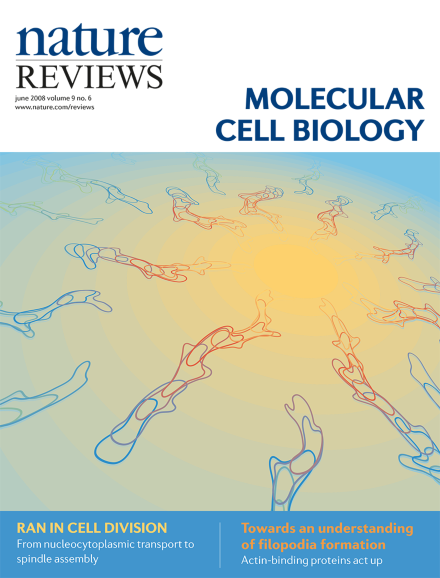
Filopodia are thin, actin-rich, finger-like structures that are involved in numerous cellular processes, such as cell migration, wound healing, neurite outgrowth and embryonic development. But what are the mechanisms that regulate filopodia formation in distinct cell types?
Chemotaxis enables immune cells to reach sites of infection, wounds to heal and the formation of embryonic patterns. Recent results have shed light on how cells orientate in chemotactic gradients, the forces that enable pseudopodia projection and the role of the endocytic cycle in movement.
The small nuclear GTPase Ran controls the directionality of macromolecular transport between the nucleus and the cytoplasm. Ran also has important roles during mitosis and directs nuclear-envelope dynamics, assembly of the mitotic spindle and the timing of cell-cycle transitions.
How do septins, GTP-binding proteins, function in a wide range of cellular processes, such as cell division, cytoskeletal organization and membrane remodelling? Electron microscopy and crystallographic studies provide a glimpse into septin-complex assembly that could answer this question.
Making discoveries is the most important part of being a scientist, and also the most fun. This article provides practical advice to young scientists on choosing a research topic, on designing, performing and interpreting experiments and on maintaining their sanity in the process.