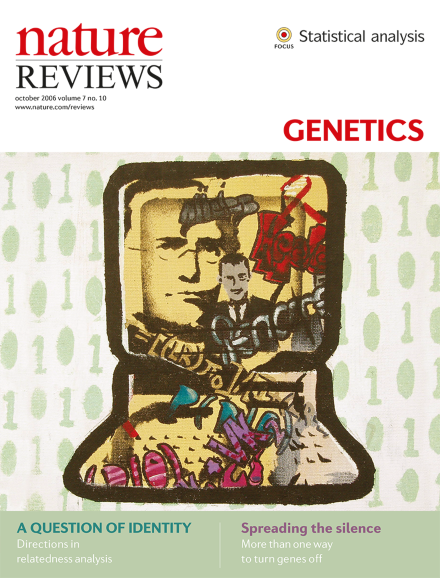
Table of contents


From the editors

p737 | doi:10.1038/nrg1963

Top

Research Highlights

Stem cells: A recipe for reprogramming

p738 | doi:10.1038/nrg1977

Transcriptomics: Every transcript counts

p739 | doi:10.1038/nrg1973

RNA interference: RNAi misses the target

p739 | doi:10.1038/nrg1974

Evolution: Jump-starting speciation

p740 | doi:10.1038/nrg1975

Reproductive Biology: From worm sperm proteins to human infertility

p740 | doi:10.1038/nrg1976

In brief

Development | Gene function | Plant biology | Cancer genetics

p741 | doi:10.1038/nrg1978

Chromatin: Eukaryotic genomes in complete control

p742 | doi:10.1038/nrg1966

Ageing: Longevity mutations inhibit tumours

p742 | doi:10.1038/nrg1972

Evolution: Putting flower colour on the landscape

p743 | doi:10.1038/nrg1971

Human genetics: INDELible markers

p744 | doi:10.1038/nrg1965

In brief

Epigenetics | Technology | Population genetics | Development

p744 | doi:10.1038/nrg1979

Top

Focus on: Statistical Analysis

Reviews

Computer programs for population genetics data analysis: a survival guide

Laurent Excoffier and Gerald Heckel

p745 | doi:10.1038/nrg1904

The increase in population genetics data has led to a parallel need for sophisticated analysis programs and packages. This article is intended as a guide to many of these statistical programs, to promote their more informed use.

Modern computational approaches for analysing molecular genetic variation data

Paul Marjoram and Simon Tavaré

p759 | doi:10.1038/nrg1961

The vast increase in the amount of molecular genetic data that are being generated, and the scale of their complexity, demand ever more sophisticated statistical analysis methods — this article surveys and compares these approaches, and the growing reliance on computational methodologies.

Genetic relatedness analysis: modern data and new challenges

Bruce S. Weir, Amy D. Anderson and Amanda B. Hepler

p771 | doi:10.1038/nrg1960

The concept of relatedness is central to many fields, from human linkage analysis to forensics to animal and plant breeding. This review covers the statistical framework for studying relatedness, its applications and the challenges that the field faces.

A tutorial on statistical methods for population association studies

David J. Balding

p781 | doi:10.1038/nrg1916

Identifying polymorphisms that are overrepresented in disease cases versus controls would seem to be a straightforward process, but genetic association studies are notoriously riddled with complex analysis problems. This article outlines these statistical issues and provides some guidance to overcoming them.

Top

Reviews

Spreading of silent chromatin: inaction at a distance

Paul B. Talbert and Steven Henikoff

p793 | doi:10.1038/nrg1920

Several models have been proposed to explain the spreading of heterochromatin, including looping, sliding and oozing. A review of studies from diverse model eukaryotes allows the authors to evaluate the existing models and leads them to propose a common, ancestral mechanism for spreading.

Top

Perspectives

Innovation

TAR cloning: insights into gene function, long-range haplotypes and genome structure and evolution

Natalay Kouprina and Vladimir Larionov

p805 | doi:10.1038/nrg1943

Transformation-associated recombination (TAR) cloning uses in vivo recombination in yeast to isolate large chromosomal segments from complex genomes. Although the principles of TAR cloning date back to the 1990s, recent modifications have opened up promising new applications of this technology.

Opinion

Genes, environment and the value of prospective cohort studies

Teri A. Manolio, Joan E. Bailey-Wilson and Francis S. Collins

p812 | doi:10.1038/nrg1919

Gene–environment interactions are key contributors to complex disease, but are hard to dissect in commonly used case–control designs. This article argues that large-scale prospective cohort studies, several of which are planned or under way, provide an essential alternative strategy.

Correspondence

Correspondence: Mining meiosis with genomic models

R. M. Ranganath and G. Venkatachalaiah

| doi:10.1038/nrg1614-c1

Erratum: Evolutionary genetics: High-resolution mutation mapping reveals parallel experimental evolution in yeast

| doi:10.1038/nrg1980

Extra navigation

Subscribe

Subscribe to Nature Reviews Genetics

naturejobs

natureproducts


Advertisement