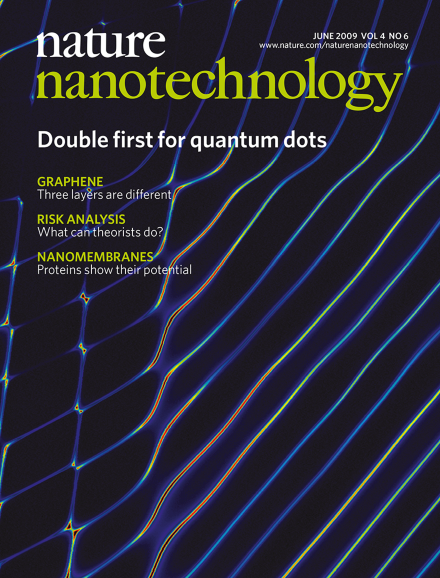
Table of contents


Top

Editorial

The responsibilities of authors p331

doi:10.1038/nnano.2009.125

Changes to our policies on authorship reflect the need for greater clarity about the contributions made by different authors to research papers.


Top

Commentary

How can ab initio simulations address risks in nanotech? pp332 - 335

Amanda S. Barnard

doi:10.1038/nnano.2009.126

Discussions of the potential risks and hazards associated with nanomaterials and nanoparticles tend to focus on the need for further experiments. However, theoretical and computational nanoscientists could also contribute by making their calculations more relevant to research into this area.


Top

Thesis

Are you a responsible nanoscientist? p336

Richard Jones

doi:10.1038/nnano.2009.127

Various codes of conduct have been proposed for nanotechnology — Richard Jones examines what they mean for individual researchers.


Top

Books and Arts

Notes on a scientific scandal p337

Plastic Fantastic: How the Biggest Fraud in Physics Shook the Scientific World by Eugenie Samuel Reich

doi:10.1038/nnano.2009.129


Top

Research Highlights

Our choice from the recent literature pp338 - 339

doi:10.1038/nnano.2009.130


Top down bottom up: Blood ties p339

doi:10.1038/nnano.2009.131

Magnetic nanoparticles are useful tools for tissue engineering and regeneration.


Top

News and Views

Nanomaterials: Viruses electrify battery research pp341 - 342

Jean-Marie Tarascon

doi:10.1038/nnano.2009.137

A new approach to making battery electrodes with the help of genetically engineered viruses could reduce costs and improve environmental sustainability.


Toxicology: Testing in the third dimension pp342 - 343

Molly M. Stevens

doi:10.1038/nnano.2009.136

Experiments with a new three-dimensional model of liver tissue find that the toxic effects of nanoparticles are reduced when compared with tests that use two-dimensional models.


Nanophotonics: Gradient force shows its potential pp344 - 345

Mark Freeman & Wayne Hiebert

doi:10.1038/nnano.2009.132

An all-optical chip-based method has been used to actuate and detect the motion of silicon nanocantilevers. Multiplexed read-out has also been demonstrated.


Separation materials: Proteins make for finer filters pp345 - 346

Olgica Bakajin & Aleksandr Noy

doi:10.1038/nnano.2009.133

Protein-based membranes can cope with water fluxes much higher than those that can be handled by commercial membranes with similar rejection properties.


Superconductivity: Flat out p346

Peter Rodgers

doi:10.1038/nnano.2009.123


Quantum dots: When a barrier is not an obstacle pp347 - 348

Mahn-Soo Choi

doi:10.1038/nnano.2009.134

Electrons in ultraclean carbon nanotubes can tunnel through barriers in a way not previously observed for particles with mass in condensed-matter physics experiments.


Top

Letters

Modular construction of DNA nanotubes of tunable geometry and single- or double-stranded character pp349 - 352

Faisal A. Aldaye, Pik Kwan Lo, Pierre Karam, Christopher K. McLaughlin, Gonzalo Cosa & Hanadi F. Sleiman

doi:10.1038/nnano.2009.72

Subject Categories: Molecular self-assembly | Structural properties


Ultrafast permeation of water through protein-based membranes pp353 - 357

Xinsheng Peng, Jian Jin, Yoshimichi Nakamura, Takahisa Ohno & Izumi Ichinose

doi:10.1038/nnano.2009.90

Subject Categories: Nanobiotechnology | Nanofluidics | Structural properties

See also: News and Views by Bakajin & Noy


Direct measurement of electrical conductance through a self-assembled molecular layer pp373 - 376

F. Song, J. W. Wells, K. Handrup, Z. S. Li, S. N. Bao, K. Schulte, M. Ahola-Tuomi, L. C. Mayor, J. C. Swarbrick, E. W. Perkins, L. Gammelgaard & Ph. Hofmann

doi:10.1038/nnano.2009.82

Subject Categories: Electronic properties and devices | Molecular self-assembly | Surface patterning and imaging


Trilayer graphene is a semimetal with a gate-tunable band overlap pp383 - 388

M. F. Craciun, S. Russo, M. Yamamoto, J. B. Oostinga, A. F. Morpurgo & S. Tarucha

doi:10.1038/nnano.2009.89

Subject Category: Electronic properties and devices


Top

Extra navigation

Subscribe to Nature Nanotechnology

Subscribe

Open Innovation Challenges

  • Single-cell Analysis Platform

    • Deadline: Dec 02 2009
    • Reward: $5,000 USD

    This Challenge is looking for novel approaches to analyzing changes at a single-cell level. This is...

  • Optimizing Sub-cellular Localization Tags

    • Deadline: Nov 29 2009
    • Reward: $20,000 USD

    The Seeker is looking for methods to optimize sub-cellular localization tags for protein expression....

naturejobs

ADVERTISEMENT