Table of contents
Special Feature
Five Year Anniversary Special
- Special Feature issue:
- October 2009 Volume 6, No 10
Nature Methods celebrates its five year anniversary with commentaries discussing the impact and progress of methodological developments in the life sciences. We also include a fun selection of papers and covers from our pages.
Editorial
Special Feature: Five Year Anniversary Special
In celebration of methods - p687
doi:10.1038/nmeth1009-687
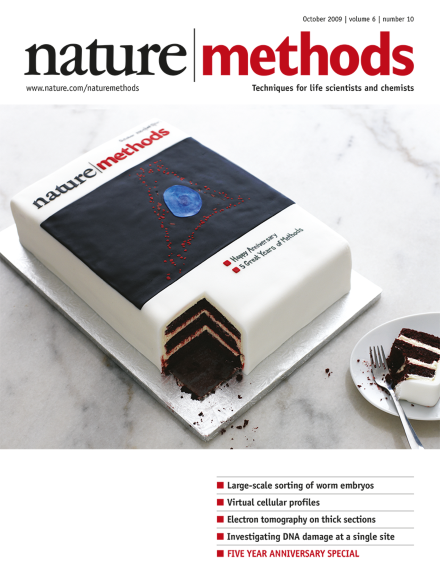
As evidenced by the cake adorning the cover, Nature Methods is five years old. To celebrate this anniversary, we look at methodological development and its role in scientific inquiry.
Abstract - In celebration of methods | Full Text - In celebration of methods | PDF (72 KB) - In celebration of methods
Correspondence
Online image analysis software for photoactivation localization microscopy - pp689 - 690
Per Niklas Hedde, Jochen Fuchs, Franz Oswald, Jörg Wiedenmann & Gerd Ulrich Nienhaus
doi:10.1038/nmeth1009-689
Full Text - Online image analysis software for photoactivation localization microscopy | PDF (226 KB) - Online image analysis software for photoactivation localization microscopy | Supplementary information
My5C: web tools for chromosome conformation capture studies - pp690 - 691
Bryan R Lajoie, Nynke L van Berkum, Amartya Sanyal & Job Dekker
doi:10.1038/nmeth1009-690
Full Text - My5C: web tools for chromosome conformation capture studies | PDF (382 KB) - My5C: web tools for chromosome conformation capture studies | Supplementary information
ADVERTISEMENT
Research Highlights
Two photons as exciting as one - p693
Natalie de Souza
doi:10.1038/nmeth1009-693
Channelrhodopsin-2 can be efficiently activated by infrared two-photon excitation light and stimulates action potentials in cultured neurons.
Abstract - Two photons as exciting as one | Full Text - Two photons as exciting as one | PDF (154 KB) - Two photons as exciting as one
'Blue' lighting cell signaling research - pp694 - 695
Irene Kaganman
doi:10.1038/nmeth1009-694a
By fusing a light-sensitive domain of an oat plant protein to Rac1, researchers created a genetically encoded protein fusion that can be reversibly activated with blue light and control cell movement—an attractive alternative to current caging tools.
Abstract - 'Blue' lighting cell signaling research | Full Text - 'Blue' lighting cell signaling research | PDF (672 KB) - 'Blue' lighting cell signaling research
A leader anyone can follow - pp694 - 695
Michael Eisenstein
doi:10.1038/nmeth1009-694b
The development of leader sequences that stimulate mRNA translation in a species-independent manner could offer new possibilities for eukaryotic protein production and proteomic research.
Abstract - A leader anyone can follow | Full Text - A leader anyone can follow | PDF (672 KB) - A leader anyone can follow
News in brief - p695
doi:10.1038/nmeth1009-695
Illuminating lipids - p696
Allison Doerr
doi:10.1038/nmeth1009-696
Visualization of choline-containing phospholipids in cells and in vivo is made possible by the metabolic incorporation of a choline analog with an alkyne handle for click chemistry–based labeling.
Abstract - Illuminating lipids | Full Text - Illuminating lipids | PDF (193 KB) - Illuminating lipids
Engineering bacteria in yeast - p698
Nicole Rusk
doi:10.1038/nmeth1009-698
Bacterial genomes shuttled into yeast can be easily altered before transplantation back into bacteria.
Abstract - Engineering bacteria in yeast | Full Text - Engineering bacteria in yeast | PDF (87 KB) - Engineering bacteria in yeast
Historical Commentaries
Special Feature: Five Year Anniversary Special
Technical matters: method, knowledge and infrastructure in twentieth-century life science - pp701 - 705
Angela N H Creager & Hannah Landecker
doi:10.1038/nmeth1009-701
Conceptual breakthroughs in science tend to garner accolades and attention. But, as the invention of tissue culture and the development of isotopic tracers show, innovative methods open up new fields and enable the solution of longstanding problems.
Abstract - Technical matters: method, knowledge and infrastructure in twentieth-century life science | Full Text - Technical matters: method, knowledge and infrastructure in twentieth-century life science | PDF (530 KB) - Technical matters: method, knowledge and infrastructure in twentieth-century life science
Special Feature: Five Year Anniversary Special
Seeing things: from microcinematography to live cell imaging - pp707 - 709
Hannah Landecker
doi:10.1038/nmeth1009-707
From histology to microcinematography, from cytochemistry to live cell imaging, the history of visualization technology in the life sciences may be understood as a series of cycles of action and reaction between static and dynamic modes of representing life.
Abstract - Seeing things: from microcinematography to live cell imaging | Full Text - Seeing things: from microcinematography to live cell imaging | PDF (384 KB) - Seeing things: from microcinematography to live cell imaging
Commentaries
Special Feature: Five Year Anniversary Special
Is sequencing enlightenment ending the dark age of the transcriptome? - pp711 - 713
Piero Carninci
doi:10.1038/nmeth1009-711
Sequencing-based technologies for RNA discovery are playing a key role in deciphering the transcriptome and hold the potential to provide us with a census of RNAs and their functions.
Abstract - Is sequencing enlightenment ending the dark age of the transcriptome? | Full Text - Is sequencing enlightenment ending the dark age of the transcriptome? | PDF (207 KB) - Is sequencing enlightenment ending the dark age of the transcriptome?
Special Feature: Five Year Anniversary Special
Engineered fluorescent proteins: innovations and applications - pp713 - 717
Michael W Davidson & Robert E Campbell
doi:10.1038/nmeth1009-713
Despite expansion of the fluorescent protein and optical highlighter palette into the orange to far-red range of the visible spectrum, achieving performance equivalent to that of EGFP has continued to elude protein engineers.
Abstract - Engineered fluorescent proteins: innovations and applications | Full Text - Engineered fluorescent proteins: innovations and applications | PDF (1,050 KB) - Engineered fluorescent proteins: innovations and applications
Special Feature: Five Year Anniversary Special
Comparative analysis to guide quality improvements in proteomics - pp717 - 719
Matthias Mann
doi:10.1038/nmeth1009-717
The potential of mass spectrometry–based proteomics to advance biology and biomedicine is nearly unlimited but so is its potential for generating bad data. Apart from the pursuit of technological progress in protocols and instruments, stringent comparative analyses of different approaches are critical for fully developing the discipline.
Abstract - Comparative analysis to guide quality improvements in proteomics | Full Text - Comparative analysis to guide quality improvements in proteomics | PDF (498 KB) - Comparative analysis to guide quality improvements in proteomics
Special Feature: Five Year Anniversary Special
From information to knowledge: new technologies for defining gene function - pp721 - 723
Sean R Collins, Jonathan S Weissman & Nevan J Krogan
doi:10.1038/nmeth1009-721
A wide range of methodology will be needed to bridge the gap between genome sequence and mechanistic understanding in biology. Recent advances in high-throughput genetic screening address this task.
Abstract - From information to knowledge: new technologies for defining gene function | Full Text - From information to knowledge: new technologies for defining gene function | PDF (918 KB) - From information to knowledge: new technologies for defining gene function
Five years of Methods
Special Feature: Five Year Anniversary Special
Five years of Methods - pp724 - 725
doi:10.1038/nmeth1009-724
Full Text - Five years of Methods | PDF (483 KB) - Five years of Methods
News and Views
Staging worms for next-generation analysis - pp727 - 728
L Ryan Baugh
doi:10.1038/nmeth1009-727
Automated stage-specific sorting of Caenorhabditis elegans embryos enables next-generation molecular and biochemical analysis of development.
Abstract - Staging worms for next-generation analysis | Full Text - Staging worms for next-generation analysis | PDF (167 KB) - Staging worms for next-generation analysis
See also: Article by Stoeckius et al.
Brief Communications
Nanoscale 3D cellular imaging by axial scanning transmission electron tomography - pp729 - 731
Martin F Hohmann-Marriott, Alioscka A Sousa, Afrouz A Azari, Svetlana Glushakova, Guofeng Zhang, Joshua Zimmerberg & Richard D Leapman
doi:10.1038/nmeth.1367
Using an axial detector, scanning transmission electron microscopy allows three-dimensional tomographic reconstruction of micrometer-thick sections of biological samples, at a resolution comparable to that obtained on thin sections.
Abstract - Nanoscale 3D cellular imaging by axial scanning transmission electron tomography | Full Text - Nanoscale 3D cellular imaging by axial scanning transmission electron tomography | PDF (1,729 KB) - Nanoscale 3D cellular imaging by axial scanning transmission electron tomography | Supplementary information
Somatic cell nuclear transfer in zebrafish - pp733 - 735
Kannika Siripattarapravat, Boonya Pinmee, Patrick J Venta, Chia-Cheng Chang & Jose B Cibelli
doi:10.1038/nmeth.1369
Technical modifications of existing methods lead to a somatic cell nuclear transfer method in the zebrafish, which yields adult cloned fish with healthy offspring that carry donor traits.
Abstract - Somatic cell nuclear transfer in zebrafish | Full Text - Somatic cell nuclear transfer in zebrafish | PDF (417 KB) - Somatic cell nuclear transfer in zebrafish | Supplementary information
Genetically encoded FRET sensors to monitor intracellular Zn2+ homeostasis - pp737 - 740
Jan L Vinkenborg, Tamara J Nicolson, Elisa A Bellomo, Melissa S Koay, Guy A Rutter & Maarten Merkx
doi:10.1038/nmeth.1368
A series of genetically encoded fluorescent sensors for intracellular Zn2+ with binding affinities spanning the picomolar and nanomolar ranges show that cytosolic Zn2+ is buffered at
0.4 nM. Targeting of the sensors to insulin-containing secretory granules indicates a free Zn2+ concentration between 1 and 100
M in these organelles.
Abstract - Genetically encoded FRET sensors to monitor intracellular Zn: 2+: homeostasis | Full Text - Genetically encoded FRET sensors to monitor intracellular Zn2+ homeostasis | PDF (663 KB) - Genetically encoded FRET sensors to monitor intracellular Zn2+ homeostasis | Supplementary information
Proteomics strategy for quantitative protein interaction profiling in cell extracts - pp741 - 744
Kirti Sharma, Christoph Weber, Michaela Bairlein, Zoltán Greff, György Kéri, Jürgen Cox, Jesper V Olsen & Henrik Daub
doi:10.1038/nmeth.1373
Quantitative information is necessary to determine which protein interactions are the most relevant in a cellular context. A defined set of affinity purification experiments combined with quantitative mass spectrometry analysis allows the determination of dissociation constants for all protein targets interacting with an introduced ligand.
Abstract - Proteomics strategy for quantitative protein interaction profiling in cell extracts | Full Text - Proteomics strategy for quantitative protein interaction profiling in cell extracts | PDF (581 KB) - Proteomics strategy for quantitative protein interaction profiling in cell extracts | Supplementary information
Articles
Large-scale sorting of C. elegans embryos reveals the dynamics of small RNA expression - pp745 - 751
Marlon Stoeckius, Jonas Maaskola, Teresa Colombo, Hans-Peter Rahn, Marc R Friedländer, Na Li, Wei Chen, Fabio Piano & Nikolaus Rajewsky
doi:10.1038/nmeth.1370
Fluorescence-activated cell sorting of worm embryos promises to replace manual sorting of staged embryos and yields large populations highly enriched in specific developmental stages, allowing high-throughput genomic analysis.
Abstract - Large-scale sorting of : C. elegans: embryos reveals the dynamics of small RNA expression | Full Text - Large-scale sorting of C. elegans embryos reveals the dynamics of small RNA expression | PDF (1,576 KB) - Large-scale sorting of C. elegans embryos reveals the dynamics of small RNA expression | Supplementary information
See also: News and Views by Baugh
A Flp-nick system to study repair of a single protein-bound nick in vivo - pp753 - 757
Ida Nielsen, Iben Bach Bentsen, Michael Lisby, Sabine Hansen, Kamilla Mundbjerg, Anni H Andersen & Lotte Bjergbaek
doi:10.1038/nmeth.1372
By targeting a mutant Flp recombinase that forms a covalent protein-DNA complex to a single FRT site placed anywhere in the yeast genome, the authors can study repair pathways activated by a single genomic insult as well as events at the site of damage.
Abstract - A Flp-nick system to study repair of a single protein-bound nick : in vivo | Full Text - A Flp-nick system to study repair of a single protein-bound nick in vivo | PDF (527 KB) - A Flp-nick system to study repair of a single protein-bound nick in vivo | Supplementary information
An approach for extensibly profiling the molecular states of cellular subpopulations - pp759 - 765
Lit-Hsin Loo, Hai-Jui Lin, Robert J Steininger III, Yanqin Wang, Lani F Wu & Steven J Altschuler
doi:10.1038/nmeth.1375
Computational compensation for the loss of information from a cellular marker visualized in one fluorescence channel increases the number of markers that can be used to study a population of cells. This should allow a more detailed molecular understanding of heterogeneity in a cellular population.
Abstract - An approach for extensibly profiling the molecular states of cellular subpopulations | Full Text - An approach for extensibly profiling the molecular states of cellular subpopulations | PDF (938 KB) - An approach for extensibly profiling the molecular states of cellular subpopulations | Supplementary information
Tn-seq: high-throughput parallel sequencing for fitness and genetic interaction studies in microorganisms - pp767 - 772
Tim van Opijnen, Kip L Bodi & Andrew Camilli
doi:10.1038/nmeth.1377
High-throughput sequencing of Mariner transposon insertion libraries is used for quantitative studies of fitness and of genetic interactions in Streptococcus pneumoniae. The approach should allow similar studies in several microorganismal species.
Abstract - Tn-seq: high-throughput parallel sequencing for fitness and genetic interaction studies in microorganisms | Full Text - Tn-seq: high-throughput parallel sequencing for fitness and genetic interaction studies in microorganisms | PDF (974 KB) - Tn-seq: high-throughput parallel sequencing for fitness and genetic interaction studies in microorganisms | Supplementary information
ADVERTISEMENT
Technology Feature
Getting inside their minds - pp773 - 781
Michael Eisenstein
doi:10.1038/nmeth1009-773
Neuroscientists are taking advantage of powerful new tools for fluorescence imaging that enable detailed visualization of the structure and activity of neuronal circuits within the living brain.
Abstract - Getting inside their minds | Full Text - Getting inside their minds | PDF (932 KB) - Getting inside their minds
Application Notes
Optimized library preparation method for next-generation sequencing
Fraz Syed, Haiying Grunenwald & Nicholas Caruccio
Abstract - Optimized library preparation method for next-generation sequencing | Full Text - Optimized library preparation method for next-generation sequencing | PDF (330 KB) - Optimized library preparation method for next-generation sequencing
In vivo real-time optical coherence tomography imaging of Drosophila for cardiovascular research
Jon Holmes
Abstract - In vivo: real-time optical coherence tomography imaging of : Drosophila: for cardiovascular research | Full Text - In vivo real-time optical coherence tomography imaging of Drosophila for cardiovascular research | PDF (333 KB) - In vivo real-time optical coherence tomography imaging of Drosophila for cardiovascular research