Table of contents
November 2008, Volume 9 No 11 pp1199-1315
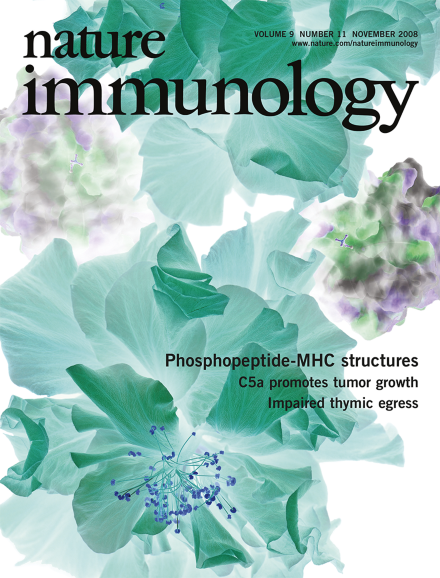
About the coverEditorials
Big money, little science? - p1199
doi:10.1038/ni1108-1199a
Turmoil in the world financial markets has forced big government spending to relieve the crisis—but at what cost?
Full Text - Big money, little science? | PDF (184 KB) - Big money, little science?
Fostering hope and wonder - p1199
doi:10.1038/ni1108-1199b
The Large Hadron Collider exemplifies big, bold science that can bring great breakthroughs and, perhaps equally importantly, inspire the public's sense of purpose and possibility.
Full Text - Fostering hope and wonder | PDF (184 KB) - Fostering hope and wonder
Commentary
The early days of the HIV-AIDS epidemic in the USA - pp1201 - 1203
Harold W Jaffe
doi:10.1038/ni1108-1201
The work of epidemiologists before the isolation of human immunodeficiency virus 25 years ago demonstrates the power of the epidemiological method to gain an understanding of disease pathogenesis.
Full Text - The early days of the HIV-AIDS epidemic in the USA | PDF (333 KB) - The early days of the HIV-AIDS epidemic in the USA
News and Views
Cancer exploiting complement: a clue or an exception? - pp1205 - 1206
Bruce E Loveland & Jonathan Cebon
doi:10.1038/ni1108-1205
Cancer cells are more resistant to complement-mediated lysis and use this attribute to set up a locally immunosuppressive environment. However, new findings suggest that tumor-driven complement activation can also provide the tumor a growth advantage.
Full Text - Cancer exploiting complement: a clue or an exception? | PDF (1,149 KB) - Cancer exploiting complement: a clue or an exception?
See also: Article by Markiewski et al.
Immunodeficiency: when T cells are stuck at home - pp1207 - 1208
Kristin A Hogquist
doi:10.1038/ni1108-1207
A flurry of studies has suggested the importance of the actin regulator coronin 1A in lymphocyte development. Now, mutants of this regulator are shown to cause immunodeficiency in both mice and humans.
Full Text - Immunodeficiency: when T cells are stuck at home | PDF (250 KB) - Immunodeficiency: when T cells are stuck at home
See also: Article by Shiow et al.
Activated pDCs: open to new antigen-presentation possibilities - pp1208 - 1210
Tineke van den Hoorn & Jacques Neefjes
doi:10.1038/ni1108-1208
Major histocompatibility complex class II molecules present peptides to CD4+ T cells. New findings indicate that conventional and plasmacytoid dendritic cells handle these molecules differently after activation.
Full Text - Activated pDCs: open to new antigen-presentation possibilities | PDF (1,563 KB) - Activated pDCs: open to new antigen-presentation possibilities
See also: Article by Young et al.
IFN-
and self-absorbed CD4+ T cells: a regulatory double negative - pp1210 - 1212
David Hildeman & Edith Janssen
doi:10.1038/ni1108-1210
Interferon-
exerts many effects on the immune system. A new report shows that it induces both autophagy and Irgm1, a GTPase that protects activated CD4+ T cells from executing autophagy.
Full Text - IFN-
and self-absorbed CD4+ T cells: a regulatory double negative | PDF (493 KB) - IFN-
and self-absorbed CD4+ T cells: a regulatory double negative
See also: Article by Feng et al.
Research Highlights - p1213
doi:10.1038/ni1108-1213
Full Text - Research Highlights | PDF (116 KB) - Research Highlights
Review
New developments in mast cell biology - pp1215 - 1223
Janet Kalesnikoff & Stephen J Galli
doi:10.1038/ni.f.216
Abstract - | Full Text - New developments in mast cell biology | PDF (1,610 KB) - New developments in mast cell biology
Articles
Modulation of the antitumor immune response by complement - pp1225 - 1235
Maciej M Markiewski, Robert A DeAngelis, Fabian Benencia, Salome K Ricklin-Lichtsteiner, Anna Koutoulaki, Craig Gerard, George Coukos & John D Lambris
doi:10.1038/ni.1655
Tumors often resist immune-mediated destruction because of the presence of suppressor cells. Lambris and colleagues show that activated complement C5a helps mediate this effect by recruiting myeloid suppressor cells to the tumor microenvironment.
Abstract - | Full Text - Modulation of the antitumor immune response by complement | PDF (886 KB) - Modulation of the antitumor immune response by complement | Supplementary information
See also: News and Views by Loveland & Cebon
Phosphorylation-dependent interaction between antigenic peptides and MHC class I: a molecular basis for the presentation of transformed self - pp1236 - 1243
Fiyaz Mohammed, Mark Cobbold, Angela L Zarling, Mahboob Salim, Gregory A Barrett-Wilt, Jeffrey Shabanowitz, Donald F Hunt, Victor H Engelhard & Benjamin E Willcox
doi:10.1038/ni.1660
Activation of intracellular signaling pathways can result in MHC binding to and presentation of phosphorylated peptides. Engelhard and colleagues identify a unique phosphorylated peptide–MHC binding mode that allows solvent exposure of phosphorylated residues.
Abstract - | Full Text - Phosphorylation-dependent interaction between antigenic peptides and MHC class I: a molecular basis for the presentation of transformed self | PDF (897 KB) - Phosphorylation-dependent interaction between antigenic peptides and MHC class I: a molecular basis for the presentation of transformed self | Supplementary information
Differential MHC class II synthesis and ubiquitination confers distinct antigen-presenting properties on conventional and plasmacytoid dendritic cells - pp1244 - 1252
Louise J Young, Nicholas S Wilson, Petra Schnorrer, Anna Proietto, Toine ten Broeke, Yohei Matsuki, Adele M Mount, Gabrielle T Belz, Meredith O'Keeffe, Mari Ohmura-Hoshino, Satoshi Ishido, Willem Stoorvogel, William R Heath, Ken Shortman & Jose A Villadangos
doi:10.1038/ni.1665
The antigen-presenting abilities of plasmacytoid dendritic cells (DCs) are not well characterized. Villadangos and colleagues show that unlike conventional DCs, plasmacytoid DCs continue to synthesize and degrade MHC class II molecules, and thereby present endogenous viral antigen, after activation.
Abstract - | Full Text - Differential MHC class II synthesis and ubiquitination confers distinct antigen-presenting properties on conventional and plasmacytoid dendritic cells | PDF (870 KB) - Differential MHC class II synthesis and ubiquitination confers distinct antigen-presenting properties on conventional and plasmacytoid dendritic cells | Supplementary information
CCR9 expression defines tolerogenic plasmacytoid dendritic cells able to suppress acute graft-versus-host disease - pp1253 - 1260
Husein Hadeiba, Tohru Sato, Aida Habtezion, Cecilia Oderup, Junliang Pan & Eugene C Butcher
doi:10.1038/ni.1658
Plasmacytoid dendritic cells are best known as potent producers of type I interferon. Butcher and colleagues identify a subset of these cells, characterized by CCR9 expression, that can elicit tolerance in the gut.
Abstract - | Full Text - CCR9 expression defines tolerogenic plasmacytoid dendritic cells able to suppress acute graft-versus-host disease | PDF (752 KB) - CCR9 expression defines tolerogenic plasmacytoid dendritic cells able to suppress acute graft-versus-host disease
Triggering the succinate receptor GPR91 on dendritic cells enhances immunity - pp1261 - 1269
Tina Rubic, Günther Lametschwandtner, Sandra Jost, Sonja Hinteregger, Julia Kund, Nicole Carballido-Perrig, Christoph Schwärzler, Tobias Junt, Hans Voshol, Josef G Meingassner, Xiaohong Mao, Gudrun Werner, Antal Rot & José M Carballido
doi:10.1038/ni.1657
Succinate is a Krebs cycle intermediate. Carballido and colleagues show that succinate released by necrotic cells also functions as an 'alarmin' by activating dendritic cells that express the succinate receptor GPR91.
Abstract - | Full Text - Triggering the succinate receptor GPR91 on dendritic cells enhances immunity | PDF (582 KB) - Triggering the succinate receptor GPR91 on dendritic cells enhances immunity | Supplementary information
CEACAM1 inhibits Toll-like receptor 2–triggered antibacterial responses of human pulmonary epithelial cells - pp1270 - 1278
Hortense Slevogt, Solveig Zabel, Bastian Opitz, Andreas Hocke, Julia Eitel, Philippe D N'Guessan, Lothar Lucka, Kristian Riesbeck, Wolfgang Zimmermann, Janine Zweigner, Bettina Temmesfeld-Wollbrueck, Norbert Suttorp & Bernhard B Singer
doi:10.1038/ni.1661
Some bacteria evade immune detection in the human respiratory tract. Slevogt and colleagues show that bacterial stimulation of the ITIM-containing CEACAM1 protein initiates signals that suppress TLR2-induced Akt activation and inflammation.
Abstract - | Full Text - CEACAM1 inhibits Toll-like receptor 2–triggered antibacterial responses of human pulmonary epithelial cells | PDF (599 KB) - CEACAM1 inhibits Toll-like receptor 2–triggered antibacterial responses of human pulmonary epithelial cells | Supplementary information
The immunity-related GTPase Irgm1 promotes the expansion of activated CD4+ T cell populations by preventing interferon-
-induced cell death - pp1279 - 1287
Carl G Feng, Lixin Zheng, Dragana Jankovic, André Báfica, Jennifer L Cannons, Wendy T Watford, Damien Chaussabel, Sara Hieny, Patricia Caspar, Pamela L Schwartzberg, Michael J Lenardo & Alan Sher
doi:10.1038/ni.1653
Interferon-
(IFN-
) is toxic to cells, yet IFN-
-producing cells survive. Feng and colleagues show that expression of the GTPase Irgm1 in these cells confers protection against IFN-
toxicity.
Abstract - | Full Text - The immunity-related GTPase Irgm1 promotes the expansion of activated CD4+ T cell populations by preventing interferon-
-induced cell death | PDF (863 KB) - The immunity-related GTPase Irgm1 promotes the expansion of activated CD4+ T cell populations by preventing interferon-
-induced cell death | Supplementary information
See also: News and Views by Hildeman & Janssen
Priming for T helper type 2 differentiation by interleukin 2–mediated induction of interleukin 4 receptor
-chain expression - pp1288 - 1296
Wei Liao, Dustin E Schones, Jangsuk Oh, Yongzhi Cui, Kairong Cui, Tae-Young Roh, Keji Zhao & Warren J Leonard
doi:10.1038/ni.1656
Interleukin 4 (IL-4) drives T helper type 2 differentiation, whereas IL-2 augments Il4 chromatin accessibility. Leonard and colleagues now find that IL-2 also maintains the expression of Il4ra and other genes in T helper type 2–committed cells.
Abstract - | Full Text - Priming for T helper type 2 differentiation by interleukin 2–mediated induction of interleukin 4 receptor
-chain expression | PDF (950 KB) - Priming for T helper type 2 differentiation by interleukin 2–mediated induction of interleukin 4 receptor
-chain expression | Supplementary information
Interactions among the transcription factors Runx1, ROR
t and Foxp3 regulate the differentiation of interleukin 17–producing T cells - pp1297 - 1306
Fuping Zhang, Guangxun Meng & Warren Strober
doi:10.1038/ni.1663
The transcriptional regulation of Il17 expression is not well understood. Strober and colleagues identify conserved noncoding sequences that, by a mechanism dependent on differential binding of Runx1 to ROR
t and Foxp3, regulate Il17 expression.
Abstract - | Full Text - Interactions among the transcription factors Runx1, ROR
t and Foxp3 regulate the differentiation of interleukin 17–producing T cells | PDF (930 KB) - Interactions among the transcription factors Runx1, ROR
t and Foxp3 regulate the differentiation of interleukin 17–producing T cells | Supplementary information
The actin regulator coronin 1A is mutant in a thymic egress–deficient mouse strain and in a patient with severe combined immunodeficiency - pp1307 - 1315
Lawrence R Shiow, David W Roadcap, Kenneth Paris, Susan R Watson, Irina L Grigorova, Tonya Lebet, Jinping An, Ying Xu, Craig N Jenne, Niko Föger, Ricardo U Sorensen, Christopher C Goodnow, James E Bear, Jennifer M Puck & Jason G Cyster
doi:10.1038/ni.1662
Defective thymic egress in mice is associated with the peripheral T cell deficiency (Ptcd) locus. Cyster and colleagues find that the actin regulator coronin 1A is mutant in Ptcd and in an atypical patient with SCID.
Abstract - | Full Text - The actin regulator coronin 1A is mutant in a thymic egress–deficient mouse strain and in a patient with severe combined immunodeficiency | PDF (1,192 KB) - The actin regulator coronin 1A is mutant in a thymic egress–deficient mouse strain and in a patient with severe combined immunodeficiency | Supplementary information
See also: News and Views by Hogquist