Table of contents
November 2008, Volume 1 No 11 pp719-802
About the coverEditorial
Half-hearted engineering - p719
doi:10.1038/ngeo354
Climate warming is not the only consequence of rising levels of atmospheric greenhouse gases. The only way to counter all effects, including those on rainfall and ocean acidity, is to remove carbon from the climate system.
Full Text - Half-hearted engineering | PDF (149 KB) - Half-hearted engineering
See also: Commentary by Boyd
Commentaries
Rare metals getting rarer - pp720 - 721
Kristín Vala Ragnarsdóttir
doi:10.1038/ngeo302
Abstract - Rare metals getting rarer | Full Text - Rare metals getting rarer | PDF (158 KB) - Rare metals getting rarer
Ranking geo-engineering schemes - pp722 - 724
Philip W. Boyd
doi:10.1038/ngeo348
Geo-engineering proposals for mitigating climate change continue to proliferate without being tested. It is time to select and assess the most promising ideas according to efficacy, cost, all aspects of risk and, importantly, their rate of mitigation.
Full Text - Ranking geo-engineering schemes | PDF (152 KB) - Ranking geo-engineering schemes
Books and Arts
Ten thousand years of climate change - p725
Natural Climate Variability and Global Warming: A Holocene Perspective by Richard W. Battarbee & Heather A. Binney
doi:10.1038/ngeo342
Full Text - Ten thousand years of climate change | PDF (111 KB) - Ten thousand years of climate change
Research Highlights
Research highlights - p726
doi:10.1038/ngeo353
Full Text - Research highlights | PDF (156 KB) - Research highlights
News and Views
Carbon Cycle: Tempestuous transport - pp727 - 728
Timothy I. Eglinton
doi:10.1038/ngeo349
Riverine transport of terrestrial organic carbon to the oceans exerts an important long-term control on atmospheric carbon dioxide levels. Tropical cyclones participate in this process by delivering recently fixed carbon to the sea.
Full Text - Carbon CycleTempestuous transport | PDF (240 KB) - Carbon CycleTempestuous transport
Subject Categories: Biogeochemistry | Climate science
Climate science: Global warming at the poles - pp728 - 729
Andrew Monaghan & David Bromwich
doi:10.1038/ngeo346
Natural climate variability and limited observational records have made identifying human-influenced climate change at the poles difficult. But a human signature is now emerging in rising Arctic and Antarctic temperatures.
Full Text - Climate scienceGlobal warming at the poles | PDF (215 KB) - Climate scienceGlobal warming at the poles
Subject Category: Climate science
Climate Science: The other greenhouse effect - p729
Anna Armstrong
doi:10.1038/ngeo350
Full Text - Climate ScienceThe other greenhouse effect | PDF (338 KB) - Climate ScienceThe other greenhouse effect
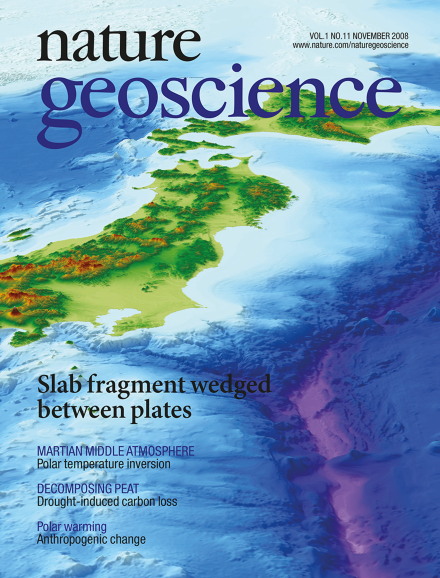
Seismology: Breaking the slab - pp730 - 731
Meghan S. Miller
doi:10.1038/ngeo341
Two chains of seamounts on the Pacific plate subduct beneath central Japan. In the process, a fragment of the Pacific slab has become wedged in the subduction zone and may be the source of recurring deep-thrust earthquakes beneath Tokyo.
Full Text - SeismologyBreaking the slab | PDF (220 KB) - SeismologyBreaking the slab
Subject Category: Seismology
Natural Disaster: Flood of evidence - p731
Alicia Newton
doi:10.1038/ngeo347
Full Text - Natural DisasterFlood of evidence | PDF (129 KB) - Natural DisasterFlood of evidence
Geomorphology: A glacial driver of tectonics - pp732 - 733
Simon H. Brocklehurst
doi:10.1038/ngeo344
The interactions between climate and tectonics in active mountain ranges are complex and important. Field and geophysical data from the St Elias Range of Alaska show that glacial erosion can influence the dynamics of the lithosphere in such settings.
Full Text - GeomorphologyA glacial driver of tectonics | PDF (272 KB) - GeomorphologyA glacial driver of tectonics
Subject Category: Geomorphology
Review
The equilibrium sensitivity of the Earth's temperature to radiation changes - pp735 - 743
Reto Knutti & Gabriele C. Hegerl
doi:10.1038/ngeo337
The quest to determine climate sensitivity has been going on for decades, with disturbingly little progress in narrowing the large uncertainty range. But fascinating new insights have been gained that will provide useful information for policy makers, even though the upper limit of climate sensitivity will probably remain uncertain for the near future.
Abstract - The equilibrium sensitivity of the Earth's temperature to radiation changes | Full Text - The equilibrium sensitivity of the Earth's temperature to radiation changes | PDF (554 KB) - The equilibrium sensitivity of the Earth's temperature to radiation changes
Subject Category: Climate science
Letters
Intense polar temperature inversion in the middle atmosphere on Mars - pp745 - 749
D. J. McCleese, J. T. Schofield, F. W. Taylor, W. A. Abdou, O. Aharonson, D. Banfield, S. B. Calcutt, N. G. Heavens, P. G. J. Irwin, D. M. Kass, A. Kleinböhl, W. G. Lawson, C. B. Leovy, S. R. Lewis, D. A. Paige, P. L. Read, M. I. Richardson, N. Teanby & R. W. Zurek
doi:10.1038/ngeo332
Current understanding of weather, climate and global atmospheric circulation on Mars is incomplete, in particular at altitudes above about 30 km. High-resolution observations from the Mars Climate Sounder instrument on the Mars Reconnaissance Orbiter show an intense warming of the middle atmosphere over the south polar region in winter, which suggests a much more vigorous equator-to-pole circulation than expected.
First Paragraph - Intense polar temperature inversion in the middle atmosphere on Mars | Full Text - Intense polar temperature inversion in the middle atmosphere on Mars | PDF (534 KB) - Intense polar temperature inversion in the middle atmosphere on Mars
Subject Category: Planetary science
Attribution of polar warming to human influence - pp750 - 754
Nathan P. Gillett, Dáithí A. Stone, Peter A. Stott, Toru Nozawa, Alexey Yu. Karpechko, Gabriele C. Hegerl, Michael F. Wehner & Philip D. Jones
doi:10.1038/ngeo338
Polar temperatures have been warming significantly over the past few decades. A comparison between observational temperature records and model simulations shows that temperature changes in both the Arctic and Antarctic regions can be attributed to human activity.
First Paragraph - Attribution of polar warming to human influence | Full Text - Attribution of polar warming to human influence | PDF (515 KB) - Attribution of polar warming to human influence | Supplementary information
Subject Category: Climate science
See also: News and Views by Monaghan & Bromwich
Strong transport and mixing of deep water through the Southwest Indian Ridge - pp755 - 758
J. A. MacKinnon, T. M. S. Johnston & R. Pinkel
doi:10.1038/ngeo340
Understanding heat exchange in the Indian Ocean requires knowledge of the magnitudes and locations of both meridional deep-water transport and mixing. Observations from a fracture zone in the Southwest Indian Ridge quantify the flow through this narrow region to 20–30% of the total meridional overturning circulation in the Indian Ocean, and provide an example of elevated turbulence in a deep sheared flow.
First Paragraph - Strong transport and mixing of deep water through the Southwest Indian Ridge | Full Text - Strong transport and mixing of deep water through the Southwest Indian Ridge | PDF (858 KB) - Strong transport and mixing of deep water through the Southwest Indian Ridge
Subject Categories: Oceanography | Climate science
Tropical-cyclone-driven erosion of the terrestrial biosphere from mountains - pp759 - 762
Robert G. Hilton, Albert Galy, Niels Hovius, Meng-Chiang Chen, Ming-Jame Horng & Hongey Chen
doi:10.1038/ngeo333
The transfer of organic carbon from the terrestrial biosphere to the oceans via erosion and riverine transport constitutes an important component of the global carbon cycle. Measurements of particulate organic carbon load and composition in the LiWu river, Taiwan, during cyclone-triggered floods suggest that tropical cyclones may facilitate the delivery of non-fossil particulate organic carbon to the ocean and its subsequent burial.
First Paragraph - Tropical-cyclone-driven erosion of the terrestrial biosphere from mountains | Full Text - Tropical-cyclone-driven erosion of the terrestrial biosphere from mountains | PDF (299 KB) - Tropical-cyclone-driven erosion of the terrestrial biosphere from mountains | Supplementary information
Subject Categories: Biogeochemistry | Climate science | Hydrology, hydrogeology and limnology
See also: News and Views by Eglinton
High sensitivity of peat decomposition to climate change through water-table feedback - pp763 - 766
Takeshi Ise, Allison L. Dunn, Steven C. Wofsy & Paul R. Moorcroft
doi:10.1038/ngeo331
The water table interacts with soil organic carbon in northern peatlands that have historically functioned as a carbon sink. Simulations with a coupled physical–biogeochemical soil model with continuously updated peat depths show that the feedback between the water table and peat depth increases the sensitivity of peat decomposition to temperature, and intensifies the loss of soil organic carbon in a changing climate.
First Paragraph - High sensitivity of peat decomposition to climate change through water-table feedback | Full Text - High sensitivity of peat decomposition to climate change through water-table feedback | PDF (279 KB) - High sensitivity of peat decomposition to climate change through water-table feedback | Supplementary information
Subject Categories: Biogeochemistry | Climate science | Hydrology, hydrogeology and limnology
Negative impact of nitrogen deposition on soil buffering capacity - pp767 - 770
William D. Bowman,
Cory C. Cleveland,
ubo
Halada,
Juraj Hre
ko
&
Jill S. Baron
doi:10.1038/ngeo339
Sustained nitrogen deposition has had a detrimental effect on ecosystems in Europe and North America. Now a grassland in Slovakia is showing symptoms of extreme soil acidification not previously observed in association with nitrogen deposition.
First Paragraph - Negative impact of nitrogen deposition on soil buffering capacity | Full Text - Negative impact of nitrogen deposition on soil buffering capacity | PDF (276 KB) - Negative impact of nitrogen deposition on soil buffering capacity
Subject Categories: Ecology | Biogeochemistry
See also: related Backstory
A slab fragment wedged under Tokyo and its tectonic and seismic implications - pp771 - 776
Shinji Toda, Ross S. Stein, Stephen H. Kirby & Serkan B. Bozkurt
doi:10.1038/ngeo318
A three-dimensional evaluation of earthquake hypocentres beneath the Kanto basin in Japan reveals the presence of a distinct, 25-km-thick and 100-km-wide body. Its fast seismic velocity and the presence of a double seismic zone suggest that it is a fragment of the Pacific slab, rather than an extension of the Philippine Sea slab. This implies that the penetration of the Philippine Sea slab is much shallower beneath the Kanto basin than was previously thought.
First Paragraph - A slab fragment wedged under Tokyo and its tectonic and seismic implications | Full Text - A slab fragment wedged under Tokyo and its tectonic and seismic implications | PDF (4,601 KB) - A slab fragment wedged under Tokyo and its tectonic and seismic implications | Supplementary information
Subject Categories: Seismology | Structural geology, tectonics and geodynamics
See also: News and Views by Miller
Seismic evidence for broken oceanic crust in the 2004 Sumatra earthquake epicentral region - pp777 - 781
Satish C. Singh, Hélène Carton, Paul Tapponnier, Nugroho D. Hananto, Ajay P. S. Chauhan, Djoko Hartoyo, Martin Bayly, Soelistijani Moeljopranoto, Tim Bunting, Phil Christie, Hasbi Lubis & James Martin
doi:10.1038/ngeo336
The 2004 Sumatra earthquake was one of the largest events to occur in a subduction zone in the past 50 years. Seismic reflection data for this subduction zone reveal thrust faults cutting across the entire oceanic crust. This observation, coupled with the hypocentres of aftershocks, suggests that the megathrust—the interface between the Indo-Australian plate and the Sunda plate—currently lies in the oceanic mantle.
First Paragraph - Seismic evidence for broken oceanic crust in the 2004 Sumatra earthquake epicentral region | Full Text - Seismic evidence for broken oceanic crust in the 2004 Sumatra earthquake epicentral region | PDF (4,407 KB) - Seismic evidence for broken oceanic crust in the 2004 Sumatra earthquake epicentral region | Supplementary information
Subject Categories: Seismology | Structural geology, tectonics and geodynamics
Putative greigite magnetofossils from the Pliocene epoch - pp782 - 786
Iuliana Vasiliev, Christine Franke, Johannes D. Meeldijk, Mark J. Dekkers, Cor G. Langereis & Wout Krijgsman
doi:10.1038/ngeo335
Greigite crystals of bacterial origin are widespread in modern sedimentary environments, but their occurrence in the fossil record remains controversial. Grains from Romanian Pliocene-aged sediments have now been identified as bacterial in origin, tentatively placing them among the oldest known greigite magnetofossils.
First Paragraph - Putative greigite magnetofossils from the Pliocene epoch | Full Text - Putative greigite magnetofossils from the Pliocene epoch | PDF (886 KB) - Putative greigite magnetofossils from the Pliocene epoch | Supplementary information
Subject Categories: Biogeochemistry | Geomagnetism, palaeomagnetism and core processes
Articles
Antarctic temperature at orbital timescales controlled by local summer duration - pp787 - 792
Peter Huybers & George Denton
doi:10.1038/ngeo311
On orbital timescales, Antarctic climate varies in phase with Northern Hemisphere insolation, but no physical mechanism for such a link is known. A new analysis suggests that at obliquity and precession timescales Antarctic climate may instead be responding to the duration of the local summer, which covaries with Northern insolation.
Abstract - Antarctic temperature at orbital timescales controlled by local summer duration | Full Text - Antarctic temperature at orbital timescales controlled by local summer duration | PDF (522 KB) - Antarctic temperature at orbital timescales controlled by local summer duration | Supplementary information
Subject Category: Palaeoclimate and palaeoceanography
Quaternary tectonic response to intensified glacial erosion in an orogenic wedge - pp793 - 799
Aaron L. Berger, Sean P. S. Gulick, James A. Spotila, Phaedra Upton, John M. Jaeger, James B. Chapman, Lindsay A. Worthington, Terry L. Pavlis, Kenneth D. Ridgway, Bryce A. Willems & Ryan J. McAleer
doi:10.1038/ngeo334
Intense glaciation during the middle Pleistocene epoch led to focused denudation and mass redistribution within the St Elias orogen in southern Alaska, and resulted in structural reorganization of the orogen. The tectonic response of this orogen to climate change is consistent with predictions of numerical models.
Abstract - Quaternary tectonic response to intensified glacial erosion in an orogenic wedge | Full Text - Quaternary tectonic response to intensified glacial erosion in an orogenic wedge | PDF (1,865 KB) - Quaternary tectonic response to intensified glacial erosion in an orogenic wedge | Supplementary information
Subject Categories: Geomorphology | Palaeoclimate and palaeoceanography | Structural geology, tectonics and geodynamics
See also: News and Views by Brocklehurst | related Backstory
Backstory
Flying high - p802
doi:10.1038/ngeo343
Aaron Berger and colleagues leapt out of helicopters in the snow and fog in their quest to understand the effects of glacial erosion on mountain formation.
Searching the soils - pE18
doi:10.1038/ngeo345
William Bowman and colleagues braved beverages of pig fat and vodka in their attempt to understand the impact of long-term nitrogen deposition on Slovakian soils.
Full Text - Searching the soils | PDF (265 KB) - Searching the soils