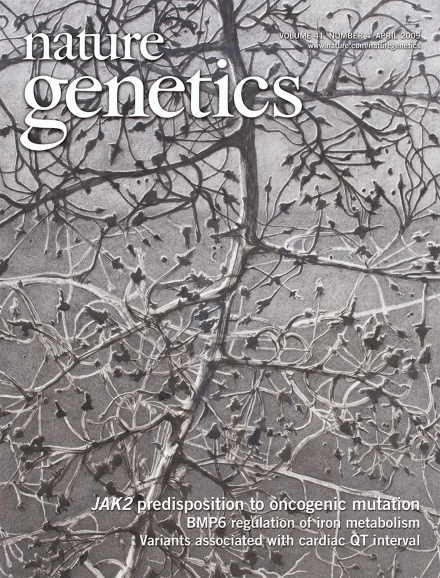
Table of contents


Top

Editorial

Metadata for the metaconsortium p383

doi:10.1038/ng0409-383

Authors frequently ask the journal to help them get properly listed in PubMed, which we do. However, representing detailed international contributor attribution is no job for a national public library's index.


Top

News and Views

Somatic and germline genetics at the JAK2 locus pp385 - 386

Peter J Campbell

doi:10.1038/ng0409-385

Myeloproliferative neoplasms are hematological malignancies frequently associated with somatically acquired mutation of the JAK2 gene. A new study shows that these mutations are preferentially found within a particular inherited JAK2 haplotype, implying the existence of a strong, but uncharacterized, interaction between somatic and germline genetics at this locus.

See also: Letter by Jones et al. | Letter by Olcaydu et al. | Letter by Kilpivaara et al.


BMP6 orchestrates iron metabolism pp386 - 388

Clara Camaschella

doi:10.1038/ng0409-386

The small liver peptide hepcidin is a major regulator of systemic iron homeostasis in mammals, adapting iron absorption to the body's demands. Two new studies now identify BMP6 as the key endogenous regulator of hepcidin.

See also: Letter by Meynard et al. | Letter by Andriopoulos Jr et al.


Genetics of cardiac repolarization pp388 - 389

Svati H Shah & Geoffrey S Pitt

doi:10.1038/ng0409-388

Prolongation of the electrocardiographic QT interval, a measure of cardiac repolarization, is associated with arrhythmogenic disorders and is a risk factor for sudden cardiac death. Two genome-wide association studies (GWAS) of variation in the QT interval in population-based cohorts now report association with variants in a subset of ion channel genes and other new associations.

See also: Article by Newton-Cheh et al. | Article by Pfeufer et al.


Top

Research Highlights

Research Highlights p390

doi:10.1038/ng0409-390


Top

Brief Communications

Human mutation rate associated with DNA replication timing pp393 - 395

John A Stamatoyannopoulos, Ivan Adzhubei, Robert E Thurman, Gregory V Kryukov, Sergei M Mirkin & Shamil R Sunyaev

doi:10.1038/ng.363

John Stamatoyannopoulos, Shamil Sunyaev and colleagues report a correlation between mutation rate and replication timing in the human genome, observing an increased mutation rate in later-replicating regions.


ccbe1 is required for embryonic lymphangiogenesis and venous sprouting pp396 - 398

Benjamin M Hogan, Frank L Bos, Jeroen Bussmann, Merlijn Witte, Neil C Chi, Henricus J Duckers & Stefan Schulte-Merker

doi:10.1038/ng.321

Stefan Schulte-Merker and colleagues report that ccbe1, a predicted secreted protein, is required for embryonic lymphangiogenesis in zebrafish. Ccbe1 acts at the same stage as Vegfc, and is required for lymphangioblast budding and angiogenic sprouting from the venous endothelium.


Top

Articles

Common variants at ten loci influence QT interval duration in the QTGEN Study pp399 - 406

Christopher Newton-Cheh, Mark Eijgelsheim, Kenneth M Rice, Paul I W de Bakker, Xiaoyan Yin, Karol Estrada, Joshua C Bis, Kristin Marciante, Fernando Rivadeneira, Peter A Noseworthy, Nona Sotoodehnia, Nicholas L Smith, Jerome I Rotter, Jan A Kors, Jacqueline C M Witteman, Albert Hofman, Susan R Heckbert, Christopher J O'Donnell, André G Uitterlinden, Bruce M Psaty, Thomas Lumley, Martin G Larson & Bruno H Ch Stricker

doi:10.1038/ng.364

Christopher Newton-Cheh and colleagues from the QTGEN consortium report genetic associations to the QT interval duration, a measure of cardiac repolarization which is a risk factor for sudden cardiac death, in three genome-wide association studies from the Framingham Heart Study, the Rotterdam Study and the Cardiovascular Health Study.

See also: News and Views by Shah & Pitt | Article by Pfeufer et al.


Common variants at ten loci modulate the QT interval duration in the QTSCD Study pp407 - 414

Arne Pfeufer, Serena Sanna, Dan E Arking, Martina Müller, Vesela Gateva, Christian Fuchsberger, Georg B Ehret, Marco Orrú, Cristian Pattaro, Anna Köttgen, Siegfried Perz, Gianluca Usala, Maja Barbalic, Man Li, Benno Pütz, Angelo Scuteri, Ronald J Prineas, Moritz F Sinner, Christian Gieger, Samer S Najjar, W H Linda Kao, Thomas W. Mühleisen, Mariano Dei, Christine Happle, Stefan Möhlenkamp, Laura Crisponi, Raimund Erbel, Karl-Heinz Jöckel, Silvia Naitza, Gerhard Steinbeck, Fabio Marroni, Andrew A Hicks, Edward Lakatta, Bertram Müller-Myhsok, Peter P Pramstaller, H-Erich Wichmann, David Schlessinger, Eric Boerwinkle, Thomas Meitinger, Manuela Uda, Josef Coresh, Stefan Kääb, Gonçalo R Abecasis & Aravinda Chakravarti

doi:10.1038/ng.362

Arne Pfeufer, Aravinda Chakravarti and colleagues from the QTSCD consortium report genetic associations influencing the QT interval duration, a measure of cardiac repolarization which is a risk factor for sudden cardiac death, in five genome-wide association studies.

See also: News and Views by Shah & Pitt | Article by Newton-Cheh et al.


Validation of candidate causal genes for obesity that affect shared metabolic pathways and networks pp415 - 423

Xia Yang, Joshua L Deignan, Hongxiu Qi, Jun Zhu, Su Qian, Judy Zhong, Gevork Torosyan, Sana Majid, Brie Falkard, Robert R Kleinhanz, Jenny Karlsson, Lawrence W Castellani, Sheena Mumick, Kai Wang, Tao Xie, Michael Coon, Chunsheng Zhang, Daria Estrada-Smith, Charles R Farber, Susanna S Wang, Atila van Nas, Anatole Ghazalpour, Bin Zhang, Douglas J MacNeil, John R Lamb, Katrina M Dipple, Marc L Reitman, Margarete Mehrabian, Pek Y Lum, Eric E Schadt, Aldons J Lusis & Thomas A Drake

doi:10.1038/ng.325

Thomas Drake and colleagues report the results of knockout or transgene introduction for nine obesity candidate genes in mice. Eight of the nine mutations result in significant changes in obesity-related traits, validating their previously developed approach for identifying candidate genes involved in particular phenotypes. They further identify related metabolic pathways that are altered by manipulation of the eight genes.


Segmental copy number variation shapes tissue transcriptomes pp424 - 429

Charlotte N Henrichsen, Nicolas Vinckenbosch, Sebastian Zöllner, Evelyne Chaignat, Sylvain Pradervand, Frédéric Schütz, Manuel Ruedi, Henrik Kaessmann & Alexandre Reymond

doi:10.1038/ng.345

Alexandre Reymond, Henrik Kaessman and colleagues report a high-resolution survey of copy number variation in mice and assess the impact of such variation on gene expression across multiple tissues and strains. They conclude that CNVs substantially influence global transcription, including long-range cis effects extending up to several hundred kilobases.


The impact of copy number variation on local gene expression in mouse hematopoietic stem and progenitor cells pp430 - 437

Patrick Cahan, Yedda Li, Masayo Izumi & Timothy A Graubert

doi:10.1038/ng.350

Timothy Graubert and colleagues report a high-resolution survey of copy number variation in mouse inbred strains and assess the impact of such variation on gene expression. They find that up to 26% of strain-dependent expression variation in hematopoietic stem/progenitor cells is associated with copy number variation.


Gene expression divergence in yeast is coupled to evolution of DNA-encoded nucleosome organization pp438 - 445

Yair Field, Yvonne Fondufe-Mittendorf, Irene K Moore, Piotr Mieczkowski, Noam Kaplan, Yaniv Lubling, Jason D Lieb, Jonathan Widom & Eran Segal

doi:10.1038/ng.324

Eran Segal and colleagues report that promoters driving expression of cellular respiration genes in aerobic yeast species encode relatively open chromatin, whereas promoters associated with the same genes in anaerobic yeast species encode relatively closed chromatin. These results suggest that phenotypic diversity may in part be influenced by changes in the DNA-encoded nucleosome organization of promoters.


Top

Letters

JAK2 haplotype is a major risk factor for the development of myeloproliferative neoplasms pp446 - 449

Amy V Jones, Andrew Chase, Richard T Silver, David Oscier, Katerina Zoi, Y Lynn Wang, Holger Cario, Heike L Pahl, Andrew Collins, Andreas Reiter, Francis Grand & Nicholas C P Cross

doi:10.1038/ng.334

Nick Cross and colleagues report that the JAK2V617F somatic mutation that drives the development of chronic myeloproliferative neoplasms is associated with the presence of a specific inherited haplotype in JAK2.

See also: News and Views by Campbell | Letter by Olcaydu et al. | Letter by Kilpivaara et al.


A common JAK2 haplotype confers susceptibility to myeloproliferative neoplasms pp450 - 454

Damla Olcaydu, Ashot Harutyunyan, Roland Jäger, Tiina Berg, Bettina Gisslinger, Ingrid Pabinger, Heinz Gisslinger & Robert Kralovics

doi:10.1038/ng.341

Robert Kralovics and colleagues report that the JAK2V617F somatic mutation that drives the development of chronic myeloproliferative neoplasms is associated with the presence of a specific inherited haplotype in JAK2.

See also: News and Views by Campbell | Letter by Jones et al. | Letter by Kilpivaara et al.


A germline JAK2 SNP is associated with predisposition to the development of JAK2V617F-positive myeloproliferative neoplasms pp455 - 459

Outi Kilpivaara, Semanti Mukherjee, Alison M Schram, Martha Wadleigh, Ann Mullally, Benjamin L Ebert, Adam Bass, Sachie Marubayashi, Adriana Heguy, Guillermo Garcia-Manero, Hagop Kantarjian, Kenneth Offit, Richard M Stone, D Gary Gilliland, Robert J Klein & Ross L Levine

doi:10.1038/ng.342

Ross Levine and colleagues report that the JAK2V617F somatic mutation that drives the development of chronic myeloproliferative neoplasms is associated with the presence of a specific inherited SNP in JAK2.

See also: News and Views by Campbell | Letter by Jones et al. | Letter by Olcaydu et al.


Common variants on 9q22.33 and 14q13.3 predispose to thyroid cancer in European populations pp460 - 464

Julius Gudmundsson, Patrick Sulem, Daniel F Gudbjartsson, Jon G Jonasson, Asgeir Sigurdsson, Jon T Bergthorsson, Huiling He, Thorarinn Blondal, Frank Geller, Margret Jakobsdottir, Droplaug N Magnusdottir, Sigurborg Matthiasdottir, Simon N Stacey, Oskar B Skarphedinsson, Hafdis Helgadottir, Wei Li, Rebecca Nagy, Esperanza Aguillo, Eduardo Faure, Enrique Prats, Berta Saez, Mariano Martinez, Gudmundur I Eyjolfsson, Unnur S Bjornsdottir, Hilma Holm, Kristleifur Kristjansson, Michael L Frigge, Hoskuldur Kristvinsson, Jeffrey R Gulcher, Thorvaldur Jonsson, Thorunn Rafnar, Hannes Hjartarsson, Jose I Mayordomo, Albert de la Chapelle, Jon Hrafnkelsson, Unnur Thorsteinsdottir, Augustine Kong & Kari Stefansson

doi:10.1038/ng.339

Julius Gudmundsson and colleagues report the association of two SNPs on chromosomes 9 and 14 with thyroid cancer in European populations. The variants are near FOXE1 and NKX2-1, both good biological candidates, and individuals who are homozygous for both risk variants have a 5.7-fold greater risk of thyroid cancer.


Multiple recurrent genetic events converge on control of histone lysine methylation in medulloblastoma pp465 - 472

Paul A Northcott, Yukiko Nakahara, Xiaochong Wu, Lars Feuk, David W Ellison, Sid Croul, Stephen Mack, Paul N Kongkham, John Peacock, Adrian Dubuc, Young-Shin Ra, Karen Zilberberg, Jessica Mcleod, Stephen W Scherer, J Sunil Rao, Charles G Eberhart, Wiesia Grajkowska, Yancey Gillespie, Boleslaw Lach, Richard Grundy, Ian F Pollack, Ronald L Hamilton, Timothy Van Meter, Carlos G Carlotti, Frederick Boop, Darrell Bigner, Richard J Gilbertson, James T Rutka & Michael D Taylor

doi:10.1038/ng.336

Michael Taylor and colleagues identify copy number aberrations of genes with critical roles in writing, reading, removing and blocking the state of histone lysine methylation, indicating that defective control of the histone code contributes to the pathogenesis of medulloblastoma.


Key susceptibility locus for nonsyndromic cleft lip with or without cleft palate on chromosome 8q24 pp473 - 477

Stefanie Birnbaum, Kerstin U Ludwig, Heiko Reutter, Stefan Herms, Michael Steffens, Michele Rubini, Carlotta Baluardo, Melissa Ferrian, Nilma Almeida de Assis, Margrieta A Alblas, Sandra Barth, Jan Freudenberg, Carola Lauster, Gül Schmidt, Martin Scheer, Bert Braumann, Stefaan J Bergé, Rudolf H Reich, Franziska Schiefke, Alexander Hemprich, Simone Pötzsch, Regine P Steegers-Theunissen, Bernd Pötzsch, Susanne Moebus, Bernhard Horsthemke, Franz-Josef Kramer, Thomas F Wienker, Peter A Mossey, Peter Propping, Sven Cichon, Per Hoffmann, Michael Knapp, Markus M Nöthen & Elisabeth Mangold

doi:10.1038/ng.333

Elisabeth Mangold and colleagues carried out a genome-wide association study for nonsyndromic cleft lip with or without cleft palate, and report a locus on 8q24.21 that is strongly associated with this phenotype.


Lack of the bone morphogenetic protein BMP6 induces massive iron overload pp478 - 481

Delphine Meynard, Léon Kautz, Valérie Darnaud, François Canonne-Hergaux, Hélène Coppin & Marie-Paule Roth

doi:10.1038/ng.320

Marie-Paule Roth and colleagues report that targeted disruption of Bmp6 in mice leads to a rapid and massive accumulation of iron in several tissues, showing that it is critical for iron homeostasis.

See also: News and Views by Camaschella | Letter by Andriopoulos Jr et al.


BMP6 is a key endogenous regulator of hepcidin expression and iron metabolism pp482 - 487

Billy Andriopoulos Jr, Elena Corradini, Yin Xia, Sarah A Faasse, Shanzhuo Chen, Lovorka Grgurevic, Mitchell D Knutson, Antonello Pietrangelo, Slobodan Vukicevic, Herbert Y Lin & Jodie L Babitt

doi:10.1038/ng.335

Jodie Babitt and colleagues report that Bmp6-null mice have a phenotype that resembles hereditary hemochromatosis, with increased serum iron concentration and tissue iron overload. Administration of Bmp6 increases hepcidin expression and reduces serum iron, suggesting that Bmp6 is a key endogenous regulator or iron metabolism in vivo

See also: News and Views by Camaschella | Letter by Meynard et al.


Many X-linked microRNAs escape meiotic sex chromosome inactivation pp488 - 493

Rui Song, Seungil Ro, Jason D Michaels, Chanjae Park, John R McCarrey & Wei Yan

doi:10.1038/ng.338

Wei Yan and colleagues report that many X-linked microRNAs escape meiotic sex chromosome inactivation (MSCI) during spermatogenesis. The authors speculate that such miRNAs may contribute to the process of MSCI or may regulate autosomal mRNAs during the latter stages of meiosis.


Natural variation at the DEP1 locus enhances grain yield in rice pp494 - 497

Xianzhong Huang, Qian Qian, Zhengbin Liu, Hongying Sun, Shuyuan He, Da Luo, Guangmin Xia, Chengcai Chu, Jiayang Li & Xiangdong Fu

doi:10.1038/ng.352

Xiangdong Fu and colleagues report characterization of a major rice grain yield QTL at the DEP1 locus.


Intrinsic variability of gene expression encoded in nucleosome positioning sequences pp498 - 503

Jung Kyoon Choi & Young-Joon Kim

doi:10.1038/ng.319

Jung Kyoon Choi and Young-Joon Kim analyze published genome-wide datasets and show that a nucleosome is commonly positioned at a critical gene regulatory region flanking promoters that respond variably to external signals. The preference for nucleosome binding at this position is encoded by the DNA sequence itself.


Top

Corrigenda

Corrigendum: Genome-wide association study identifies ANXA11 as a new susceptibility locus for sarcoidosis p504

Sylvia Hofmann, Andre Franke, Annegret Fischer, Gunnar Jacobs, Michael Nothnagel, Karoline I Gaede, Manfred Schürmann, Joachim Müller-Quernheim, Michael Krawczak, Philip Rosenstiel & Stefan Schreiber

doi:10.1038/ng0409-504a


Corrigendum: Variant in the sequence of the LINGO1 gene confers risk of essential tremor p504

Hreinn Stefansson, Stacy Steinberg, Hjorvar Petursson, Omar Gustafsson, Iris H Gudjonsdottir, Gudrun A Jonsdottir, Stefan T Palsson, Thorlakur Jonsson, Jona Saemundsdottir, Gyda Bjornsdottir, Yvonne Böttcher, Theodora Thorlacius, Dietrich Haubenberger, Alexander Zimprich, Eduard Auff, Christoph Hotzy, Claudia M Testa, Lisa A Miyatake, Ami R Rosen, Kristleifur Kristleifsson, David Rye, Friedrich Asmus, Ludger Schöls, Martin Dichgans, Finnbogi Jakobsson, John Benedikz, Unnur Thorsteinsdottir, Jeffrey Gulcher, Augustine Kong & Kari Stefansson

doi:10.1038/ng0409-504b


Top

Extra navigation

Subscribe to Nature Genetics

Subscribe

Open Innovation Challenges

naturejobs

ADVERTISEMENT