In this issue - pv
doi:10.1038/nchembio0309-v
Providers and users of chemical libraries must adopt quality and reporting standards to advance the impact of small-molecule high-throughput screening.
Full Text - Screening we can believe in | PDF (124 KB) - Screening we can believe in
Kristen M Garner, Alexandre A Pletnev & Alan Eastman
doi:10.1038/nchembio0309-129
Full Text - Corrected structure of mirin, a small-molecule inhibitor of the Mre11–Rad50–Nbs1 complex | PDF (312 KB) - Corrected structure of mirin, a small-molecule inhibitor of the Mre11–Rad50–Nbs1 complex | Supplementary information
Shaun Peterson, Lily Wang, Kirsten Robertson, Geralda Torchon, Ouathek Ouerfelli & Jean Gautier
doi:10.1038/nchembio0309-130
Full Text - Reply to 'Corrected structure of mirin, a small-molecule inhibitor of the Mre11–Rad50–Nbs1 complex' | PDF (138 KB) - Reply to 'Corrected structure of mirin, a small-molecule inhibitor of the Mre11–Rad50–Nbs1 complex'
Sergi Ferré, Ruben Baler, Michel Bouvier, Marc G Caron, Lakshmi A Devi, Thierry Durroux, Kjell Fuxe, Susan R George, Jonathan A Javitch, Martin J Lohse, Ken Mackie, Graeme Milligan, Kevin D G Pfleger, Jean-Philippe Pin, Nora D Volkow, Maria Waldhoer, Amina S Woods & Rafael Franco
doi:10.1038/nchembio0309-131
Receptor heteromers constitute a new area of research that is reshaping our thinking about biochemistry, cell biology, pharmacology and drug discovery. In this commentary, we recommend clear definitions that should facilitate both information exchange and research on this growing class of transmembrane signal transduction units and their complex properties. We also consider research questions underlying the proposed nomenclature, with recommendations for receptor heteromer identification in native tissues and their use as targets for drug development.
Full Text - Building a new conceptual framework for receptor heteromers | PDF (448 KB) - Building a new conceptual framework for receptor heteromers
Enrico Schleiff & Robert Tampé
doi:10.1038/nchembio0309-135
Biological membranes are dynamic frontiers whose molecules must delicately balance the needs for compartmentalization and communication, and the gap between the vital significance of transport and signaling through membranes and our poor understanding of the precise functionality of these processes is daunting. However, a recent conference highlighted promising progress in the field, particularly made possible by the increasing structural knowledge about membrane proteins.
Full Text - Membrane proteins take center stage in Frankfurt | PDF (2,557 KB) - Membrane proteins take center stage in Frankfurt
Katherine S Ryan & Bradley S Moore
doi:10.1038/nchembio0309-140
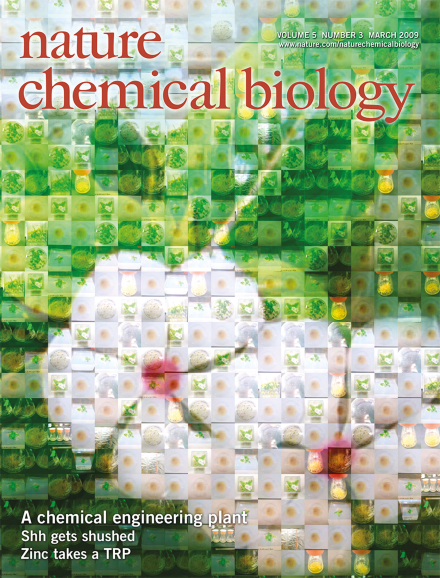
Engineered biosynthesis of modified natural products normally uses microbes as biochemical factories. Now, chemical biologists are taking advantage of the largely untapped biochemical potential of plants.
Full Text - Alkaloid biosynthesis takes root | PDF (578 KB) - Alkaloid biosynthesis takes root
Tue G Banke & Alan D Wickenden
doi:10.1038/nchembio0309-141
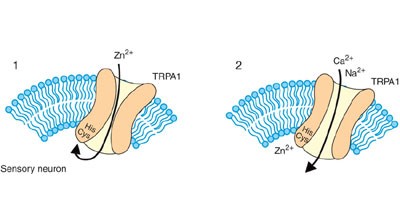
Exposure to zinc can cause pain and inflammation and can be harmful to human health. New evidence suggests that activation of the irritant receptor, TRPA1, which is expressed on pain-sensing neurons, may be responsible for some of these symptoms of zinc toxicity.
Full Text - Intracellular zinc irritates TRPA1 | PDF (1,502 KB) - Intracellular zinc irritates TRPA1
See also: Article by Hu et al.
Andrew M Gulick
doi:10.1038/nchembio0309-143
Under iron-depleted conditions, bacteria produce siderophores that bind iron and are then actively taken up by the cell. New structural and biochemical insights are reported for the synthetic pathway of achromobactin, a siderophore from the plant pathogen Pectobacterium chrysanthemi.
Full Text - Ironing out a new siderophore synthesis strategy | PDF (192 KB) - Ironing out a new siderophore synthesis strategy
See also: Article by Schmelz et al.
James E Bradner
doi:10.1038/nchembio0309-144
Inhibition of growth stimulatory pathways has emerged as a major focus of targeted cancer drug development. New insights regarding potent, transient inhibition of cell signaling may challenge the dogma of medicinal chemistry and clinical trial design.
Full Text - A pulse at the heart of targeted therapy | PDF (1,523 KB) - A pulse at the heart of targeted therapy
Irmgard Sinning, Klemens Wild & Gert Bange
doi:10.1038/nchembio0309-146
Newly synthesized secretory and membrane proteins contain cleavable signal sequences at the N terminus that allow for cotranslational protein targeting by interaction with the signal recognition particle (SRP). New results now suggest that signal sequences enable the conserved SRP RNA to accelerate complex formation with the SRP receptor.
Full Text - Signal sequences get active | PDF (601 KB) - Signal sequences get active
doi:10.1038/nchembio0309-148
Full Text - Research highlights | PDF (461 KB) - Research highlights
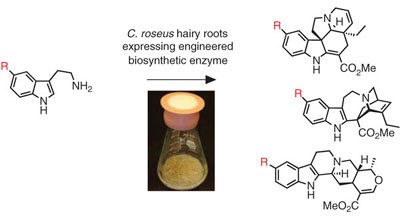
Weerawat Runguphan & Sarah E O'Connor
doi:10.1038/nchembio.141

Abstract - Metabolic reprogramming of periwinkle plant culture | Full Text - Metabolic reprogramming of periwinkle plant culture | PDF (312 KB) - Metabolic reprogramming of periwinkle plant culture | Supplementary information | Chemical compounds
See also: News and Views by Ryan & Moore
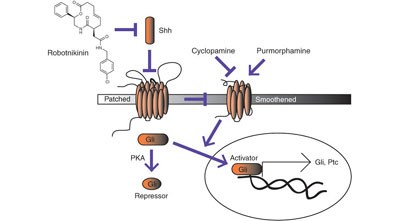
Benjamin Z Stanton, Lee F Peng, Nicole Maloof, Kazuo Nakai, Xiang Wang, Jay L Duffner, Kennedy M Taveras, Joel M Hyman, Sam W Lee, Angela N Koehler, James K Chen, Julia L Fox, Anna Mandinova & Stuart L Schreiber
doi:10.1038/nchembio.142

Abstract - A small molecule that binds Hedgehog and blocks its signaling in human cells | Full Text - A small molecule that binds Hedgehog and blocks its signaling in human cells | PDF (430 KB) - A small molecule that binds Hedgehog and blocks its signaling in human cells | Supplementary information | Chemical compounds
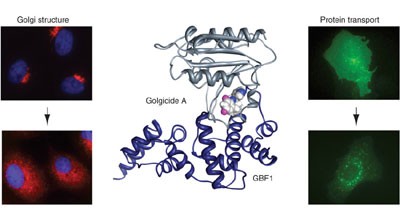
José B Sáenz, William J Sun, Jae Won Chang, Jinmei Li, Badry Bursulaya, Nathanael S Gray & David B Haslam
doi:10.1038/nchembio.144

Abstract - Golgicide A reveals essential roles for GBF1 in Golgi assembly and function | Full Text - Golgicide A reveals essential roles for GBF1 in Golgi assembly and function | PDF (892 KB) - Golgicide A reveals essential roles for GBF1 in Golgi assembly and function | Supplementary information | Chemical compounds
Pooja Arora, Aneesh Goyal, Vivek T Natarajan, Eerappa Rajakumara, Priyanka Verma, Radhika Gupta, Malikmohamed Yousuf, Omita A Trivedi, Debasisa Mohanty, Anil Tyagi, Rajan Sankaranarayanan & Rajesh S Gokhale
doi:10.1038/nchembio.143

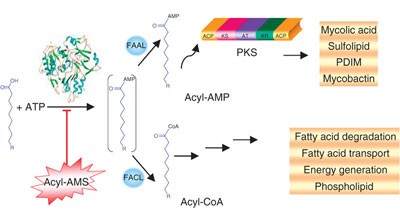
Abstract - Mechanistic and functional insights into fatty acid activation in : Mycobacterium tuberculosis | Full Text - Mechanistic and functional insights into fatty acid activation in Mycobacterium tuberculosis | PDF (762 KB) - Mechanistic and functional insights into fatty acid activation in Mycobacterium tuberculosis | Supplementary information | Chemical compounds
Stefan Schmelz, Nadia Kadi, Stephen A McMahon, Lijiang Song, Daniel Oves-Costales, Muse Oke, Huanting Liu, Kenneth A Johnson, Lester G Carter, Catherine H Botting, Malcolm F White, Gregory L Challis & James H Naismith
doi:10.1038/nchembio.145

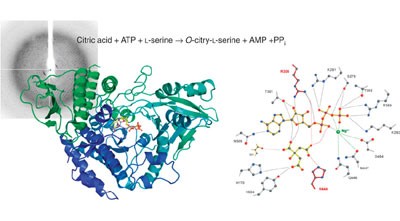
Abstract - AcsD catalyzes enantioselective citrate desymmetrization in siderophore biosynthesis | Full Text - AcsD catalyzes enantioselective citrate desymmetrization in siderophore biosynthesis | PDF (816 KB) - AcsD catalyzes enantioselective citrate desymmetrization in siderophore biosynthesis | Supplementary information | Chemical compounds
See also: News and Views by Gulick
Hongzhen Hu, Michael Bandell, Matt J Petrus, Michael X Zhu & Ardem Patapoutian
doi:10.1038/nchembio.146

Abstract - Zinc activates damage-sensing TRPA1 ion channels | Full Text - Zinc activates damage-sensing TRPA1 ion channels | PDF (552 KB) - Zinc activates damage-sensing TRPA1 ion channels | Supplementary information | Chemical compounds
See also: News and Views by Banke & Wickenden
Aude Dupré, Louise Boyer-Chatenet, Rose M Sattler, Ami P Modi, Ji-Hoon Lee, Matthew L Nicolette, Levy Kopelovich, Maria Jasin, Richard Baer, Tanya T Paull & Jean Gautier
doi:10.1038/nchembio0309-191a
Full Text - Corrigendum: A forward chemical genetic screen reveals an inhibitor of the Mre11–Rad50–Nbs1 complex | PDF (84 KB) - Corrigendum: A forward chemical genetic screen reveals an inhibitor of the Mre11–Rad50–Nbs1 complex
James T Stivers
doi:10.1038/nchembio0309-191b
Full Text - Corrigendum: Small molecule versus DNA repair nanomachine | PDF (84 KB) - Corrigendum: Small molecule versus DNA repair nanomachine
Mirella Bucci
doi:10.1038/nchembio0309-191c
Full Text - Corrigendum: In this issue | PDF (84 KB) - Corrigendum: In this issue
This Challenge is looking for novel approaches to protein and nucleic acid detection. This is an Id...
This Challenge is looking for novel approaches to analyzing changes at a single-cell level. This is...