Current issue


Top

Editorial

Peer pressure p585

doi:10.1038/nchem.434

Perceived lapses in the peer-review process often receive a lot of attention, but the majority of researchers declare themselves satisfied with the system. But if it is broken, how do we fix it?

Subject Category: General chemistry


Top

Commentaries

Learning from students at Lindau pp586 - 587

Martin Chalfie

doi:10.1038/nchem.375

Each year since 1951, young researchers and Nobel Laureates have gathered on the shores of Lake Constance for a unique scientific conference. In 2009 the meeting was dedicated to chemistry, and Laureates and students all came away enriched by their experiences.

Subject Category: General chemistry


Looking back on Lindau pp587 - 590

Jeffrey R. Lancaster

doi:10.1038/nchem.374

The Nobel Laureate Meetings held on the German island of Lindau bring together some of the world's brightest young minds with those individuals who have reached a pinnacle of scientific achievement. The impact of this unique event on all the delegates — especially the young researchers — is far-reaching.

Subject Category: General chemistry


Top

Thesis

Mapping the two cultures pp591 - 592

Michelle Francl

doi:10.1038/nchem.425

How long a road is it from physical chemistry to philosophy? Michelle Francl tries to find her way using charts of the intellectual world, old and new.

Subject Category: General chemistry


Top

Books and Arts

Of dragon's blood and chicken bones p593

Jan Wouters reviews The Alchemy of Paint: Art, Science and Secrets from the Middle Ages by Spike Bucklow

doi:10.1038/nchem.426

Subject Category: General chemistry


Top

Research Highlights

Our choice from the recent literature pp594 - 595

doi:10.1038/nchem.423


Blogroll: Lead plays the copper p595

doi:10.1038/nchem.424


Top

News and Views

Protein–protein interactions: Making drug design second nature pp596 - 597

Dan L. Sackett & David Sept

doi:10.1038/nchem.427

Identifying inhibitors of protein–protein interactions is an ongoing challenge in the field of drug design, but the use of peptide fragments based on a known binding interface is showing promise.

Subject Categories: Medicinal chemistry | Theoretical chemistry


Molecular imaging: The tip of what can be seen pp597 - 598

Neil R. Champness

doi:10.1038/nchem.418

Chemists have long relied on techniques that give indirect hints and clues as to the structure of the molecules they study, but advances in scanning probe microscopy provide a glimpse of the individual atoms and bonds within pentacene.

Subject Categories: Analytical chemistry | Surface chemistry


Functional supramolecules: Vesicles head in white direction pp599 - 600

Naomi Sakai & Stefan Matile

doi:10.1038/nchem.428

Synthetic vesicles with membranes made from amphiphiles that are fluorescence acceptors encapsulate donor molecules in their cores, and emit different proportions of red, blue and green light depending on pH. The balance of these coloured emissions at pH 9 results in white fluorescence.

Subject Categories: Photochemistry | Supramolecular chemistry


X-ray crystallography: Transient trapped p601

Stephen Davey

doi:10.1038/nchem.435

Subject Categories: General chemistry | Organic chemistry


Molecular electronics: Rectifying current behaviours pp601 - 603

David Janes

doi:10.1038/nchem.429

Inorganic semiconductors have long been used to construct rectifying diodes, but making them out of single molecules has remained a challenge. Now, two separate studies have induced rectification behaviour within molecular systems through different approaches.

Subject Category: Nanotechnology


Metal–organic frameworks: Entering the recognition domain pp603 - 604

Kimoon Kim

doi:10.1038/nchem.419

The host–guest properties of metal–organic frameworks have usually relied on molecular separation by the pore aperture or non-specific binding with the pore walls. Incorporating supramolecular recognition units into the frameworks has now enabled the docking of a specific guest.

Subject Categories: Materials chemistry | Supramolecular chemistry


Top

Perspective

Mechanically induced luminescence changes in molecular assemblies pp605 - 610

Yoshimitsu Sagara & Takashi Kato

doi:10.1038/nchem.411

no alt info

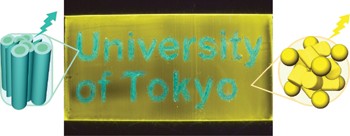
Altering the properties of materials by using an external signal, such as light, heat or mechanical stress, is attractive for the preparation of functional materials in diverse fields. This Perspective focuses on liquid and solid materials that change the colour of their luminescence under mechanical pressure, and highlights the structural changes involved.

Subject Category: Materials chemistry


Top

Review

Opportunities and challenges in synthetic oligosaccharide and glycoconjugate research pp611 - 622

Thomas J. Boltje, Therese Buskas & Geert-Jan Boons

doi:10.1038/nchem.399

no alt info

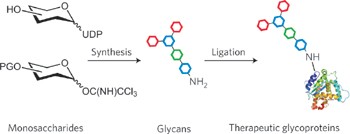
The development of general synthetic strategies for the prepartion of oligonucleotides and peptides has enabled them to be made routinely — often using automated systems. Making complex oligosaccharides is much less straightforward, but advances in areas such as one-pot multi-step protecting-group manipulations, stereoselective glycosylation protocols and chemo-enzymatic methods are offering new opportunities for carbohydrate chemistry.

Subject Categories: Chemical biology | Organic chemistry | Synthesis


Top

Articles

Vesicular perylene dye nanocapsules as supramolecular fluorescent pH sensor systems pp623 - 629

Xin Zhang, Stefanie Rehm, Marina M. Safont-Sempere & Frank Würthner

doi:10.1038/nchem.368

no alt info

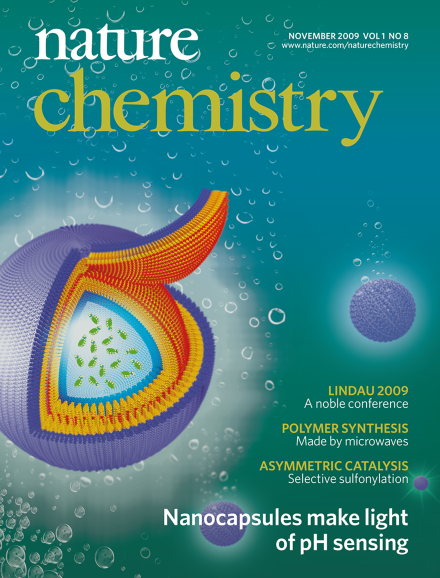
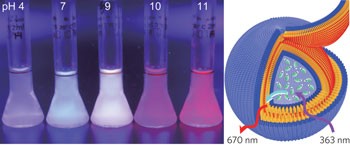
Artificial vesicles consisting of encapsulated fluorescence resonance energy transfer (FRET)-donor molecules and a FRET-acceptor bilayer dye-membrane provide ultrasensitive pH information in aqueous media by displaying pH-dependent fluorescence colour covering the entire visible light range. An exceptional white fluorescence was observed at pH 9.

Subject Categories: Nanotechnology | Supramolecular chemistry

See also: News and Views by Sakai & Matile


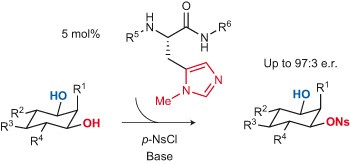
Enantioselective sulfonylation reactions mediated by a tetrapeptide catalyst pp630 - 634

Kristin Williams Fiori, Angela L. A. Puchlopek & Scott J. Miller

doi:10.1038/nchem.410

no alt info

Small peptide-derived catalysts are shown to be effective in the enantioselective sulfonylation of polyols. The observation that, using closely related catalysts, enantiotopic alcohols can be phosphorylated or sulfonylated, raises questions about the details of catalyst–substrate recognition and, from a biomimetic standpoint, the role of histidine residues in enzyme active sites.

Subject Categories: Organic chemistry | Synthesis


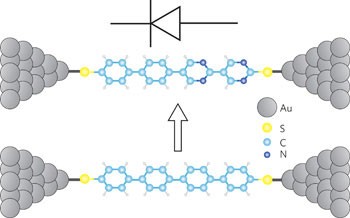
Rectification and stability of a single molecular diode with controlled orientation pp635 - 641

Ismael Díez-Pérez, Joshua Hihath, Youngu Lee, Luping Yu, Lyudmyla Adamska, Mortko A. Kozhushner, Ivan I. Oleynik & Nongjian Tao

doi:10.1038/nchem.392

no alt info

The properties of molecular electronic devices can be tuned by tailoring the structures of the molecules from which they are built. Researchers now show that two closely related molecules — each containing a string of four aryl groups — behave very differently when strung between gold electrodes, with the non-symmetrical structure leading to diode-like behaviour.

Subject Category: Nanotechnology

See also: News and Views by Janes


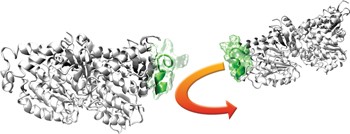
In silico design of tubulin-targeted antimitotic peptides pp642 - 648

Stefano Pieraccini, Giorgio Saladino, Graziella Cappelletti, Daniele Cartelli, Pierangelo Francescato, Giovanna Speranza, Paolo Manitto & Maurizio Sironi

doi:10.1038/nchem.401

no alt info

The development of molecules that target protein–protein interactions is one of the main goals of contemporary medicinal chemistry. Computational alanine scanning and molecular dynamics now leads to the identification of two peptide sequences that are important in microtubule assembly, and shows that the in silico activity can be translated into in vitro activity.

Subject Categories: Biochemistry | Physical chemistry | Theoretical chemistry

See also: News and Views by Sackett & Sept


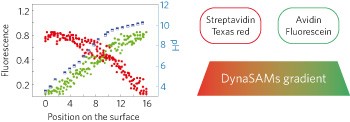
Hierarchical functional gradients of pH-responsive self-assembled monolayers using dynamic covalent chemistry on surfaces pp649 - 656

Lara Tauk, André P. Schröder, Gero Decher & Nicolas Giuseppone

doi:10.1038/nchem.400

no alt info

The properties of surfaces can be tailored by coating them with a thin film of molecules, for example by forming self-assembled monolayers. Now, researchers have shown how dynamic covalent chemistry can be used to reversibly pattern different compounds on to a surface with a high degree of spatial control to produce molecular gradients.

Subject Categories: Supramolecular chemistry | Surface chemistry


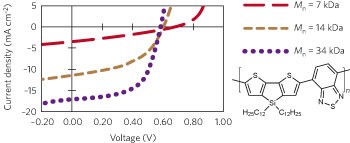
Streamlined microwave-assisted preparation of narrow-bandgap conjugated polymers for high-performance bulk heterojunction solar cells pp657 - 661

Robert C. Coffin, Jeff Peet, James Rogers & Guillermo C. Bazan

doi:10.1038/nchem.403

no alt info

Plastic solar cells contain a blend of conjugated polymer and fullerene electron-acceptor material that phase separates, resulting in the formation of heterojunctions. Improving the performance of these devices requires an understanding of the blend morphology. Now researchers show how a microwave-assisted synthesis method can be used to create structurally diverse copolymers enabling the investigation of their structure–function relationship.

Subject Categories: Polymer chemistry | Synthesis


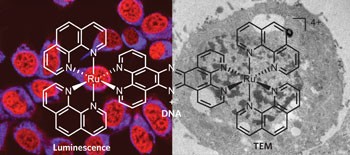
A ruthenium(II) polypyridyl complex for direct imaging of DNA structure in living cells pp662 - 667

Martin R. Gill, Jorge Garcia-Lara, Simon J. Foster, Carl Smythe, Giuseppe Battaglia & Jim A. Thomas

doi:10.1038/nchem.406

no alt info

The ability to study structural changes of DNA in live cells is of considerable interest. Here, a dinuclear ruthenium (II) complex that acts as a multifunctional stain for DNA and its use in both luminescence and transmission electron microscopy studies is described.

Subject Categories: Biochemistry | Inorganic chemistry | Photochemistry


Top

Corrigendum

Highly dynamic motion of crown ethers along oligolysine peptide chains p668

Dominik P. Weimann, Henrik D. F. Winkler, Jessica A. Falenski, Beate Koksch & Christoph A. Schalley

doi:10.1038/nchem.431


Top

In Your Element

Finding francium p670

Eric Scerri

doi:10.1038/nchem.430

Eric Scerri recounts the story of element 87, which after a number of false starts was finally tracked down in France — and named in its honour.


Top

Extra navigation

Subscribe to Nature Chemistry

Subscribe

naturejobs

ADVERTISEMENT