Table of contents
April 2004, Volume 6 No 4 pp275-374
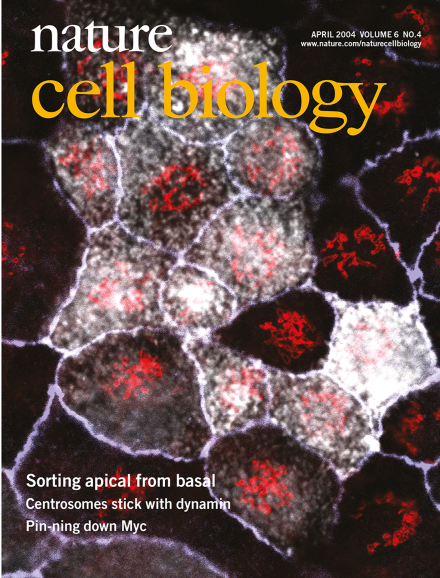
About the coverEditorial
Gel slicing and dicing: a recipe for disaster - p275
doi:10.1038/ncb0404-275
Full Text - Gel slicing and dicing: a recipe for disaster | PDF (76 KB) - Gel slicing and dicing: a recipe for disaster
Book Review
The Silent Revolution - p277
Gopalakrishna Ramaswamy & Frank J. Slack review RNAi: A Guide to Gene Silencing by Gregory Hannon
doi:10.1038/ncb0404-277
Full Text - The Silent Revolution | PDF (98 KB) - The Silent Revolution
News and Views
Solving the WAVE function - pp279 - 281
Simone L. Blagg & Robert H. Insall
doi:10.1038/ncb0404-279
SCAR/WAVE proteins are central regulators of cell motility that coordinate actin reorganization through activation of the Arp2/3 complex. Their activity is controlled by a large complex with four other members. A new study contradicts earlier work by suggesting that the entire complex is required for SCAR/WAVE activity at the leading edge.
Full Text - Solving the WAVE function | PDF (190 KB) - Solving the WAVE function
See also: Letter by Innocenti et al.
Getting connected - p281
Alison Schuldt
doi:10.1038/ncb0404-281
Full Text - Getting connected | PDF (149 KB) - Getting connected
Unravelling protein sorting - pp282 - 284
W. James Nelson & Enrique Rodriguez-Boulan
doi:10.1038/ncb0404-282
Protein sorting to distinct plasma membrane domains in polarized epithelial cells is thought to occur in the Golgi complex, and to be mediated in part by lipid rafts. Now, analysis of protein trafficking in live cells has revealed unexpected sorting pathways that raise new questions about the specificity and sites of action of sorting mechanisms.
Full Text - Unravelling protein sorting | PDF (160 KB) - Unravelling protein sorting
See also: Article by Polishchuk et al.
A helicase that gets Oskar's message across - pp285 - 287
Ilan Davis
doi:10.1038/ncb0404-285
Messenger RNA localization is a common way of targeting proteins to their site of function. This process is dependent on RNA signals that are interpreted by trans-acting factors. A putative RNA helicase and translational initiation factor is now shown to form a conserved complex, important for localization of oskar mRNA in Drosophila melanogaster and RNA surveillance in human cells.
Full Text - A helicase that gets Oskar's message across | PDF (272 KB) - A helicase that gets Oskar's message across
New neurons? - p287
Jack Horne
doi:10.1038/ncb0404-287
PINning down the c-Myc oncoprotein - pp288 - 289
David Dominguez-Sola & Riccardo Dalla-Favera
doi:10.1038/ncb0404-288
The proto-oncogenic transcription factor c-Myc is a central regulator of the cell cycle and cell growth. Amino-terminal phosphorylation of c-Myc results in its proteasomal degradation. A new study shows that its dephosphorylation is regulated by the Pin1 prolyl isomerase and PP2A phosphatase, and that stabilized c-Myc can replace SV40 small T antigen in the oncogenic transformation of human cells.
Full Text - PINning down the c-Myc oncoprotein | PDF (124 KB) - PINning down the c-Myc oncoprotein
See also: Article by Yeh et al.
Understanding the diversity of prions - pp290 - 292
Adriano Aguzzi
doi:10.1038/ncb0404-290
The protein-only hypothesis proposes that prions propagate by imparting specific folds onto cellular proteins. This hypothesis has met with resistance, partly because of the observation that many phenotypically distinct prion 'strains' are known to exist in yeast and mammals. Recent work on yeast prions may help reconcile the occurrence of prion strains with the prion hypothesis.
Full Text - Understanding the diversity of prions | PDF (265 KB) - Understanding the diversity of prions
Bicarbonate secretion: it takes two to tango - pp292 - 294
Michael A. Gray
doi:10.1038/ncb0404-292
New research reveals a reciprocal regulation between the CFTR chloride channel, implicated in cystic fibrosis, and several members of the SLC26 family of chloride-bicarbonate exchangers. These findings provide new insights into the mechanism of epithelial bicarbonate and fluid transport and may lead to better treatments for cystic fibrosis and congenital chloride diarrhoeas.
Full Text - Bicarbonate secretion: it takes two to tango | PDF (141 KB) - Bicarbonate secretion: it takes two to tango
See also: Letter by Ko et al.
Cell of the month: Heterochromatic domains in a mouse nucleus - p295
David Solomon
doi:10.1038/ncb0404-295
Full Text - Cell of the month: Heterochromatic domains in a mouse nucleus | PDF (349 KB) - Cell of the month: Heterochromatic domains in a mouse nucleus
Articles
Delivery of raft-associated, GPI-anchored proteins to the apical surface of polarized MDCK cells by a transcytotic pathway - pp297 - 307
Roman Polishchuk, Alessio Di Pentima & Jennifer Lippincott-Schwartz
doi:10.1038/ncb1109
Abstract - | Full Text - Delivery of raft-associated, GPI-anchored proteins to the apical surface of polarized MDCK cells by a transcytotic pathway | PDF (1,989 KB) - Delivery of raft-associated, GPI-anchored proteins to the apical surface of polarized MDCK cells by a transcytotic pathway | Supplementary information
A signalling pathway controlling c-Myc degradation that impacts oncogenic transformation of human cells - pp308 - 318
Elizabeth Yeh, Melissa Cunningham, Hugh Arnold, Dawn Chasse, Teresa Monteith, Giovanni Ivaldi, William C. Hahn, P. Todd Stukenberg, Shirish Shenolikar, Takafumi Uchida, Christopher M. Counter, Joseph R. Nevins, Anthony R. Means & Rosalie Sears
doi:10.1038/ncb1110
Abstract - | Full Text - A signalling pathway controlling c-Myc degradation that impacts oncogenic transformation of human cells | PDF (1,465 KB) - A signalling pathway controlling c-Myc degradation that impacts oncogenic transformation of human cells | Supplementary information
Letters
Abi1 is essential for the formation and activation of a WAVE2 signalling complex - pp319 - 327
Metello Innocenti, Adriana Zucconi, Andrea Disanza, Emanuela Frittoli, Liliana B. Areces, Anika Steffen, Theresia E. B. Stradal, Pier Paolo Di Fiore, Marie-France Carlier & Giorgio Scita
doi:10.1038/ncb1105
First Paragraph - | Full Text - Abi1 is essential for the formation and activation of a WAVE2 signalling complex | PDF (533 KB) - Abi1 is essential for the formation and activation of a WAVE2 signalling complex | Supplementary information
See also: News and Views by Blagg & Insall
Role of the PAR-3–KIF3 complex in the establishment of neuronal polarity - pp328 - 334
Takashi Nishimura, Katsuhiro Kato, Tomoya Yamaguchi, Yuko Fukata, Shigeo Ohno & Kozo Kaibuchi
doi:10.1038/ncb1118
First Paragraph - | Full Text - Role of the PAR-3–KIF3 complex in the establishment of neuronal polarity | PDF (560 KB) - Role of the PAR-3–KIF3 complex in the establishment of neuronal polarity | Supplementary information
Dynamin 2 binds
-tubulin and participates in centrosome cohesion - pp335 - 342
Heather M. Thompson, Hong Cao, Jing Chen, Ursula Euteneuer & Mark A. McNiven
doi:10.1038/ncb1112
First Paragraph - | Full Text - Dynamin 2 binds
-tubulin and participates in centrosome cohesion | PDF (1,523 KB) - Dynamin 2 binds
-tubulin and participates in centrosome cohesion | Supplementary information
Gating of CFTR by the STAS domain of SLC26 transporters - pp343 - 350
Shigeru B.H. Ko, Weizhong Zeng, Michael R. Dorwart, Xiang Luo, Kil Hwan Kim, Linda Millen, Hidemi Goto, Satoru Naruse, Abigail Soyombo, Philip J. Thomas & Shmuel Muallem
doi:10.1038/ncb1115
First Paragraph - | Full Text - Gating of CFTR by the STAS domain of SLC26 transporters | PDF (681 KB) - Gating of CFTR by the STAS domain of SLC26 transporters | Supplementary information
See also: News and Views by Gray
SREBPs suppress IRS-2-mediated insulin signalling in the liver - pp351 - 357
Tomohiro Ide, Hitoshi Shimano, Naoya Yahagi, Takashi Matsuzaka, Masanori Nakakuki, Takashi Yamamoto, Yoshimi Nakagawa, Akimitsu Takahashi, Hiroaki Suzuki, Hirohito Sone, Hideo Toyoshima, Akiyoshi Fukamizu & Nobuhiro Yamada
doi:10.1038/ncb1111
First Paragraph - | Full Text - SREBPs suppress IRS-2-mediated insulin signalling in the liver | PDF (250 KB) - SREBPs suppress IRS-2-mediated insulin signalling in the liver | Supplementary information
PKB/Akt modulates TGF-
signalling through a direct interaction with Smad3 - pp358 - 365
Ingrid Remy, Annie Montmarquette & Stephen W. Michnick
doi:10.1038/ncb1113
First Paragraph - | Full Text - PKB/Akt modulates TGF-
signalling through a direct interaction with Smad3 | PDF (337 KB) - PKB/Akt modulates TGF-
signalling through a direct interaction with Smad3 | Supplementary information
Akt interacts directly with Smad3 to regulate the sensitivity to TGF-
-induced apoptosis - pp366 - 372
Andrew R. Conery, Yanna Cao, E. Aubrey Thompson, Courtney M. Townsend, Jr, Tien C. Ko & Kunxin Luo
doi:10.1038/ncb1117
First Paragraph - | Full Text - Akt interacts directly with Smad3 to regulate the sensitivity to TGF-
-induced apoptosis | PDF (350 KB) - Akt interacts directly with Smad3 to regulate the sensitivity to TGF-
-induced apoptosis | Supplementary information
Corrigendum
Corrigendum: Ku70 suppresses the apoptotic translocation of Bax to mitochondria - pp373 - 374
Motoshi Sawada & Shigemi Matsuyama
doi:10.1038/ncb1116
Full Text - Corrigendum: Ku70 suppresses the apoptotic translocation of Bax to mitochondria | PDF (282 KB) - Corrigendum: Ku70 suppresses the apoptotic translocation of Bax to mitochondria