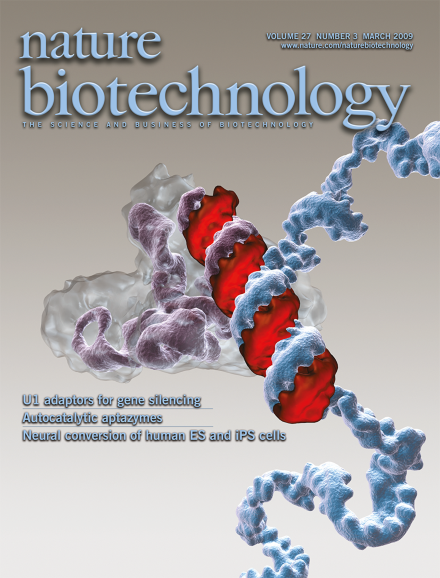
Table of contents


Top

Editorial

A balancing act p209

doi:10.1038/nbt0309-209

Contrary to Genentech's claims, turning over all in vitro diagnostics to the US Food and Drug Administration (FDA) is the wrong approach to achieve better clinical validation of tests.


Top

News

Comparative effectiveness casts first shadows across US industry pp211 - 212

Emily Waltz

doi:10.1038/nbt0309-211


Genentech grapples with direct offer p212

Brady Huggett

doi:10.1038/nbt0309-212


Geron gets green light for human trial of ES cell–derived product pp213 - 214

Joe Alper

doi:10.1038/nbt0309-213a


Alnylam dealt blow p213

Asher Mullard

doi:10.1038/nbt0309-213b


C-Path sets diagnostics standard p213

Jim Roberts

doi:10.1038/nbt0309-213c


Vatican cheers GM p214

Anna Meldolesi

doi:10.1038/nbt0309-214a


China overhauls patent law p214

Jane Qiu

doi:10.1038/nbt0309-214b


Report blames NICE for hastening decline of UK biotech pp215 - 217

Nuala Moran

doi:10.1038/nbt0309-215


Norway's swift bail out p216

Nayanah Siva

doi:10.1038/nbt0309-216a


Green fuels thrust p216

Victor Bethencourt

doi:10.1038/nbt0309-216b


Pfizer swallows Wyeth, validates niche buster pp218 - 219

Cormac Sheridan

doi:10.1038/nbt0309-218


Profile

Willem 'Pim' Stemmer p220

Crispin Littlehales

doi:10.1038/nbt0309-220

One of the most pioneering protein engineers of his generation is also a serial entrepreneur with a flair for spotting new business opportunities.


Data Page

13.3 million farmers cultivate GM crops p221

Andrew Marshall

doi:10.1038/nbt0309-221


News Feature

Fresh from the biologic pipeline pp222 - 225

Randall Osborne

doi:10.1038/nbt0309-222

Randy Osborne reports on the latest product approvals.


Top

Bioentrepreneur

Building a business

When times get tough pp226 - 228

Simcha Jong

doi:10.1038/bioe.2009.1


Top

Opinion and Comment

Correspondence

A survey of South-North health biotech collaboration pp229 - 232

Christina C. Melon, Monali Ray, Sharon Chakkalackal, Michelle Li, Jan E. Cooper, Jennifer Chadder, Wen Ke, Lexuan Li, Magdy A. Madkour, Sahar Aly, Nefertiti Adly, Sachin Chaturvedi, Victor Konde, Abdallah S. Daar, Peter A. Singer & Halla Thorsteinsdóttir

doi:10.1038/nbt0309-229


BIO and the next generation p232

Jim Greenwood

doi:10.1038/nbt0309-232


Bonsai biotech p233

William Bains

doi:10.1038/nbt0309-233


Commentary

Proliferation-resistant biotechnology: an approach to improve biological security pp234 - 236

Ali Nouri & Christopher F Chyba

doi:10.1038/nbt0309-234

Is there a way to design DNA synthesis technology with safeguards that prevent its cooption for nefarious purposes?


Top

Features

Biotech under Barack pp237 - 244

Jeffrey L Fox

doi:10.1038/nbt0309-237

The Obama administration looks to be a welcome shot in the arm for the scientific endeavor, but the current economic crisis is likely to keep several issues of key interest to biotech firmly on the back burner.


Patents

Bilski blundering biotech pp245 - 248

William J Simmons

doi:10.1038/nbt0309-245

Is the Federal Circuit's decision in In re: Bilski yet a further restraint on patenting biotech and pharmaceutical inventions?


Recent patent applications in RNA interference p249

doi:10.1038/nbt0309-249


Top

News and Views

A splicing component adapted to gene silencing pp250 - 251

Xavier Roca & Adrian R Krainer

doi:10.1038/nbt0309-250

U1 adaptors offer an alternative to siRNA for targeted gene knockdown.

See also: Research by Goraczniak et al.


Jump-starting cancer gene discovery pp251 - 252

Anthony Uren & Anton Berns

doi:10.1038/nbt0309-251

Targeting transposon mutagenesis to a specific tissue facilitates screening for tumor-associated genes and tracking of tumor lineages.

See also: Research by Keng et al.


Combinatorial stem cell mobilization pp252 - 253

Mikhail G Kolonin & Paul J Simmons

doi:10.1038/nbt0309-252

Different subsets of bone marrow stem cells can be mobilized by varying drug treatments.


Research highlights p254

doi:10.1038/nbt0309-254


Top

Computational Biology

Primer

Maximizing power in association studies pp255 - 256

Eran Halperin & Dietrich A Stephan

doi:10.1038/nbt0309-255

Only a subset of genetic variants can be examined in genome-wide surveys for genetic risk factors. How can a fixed set of markers account for the entire genome by acting as proxies for neighboring associations?


Top

Research

Articles

Gene silencing by synthetic U1 Adaptors pp257 - 263

Rafal Goraczniak, Mark A Behlke & Samuel I Gunderson

doi:10.1038/nbt.1525

Goraczniak et al. introduce a gene-silencing method that uses 'U1 adaptors' to block polyadenylation of pre-mRNA in the nucleus. Silencing is stronger when U1 adaptors are combined with siRNAs than when either is used alone.

See also: News and Views by Roca & Krainer


A conditional transposon-based insertional mutagenesis screen for genes associated with mouse hepatocellular carcinoma pp264 - 274

Vincent W Keng, Augusto Villanueva, Derek Y Chiang, Adam J Dupuy, Barbara J Ryan, Ilze Matise, Kevin A T Silverstein, Aaron Sarver, Timothy K Starr, Keiko Akagi, Lino Tessarollo, Lara S Collier, Scott Powers, Scott W Lowe, Nancy A Jenkins, Neal G Copeland, Josep M Llovet & David A Largaespada

doi:10.1038/nbt.1526

Keng et al. characterize the mouse hepatocellular carcinoma genome by using tissue-specific recombinase expression to restrict mobilization of the Sleeping Beauty transposon to the liver. High throughput sequencing of >100,000 insertions sites in mouse tumor nodules identifies potential therapeutic targets.

See also: News and Views by Uren & Berns


Letters

Highly efficient neural conversion of human ES and iPS cells by dual inhibition of SMAD signaling pp275 - 280

Stuart M Chambers, Christopher A Fasano, Eirini P Papapetrou, Mark Tomishima, Michel Sadelain & Lorenz Studer

doi:10.1038/nbt.1529

Chambers et al. present an improved method for neural differentiation of human pluripotent stem cells that avoids the use of stromal feeder cells and embryoid bodies. By combining two inhibitors of SMAD signaling, the protocol generates neural cells with an efficiency of >80%.


The anti-apoptotic gene survivin contributes to teratoma formation by human embryonic stem cells pp281 - 287

Barak Blum, Ori Bar-Nur, Tamar Golan-Lev & Nissim Benvenisty

doi:10.1038/nbt.1527

Teratoma formation is a safety concern for any therapeutic strategy involving human embryonic stem cells. Blum et al. characterize teratomas derived from mouse and human embryonic stem cells and uncover a key role for the oncofetal gene survivin.


Autocatalytic aptazymes enable ligand-dependent exponential amplification of RNA pp288 - 292

Bianca J Lam & Gerald F Joyce

doi:10.1038/nbt.1528

Lam and Joyce describe a new approach to ligand detection based on two cross-replicating RNA ligases with allosteric ligand-binding domains. The ligases amplify exponentially at a rate dependent on ligand concentration—a system analogous to qPCR for detection of small molecules and proteins.


Top

Naturejobs

Careers and Recruitment

Biotech scientists bank on big pharma's biologics push pp293 - 295

Grace Wong

doi:10.1038/nbt0309-293

Biologics represent a new hope for big pharma and new dreams for biotech scientists.


People

People p296

doi:10.1038/nbt0309-296


Top

Extra navigation

Open Innovation Challenges

naturejobs

ADVERTISEMENT