Table of contents

indicates content that is available online only

Top

Editorials

What's wrong with UNESCO p447

The new director-general needs to buck all expectations and transform the agency.

doi:10.1038/461447a


Earth's boundaries? p447

An attempt to quantify the limits of humanity's load on our planet opens an important debate.

doi:10.1038/461447b


Biobanks need pharma p448

Which is why Europe's citizens need reassurance that their donations will be in the public interest.

doi:10.1038/461448a


Top

Research Highlights

Glaciology: Getting thinner faster p450

doi:10.1038/461450a


Immunology: Natural born killers p450

doi:10.1038/461450b


Systems biology: Metabolic map p450

doi:10.1038/461450c


Evolution: Armed and dangerous p450

doi:10.1038/461450d


Behavioural science: Jelly shots and jackpots p450

doi:10.1038/461450e


Neurobiology: Shocktopus p451

doi:10.1038/461451a


Gene therapy: Panning for phage p451

doi:10.1038/461451b


Evolutionary biology: Well endowed p451

doi:10.1038/461451c


Analytical chemistry: Evaporating flesh p451

doi:10.1038/461451d


Aquatic toxicology: Mixed-up fish p451

doi:10.1038/461451e


Top

Journal Club

Journal club p451

Mikiko C. Siomi

doi:10.1038/461451f


Correction p451

doi:10.1038/461451g


Top

News

News briefing: 24 September 2009 p452

doi:10.1038/461452a


Buoy damage blurs El Niño forecasts p455

Missing data from the eastern Pacific Ocean may hinder predictions of this year's event.

Naomi Lubick

doi:10.1038/461455a


German science looks to new political players p456

Coalition change could affect policies, reports Quirin Schiermeier.

Quirin Schiermeier

doi:10.1038/461456a


Genomics shifts focus to rare diseases p458

Disappointing genome-wide studies prompt researchers to tackle single-gene defects.

Erika Check Hayden

doi:10.1038/461458a


The elephant and the neutrino p459

Conservationists challenge physics observatory in Indian wildlife reserve.

Killugudi Jayaraman

doi:10.1038/461459a


Gold rush for algae p460

The second of four weekly articles on biofuels describes how oil giants and others are placing their bets on algae.

Amanda Leigh Mascarelli

doi:10.1038/461460a


Correction p461

doi:10.1038/461461a


Top

News Features

Physics: The edge of physics p462

Canada's Perimeter Institute of Theoretical Physics was intended to become a world leader in the field. Eric Hand finds out if it has lived up to its ambitions.

doi:10.1038/461462a


Atmospheric science: Cloudy, with a chance of science p466

When American and Chinese scientists agreed to measure pollution and dust over China, nobody foresaw how difficult it would be. Jane Qiu reports.

doi:10.1038/461466a


Top

Correspondence

Luxury bushmeat trade threatens lemur conservation p470

Meredith A. Barrett & Jonah Ratsimbazafy

doi:10.1038/461470a


A communication wipeout by gabbling presenters p470

Dongwook Ko

doi:10.1038/461470b


Politics and priorities behind Greek research reforms p470

Fragiskos N. Kolisis

doi:10.1038/461470c


Overzealous use of decimal places has wrong kind of impact p470

J. M. D. Coey

doi:10.1038/461470d


Top

Feature

A safe operating space for humanity p472

Identifying and quantifying planetary boundaries that must not be transgressed could help prevent human activities from causing unacceptable environmental change, argue Johan Rockström and colleagues.

Johan Rockström, Will Steffen, Kevin Noone, Åsa Persson, F. Stuart Chapin, III, Eric F. Lambin, Timothy M. Lenton, Marten Scheffer, Carl Folke, Hans Joachim Schellnhuber, Björn Nykvist, Cynthia A. de Wit, Terry Hughes, Sander van der Leeuw, Henning Rodhe, Sverker Sörlin, Peter K. Snyder, Robert Costanza, Uno Svedin, Malin Falkenmark, Louise Karlberg, Robert W. Corell, Victoria J. Fabry, James Hansen, Brian Walker, Diana Liverman, Katherine Richardson, Paul Crutzen & Jonathan A. Foley

doi:10.1038/461472a


Top

Books and Arts

The younger Oppenheimer p476

Frank Oppenheimer founded the San Francisco Exploratorium: his charisma and passion for science education made him as influential, if not as famous, as his brother, explains Robert Crease.

Robert Crease reviews Something Incredibly Wonderful Happens: Frank Oppenheimer and the World He Made Up by K.C. Cole

doi:10.1038/461476a


Howard's end at Perimeter p477

João Magueijo reviews First Principles: The Crazy Business of Doing Serious Science by Howard Burton

doi:10.1038/461477a


A floating island of sustainability p478

Christopher Turner reviews The Waterpod Project

doi:10.1038/461478a


Correction p478

doi:10.1038/461478b


Top

News and Views

Archaeology: Maya, Khmer and Inca p479

Past societies have struggled against environmental problems similar to those that beset us today. Three publications illuminate the outcomes for three different tropical civilizations during the period AD 700–1600.

Jared Diamond

doi:10.1038/461479a


Developmental biology: Rise of the source–sink model p480

Gradients of signalling molecules dictate where specific cell types form in developing tissues, but how these gradients are set up is much debated. A model proposed 40 years ago by Francis Crick may provide an answer.

Alexander F. Schier & Daniel Needleman

doi:10.1038/461480a

See also: Editor's summary


Climate change: The El Niño with a difference p481

Patterns of sea-surface warming and cooling in the tropical Pacific seem to be changing, as do the associated atmospheric effects. Increased global warming is implicated in these shifts in El Niño phenomena.

Karumuri Ashok & Toshio Yamagata

doi:10.1038/461481a

See also: Editor's summary


Chemical biology: Caught in the activation p484

A crystal structure reveals how a protein kinase is activated by the binding of a small molecule at a pocket far from the catalytic site. This opens the door to the design of modulators of protein phosphorylation.

Yi Liu

doi:10.1038/461484a


Astrophysics: Inner workings of a star p485

By borrowing a technique used by seismologists to investigate Earth's interior, astronomers have probed the hitherto-unknown interior rotation profile of a white-dwarf star.

Sung-Chul Yoon

doi:10.1038/461485a

See also: Editor's summary


Developmental biology: A bad boy comes good p486

Reactive oxygen species are often blamed for the development of cancer and other diseases. Contrary to their 'bad boy' reputation, these species seem to be essential for the development of immune cells, at least in the fly.

Ulrich Theopold

doi:10.1038/461486a

See also: Editor's summary


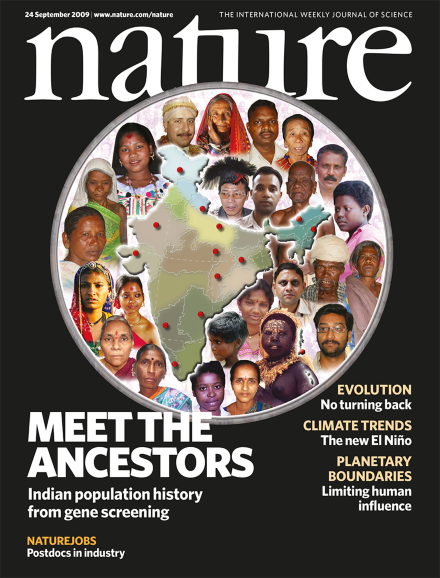
Human genetics: Tracing India's invisible threads p487

One measure of the extraordinary level of human diversity found in India is the use of 15 languages on its banknotes. The genetic underpinnings of that population diversity are yielding to whole-genome analysis.

Aravinda Chakravarti

doi:10.1038/461487a

See also: Editor's summary


Top

Articles

Reconstructing Indian population history p489

Genome-wide analysis of human variation in 25 diverse groups from India reveals two ancient populations, genetically divergent, that are ancestral to most Indians today. Traditionally upper caste and Indo-European speakers tend to be descended from a group that is genetically close to Middle Easterners, Central Asians and Europeans. The other group, the 'Ancestral South Indians', does not appear to be close to any group outside the subcontinent.

David Reich, Kumarasamy Thangaraj, Nick Patterson, Alkes L. Price & Lalji Singh

doi:10.1038/nature08365

See also: Editor's summary | News and Views by Chakravarti


A luminal epithelial stem cell that is a cell of origin for prostate cancer p495

A known regulator of prostate epithelial differentiation, Nkx3-1, is shown here to mark a stem cell population that functions during prostate regeneration. Furthermore, in mice in which the Pten tumour suppressor gene is deleted in a group of rare cells that express Nkx3-1 in the absence of testicular androgens, termed CARN cells, there is rapid carcinoma formation after andogen-mediated regeneration. These observations indicate that prostate cancer can originate in CARN cells.

Xi Wang, Marianna Kruithof-de Julio, Kyriakos D. Economides, David Walker, Hailong Yu, M. Vivienne Halili, Ya-Ping Hu, Sandy M. Price, Cory Abate-Shen & Michael M. Shen

doi:10.1038/nature08361

See also: Editor's summary


Top

Letters

Seismic evidence for the loss of stellar angular momentum before the white-dwarf stage p501

The majority of all stars finish their evolution as white dwarf stars. If white dwarf stars kept the angular momentum of their progenitors, they should rotate relatively rapidly, with typical periods of the order of a few seconds. Observations show that they rotate much more slowly, but it is not known whether a white dwarf could 'hide' some of its original angular momentum below its superficial layers. Here, a determination of the internal rotation profile of a white dwarf shows that it rotates as a solid body and with a relatively long period.

S. Charpinet, G. Fontaine & P. Brassard

doi:10.1038/nature08307

See also: Editor's summary | News and Views by Yoon


Violation of Bell's inequality in Josephson phase qubits p504

Bell inequalities are a quantitative measure that can distinguish classically determined correlations from stronger quantum correlations, and their measurement provides strong experimental evidence that quantum mechanics provides a complete description. The violation of a Bell inequality is now demonstrated in a solid-state system; the experiment provides further strong evidence that a macroscopic electrical circuit is really a quantum system.

Markus Ansmann, H. Wang, Radoslaw C. Bialczak, Max Hofheinz, Erik Lucero, M. Neeley, A. D. O'Connell, D. Sank, M. Weides, J. Wenner, A. N. Cleland & John M. Martinis

doi:10.1038/nature08363

See also: Editor's summary


Stable isotope constraints on Holocene carbon cycle changes from an Antarctic ice core p507

Antarctic ice cores can be used to reconstruct atmospheric CO2 concentrations, revealing significant changes during the Holocene epoch which started 11,000 years ago. Here, a highly resolved delta13C record is presented for the past 11,000 years from measurements on atmospheric CO2 trapped in an Antarctic ice core. These data are combined with a simplified carbon cycle model to shed light on the processes responsible for the changes in CO2 concentrations.

Joachim Elsig, Jochen Schmitt, Daiana Leuenberger, Robert Schneider, Marc Eyer, Markus Leuenberger, Fortunat Joos, Hubertus Fischer & Thomas F. Stocker

doi:10.1038/nature08393

See also: Editor's summary


El Niño in a changing climate p511

A distinctly different type of El Niño event, causing global climate effects dramatically different from those caused by the canonical El Niño, was observed in the late twentieth century. Using data from projected global warming scenarios it is now demonstrated that this new type of El Niño event is likely to become progressively more common in the future as a result of anthropogenic climate change.

Sang-Wook Yeh, Jong-Seong Kug, Boris Dewitte, Min-Ho Kwon, Ben P. Kirtman & Fei-Fei Jin

doi:10.1038/nature08316

See also: Editor's summary | News and Views by Ashok & Yamagata


An epistatic ratchet constrains the direction of glucocorticoid receptor evolution p515

Whether evolution can go back to an ancestral structure by reversing the selection pressure on function has long fascinated biologists. Here, the evolution of hormone specificity in the vertebrate glucocorticoid receptor is used as a case-study to investigate this issue; the mutations that optimized the new specificity of the glucocorticoid receptor are found to have destabilized elements of the protein structure that were required to support the ancestral conformation.

Jamie T. Bridgham, Eric A. Ortlund & Joseph W. Thornton

doi:10.1038/nature08249

See also: Editor's summary


Population context determines cell-to-cell variability in endocytosis and virus infection p520

Susceptibility to drug treatment or viral infection can vary greatly from one cell to another even in a population of genetically identical cells cultured together, but until now the causes of this heterogeneity had not been investigated. Here, deterministic links are revealed between fundamental cellular features and a cell's population context — for example, whether a cell is localized at the centre or at the periphery of an island of adhering cells.

Berend Snijder, Raphael Sacher, Pauli Rämö, Eva-Maria Damm, Prisca Liberali & Lucas Pelkmans

doi:10.1038/nature08282

See also: Editor's summary


Integration of neuronal clones in the radial cortical columns by EphA and ephrin-A signalling p524

During development of the cerebral cortex, excitatory projection neurons migrate to form a cellular infrastructure of radial columns. However, some of these clonally related neurons undergo a lateral shift to intermix with neurons originating from neighbouring proliferative units. This process is now shown to be dependent on Eph receptor A and ephrin A signalling, a so far unrecognized mechanism for lateral neuronal dispersion that seems to be essential for the proper intermixing of neuronal types in the cortical columns.

Masaaki Torii, Kazue Hashimoto-Torii, Pat Levitt & Pasko Rakic

doi:10.1038/nature08362

See also: Editor's summary


Asymptomatic deer excrete infectious prions in faeces p529

Infectious prion diseases are transmitted naturally within affected host populations, for example of sheep and deer. Once an animal is symptomatic its excretions may contain contagious prions, but the biological importance of these sources in sustaining epidemics remains unclear. Here it is shown that asymptomatic mule deer infected with chronic wasting disease excrete infectious prions in their faeces long before they develop clinical signs of prion disease.

Gültekin Tamgüney, Michael W. Miller, Lisa L. Wolfe, Tracey M. Sirochman, David V. Glidden, Christina Palmer, Azucena Lemus, Stephen J. DeArmond & Stanley B. Prusiner

doi:10.1038/nature08289

See also: Editor's summary


Fgf8 morphogen gradient forms by a source-sink mechanism with freely diffusing molecules p533

Concentration gradients of certain molecules termed 'morphogens' are known to control tissue development during embryogenesis, but how exactly these gradients are formed remains unclear. Using the technique of fluorescence correlation spectroscopy, Fgf8 morphogen gradients are now shown to be established and maintained in living zebrafish by two essential factors: free diffusion of single molecules away from the source and a sink function of the receiving cells.

Shuizi Rachel Yu, Markus Burkhardt, Matthias Nowak, Jonas Ries, Zdene caronk Petrás caronek, Steffen Scholpp, Petra Schwille & Michael Brand

doi:10.1038/nature08391

See also: Editor's summary | News and Views by Schier & Needleman


Reactive oxygen species prime Drosophila haematopoietic progenitors for differentiation p537

Reactive oxygen species (ROS) are generally considered to be deleterious to cells. Despite the fact that, in mammals, haematopoietic stem cells contain low levels of ROS, common myeloid progenitors (CMPs) unexpectedly produce relatively high levels of ROS. Here it is shown that the equivalent class of cells to CMPs in Drosophila display increased levels of ROS in vivo, apparently priming them for differentiation.

Edward Owusu-Ansah & Utpal Banerjee

doi:10.1038/nature08313

See also: Editor's summary | News and Views by Theopold


A dimerization-dependent mechanism drives RAF catalytic activation p542

Activation of the kinase RAF, a member of the ERK (extracellular signal-regulated kinase) pathway, is triggered by the binding of growth factors to receptor tyrosine kinases. Activating mutations in RAF can lead to unbridled signalling through the ERK pathway and have been linked to several human cancers. Here, the activation mechanism of RAF is shown to involve a specific mode of dimerization of its kinase domain, which is relevant for the action of the RAF activator KSR and certain oncogenic mutations.

Thanashan Rajakulendran, Malha Sahmi, Martin Lefrançois, Frank Sicheri & Marc Therrien

doi:10.1038/nature08314

See also: Editor's summary


Active turnover modulates mature microRNA activity in Caenorhabditis elegans p546

MicroRNAs have important roles in shaping gene expression profiles during development, repressing target messenger RNAs to control various biological processes. The degradation of mature microRNAs in the nematode Caenorhabditis elegans, mediated by the 5'right arrow3' exoribonuclease XRN-2, is now found to affect functional microRNA homeostasis in vivo.

Saibal Chatterjee & Helge Gros zlighans

doi:10.1038/nature08349

See also: Editor's summary


Top

Corrigenda

The nature of the globular- to fibrous-actin transition p550

Toshiro Oda, Mitsusada Iwasa, Tomoki Aihara, Yuichiro Maéda & Akihiro Narita

doi:10.1038/nature08440


Reptilian heart development and the molecular basis of cardiac chamber evolution p550

Kazuko Koshiba-Takeuchi, Alessandro D. Mori, Bogac L. Kaynak, Judith Cebra-Thomas, Tatyana Sukonnik, Romain O. Georges, Stephany Latham, Laurel Beck, R. Mark Henkelman, Brian L. Black, Eric N. Olson, Juli Wade, Jun K. Takeuchi, Mona Nemer, Scott F. Gilbert & Benoit G. Bruneau

doi:10.1038/nature08464


Top

Erratum

Structural basis for leucine-rich nuclear export signal recognition by CRM1 p550

Xiuhua Dong, Anindita Biswas, Katherine E. Süel, Laurie K. Jackson, Rita Martinez, Hongmei Gu & Yuh Min Chook

doi:10.1038/nature08491


Top

Naturejobs

News

Sponsor a scientist, online p553

Non-profit collective looks to eBay in search of funds.

Virginia Gewin

doi:10.1038/nj7263-553a


Postdoc journal

Lab trips foster collegiality p553

A well-run lab needs cooperation and communication among lab members.

Bryan Venters

doi:10.1038/nj7263-553b


In Brief

Biotech goes to school p553

Stem-cell and biotech curricula to be added to California public education.

doi:10.1038/nj7263-553c


Teaching sequestration p553

University of Texas introduces training programme for carbon capture and storage.

doi:10.1038/nj7263-553d


International health p553

Survey finds increases in graduate and undergraduate global-health enrolment.

doi:10.1038/nj7263-553e


Careers and Recruitment

Industrial endeavours p554

Biotechnology and drug companies are piquing graduate student interest with goal-oriented postdoctoral fellowships that maintain academic ties. Karen Kaplan surveys the offerings.

Karen Kaplan

doi:10.1038/nj7263-554a


Top

Futures

A kiss isn't just a kiss p558

Mouth-to-mouth resuscitation.

Steve Carper

doi:10.1038/461558a


Extra navigation

.
  • Japanese table of contents

Open Innovation Challenges

naturejobs

ADVERTISEMENT