Table of contents

indicates content that is available online only

Top

Editorials

Tribal culture versus genetics p489

A dispute between researchers and a small Native American tribe has cast an unduly large shadow over genetics. Both sides have much to gain from deeper communication, aided by those who belong to both communities.

doi:10.1038/430489a


States versus gases p489

A state-led lawsuit against greenhouse-gas emitters highlights a forceful regional movement in US climate policy.

doi:10.1038/430489b


Top

News

Lawyers blast nuclear pact as a breach of disarmament treaty p491

Jim Giles

doi:10.1038/430491a


Energy labs halt classified research amid security fears p491

Geoff Brumfiel

doi:10.1038/430491b


Joint suits aim to weed out agencies' red tape p492

Helen Pearson

doi:10.1038/430492a


Sea snapshots will map frequency of freak waves p492

Michael Hopkin

doi:10.1038/430492b


Dinosaur eggs escape sale as smuggling claims unearthed p493

Rex Dalton

doi:10.1038/430493a


Swedish enthusiasm peps up plans for neutron source p493

Quirin Schiermeier

doi:10.1038/430493b


Winged messenger set to follow ancient mariner to Mercury p494

Tony Reichhardt

doi:10.1038/430494a


Russian bid to drill Antarctic lake gets chilly response p494

Jim Giles

doi:10.1038/430494b


Tough talker quits Congress for bioindustry p495

Meredith Wadman

doi:10.1038/430495a


Biologists lobby China's government for funding reform p495

David Cyranoski

doi:10.1038/430495b


News in brief p496

doi:10.1038/430496a


Top

News Features

What's in a name? p498

Physicists agree that experiments at the Brookhaven atom collider have created a new form of matter. But theorists and experimentalists are still arguing about what to call it. Geoff Brumfiel investigates.

doi:10.1038/430498a


When two tribes go to war p500

Medical geneticists and isolated Native American communities afflicted by inherited diseases should have much to gain from working together. But the relationship can go sour, as Rex Dalton finds out.

doi:10.1038/430500a


Top

Correspondence

If you can lose a driving licence, why not a PhD? p503

A doctorate is seen as a licence to do science. It should be revocable for misconduct.

Adam G. Hart

doi:10.1038/430503a


Species problem solved 100 years ago p503

James Mallet

doi:10.1038/430503b


Tight budget should fund benefits, not more posts p503

Robert D. Wells

doi:10.1038/430503c


Top

Books and Arts

The decline of China's environment p505

The spread of agriculture led to deforestation and the growth of towns.

Crispin Tickell reviews The Retreat of the Elephants: An Environmental History of China by Mark Elvin

doi:10.1038/430505a


The body-plan explosion p506

Stefan Bengtson reviews On the Origin of Phyla by James W. Valentine

doi:10.1038/430506a


Sorrows of the young statistician p507

Peter J. Bowler reviews Karl Pearson: The Scientific Life in a Statistical Age by Theodore M. Porter

doi:10.1038/430507a


Seeing the world p507

doi:10.1038/430507b


Science in culture p508

Margaret Leiteritz turns scientific graphs into painted diagrams.

Martin Kemp reviews

doi:10.1038/430508a


Top

Essay

Concept

Why can't planets be like stars? p509

Planetary science: both the deductive skills of geologists and the mathematical approach of astrophysicists are needed to study planets.

Stuart Ross Taylor

doi:10.1038/430509a


Top

News and Views

Neurobiology:  Odorant receptors make scents p511

The goal of making sense of the sense of smell has come a step closer. Work on fruitflies reveals that odorant receptors act as bidirectional chemical detectors and determine the function of sensory neurons.

Rainer W. Friedrich

doi:10.1038/430511a


Superconductivity:  Why the temperature is high p512

According to a new empirical law, the transition temperature to superconductivity is high in copper oxides because their metallic states are as viscous as is permitted by the laws of quantum physics.

Jan Zaanen

doi:10.1038/430512a


Cell biology:  How to build a cell junction p513

Structures of the protein vinculin reveal drastic conformational changes associated with binding to its partners in cell-adhesion contacts. These changes might let vinculin regulate the assembly of these complexes.

William I. Weis

doi:10.1038/430513a


Evolutionary biology:  Oceans of bacteria p515

Cloning microbial genes from natural environments has revealed a surprising amount of diversity. In understanding how microorganisms function in ecosystems, how much of this diversity really matters?

Stephen Giovannoni

doi:10.1038/430515a


Nuclear physics:  Not-so-magic numbers p517

When a nucleus has a 'magic' number of neutrons or protons, it is particularly stable. But it seems that for exotic nuclei, with large numbers of neutrons relative to protons, these magic numbers can change.

David Warner

doi:10.1038/430517a


Self-assembly:  Towards precision micelles p519

Detailed imaging reveals the structure of a spherical 'micelle', self-assembled from cone-shaped molecules, and marks progress towards mimicking the natural assembly skills of biological systems.

Dennis E. Discher and Randall D. Kamien

doi:10.1038/430519a


100 and 50 years ago p520

doi:10.1038/430520a


Molecular biology:  Cohesins slip sliding away p520

Cohesin complexes have a central role in cell division, mediating the association between sister chromosomes. It now seems that cohesin binding is dynamic, adapting to changes in gene transcription.

Karen E. Ross and Orna Cohen-Fix

doi:10.1038/430520b


Research highlights p522

doi:10.1038/430522a


Top

Brief Communications

Animal communication:  Ground squirrel uses ultrasonic alarms p523

This rodent emits a high-frequency shriek as a warning that is inaudible to predators.

David R. Wilson and James F. Hare

doi:10.1038/430523a


Top

Brief Communications Arising

Earth science:  Role of fO2 on fluid saturation in oceanic basalt

Bruno Scaillet and Michel Pichavant

doi:10.1038/nature02814


Earth science:  Role of fO2 on fluid saturation in oceanic basalt (reply)

Alberto E. Saal, Erik H. Hauri, Charles H. Langmuir and Michael R. Perfit

doi:10.1038/nature02815


Top

Progress

The nonlinear nature of friction p525

Michael Urbakh, Joseph Klafter, Delphine Gourdon and Jacob Israelachvili

doi:10.1038/nature02750


Top

Article

Crystal structure of the calcium pump with a bound ATP analogue p529

Chikashi Toyoshima and Tatsuaki Mizutani

doi:10.1038/nature02680


Top

Letters to Nature

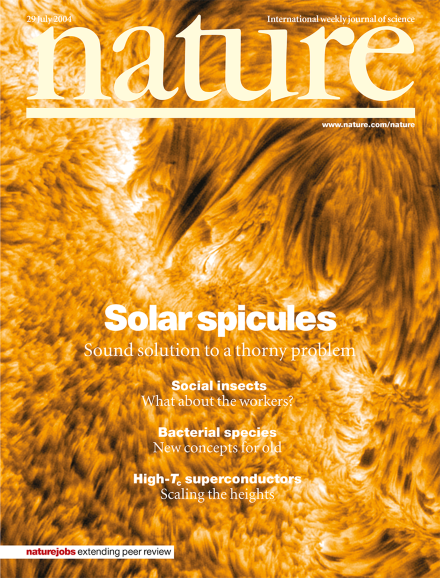
Solar chromospheric spicules from the leakage of photospheric oscillations and flows p536

Bart De Pontieu, Robert Erdélyi and Stewart P. James

doi:10.1038/nature02749


A universal scaling relation in high-temperature superconductors p539

C. C. Homes, S. V. Dordevic, M. Strongin, D. A. Bonn, Ruixing Liang, W. N. Hardy, Seiki Komiya, Yoichi Ando, G. Yu, N. Kaneko, X. Zhao, M. Greven, D. N. Basov and T. Timusk

doi:10.1038/nature02673

See also: News and Views by Zaanen


Magnetic phase control by an electric field p541

Thomas Lottermoser, Thomas Lonkai, Uwe Amann, Dietmar Hohlwein, Jörg Ihringer and Manfred Fiebig

doi:10.1038/nature02728


Demixing in simple fluids induced by electric field gradients p544

Yoav Tsori, François Tournilhac and Ludwik Leibler

doi:10.1038/nature02758


Evidence of power-law flow in the Mojave desert mantle p548

Andrew M. Freed and Roland Bürgmann

doi:10.1038/nature02784


Fine-scale phylogenetic architecture of a complex bacterial community p551

Silvia G. Acinas, Vanja Klepac-Ceraj, Dana E. Hunt, Chanathip Pharino, Ivica Ceraj, Daniel L. Distel and Martin F. Polz

doi:10.1038/nature02649

See also: News and Views by Giovannoni


Cambrian origins and affinities of an enigmatic fossil group of arthropods p554

N. E. Vaccari, G. D. Edgecombe and C. Escudero

doi:10.1038/nature02705


Social parasitism by male-producing reproductive workers in a eusocial insect p557

Carlos Lopez-Vaamonde, J. Will Koning, Ruth M. Brown, William C. Jordan and Andrew F. G. Bourke

doi:10.1038/nature02769


Neurons compute internal models of the physical laws of motion p560

Dora E. Angelaki, Aasef G. Shaikh, Andrea M. Green and J. David Dickman

doi:10.1038/nature02754


Median bundle neurons coordinate behaviours during Drosophila male courtship p564

Devanand S. Manoli and Bruce S. Baker

doi:10.1038/nature02713


Cyclophilin A retrotransposition into TRIM5 explains owl monkey resistance to HIV-1 p569

David M. Sayah, Elena Sokolskaja, Lionel Berthoux and Jeremy Luban

doi:10.1038/nature02777


Cohesin relocation from sites of chromosomal loading to places of convergent transcription p573

Armelle Lengronne, Yuki Katou, Saori Mori, Shihori Yokobayashi, Gavin P. Kelly, Takehiko Itoh, Yoshinori Watanabe, Katsuhiko Shirahige and Frank Uhlmann

doi:10.1038/nature02742

See also: News and Views by Ross & Cohen-Fix


Structural determinants for generating centromeric chromatin p578

Ben E. Black, Daniel R. Foltz, Srinivas Chakravarthy, Karolin Luger, Virgil L. Woods, Jr and Don W. Cleveland

doi:10.1038/nature02766


Structural basis for vinculin activation at sites of cell adhesion p583

Constantina Bakolitsa, Daniel M. Cohen, Laurie A. Bankston, Andrey A. Bobkov, Gregory W. Cadwell, Lisa Jennings, David R. Critchley, Susan W. Craig and Robert C. Liddington

doi:10.1038/nature02610

See also: News and Views by Weis


Low-populated folding intermediates of Fyn SH3 characterized by relaxation dispersion NMR p586

Dmitry M. Korzhnev, Xavier Salvatella, Michele Vendruscolo, Ariel A. Di Nardo, Alan R. Davidson, Christopher M. Dobson and Lewis E. Kay

doi:10.1038/nature02655


Top

Naturejobs

Prospects

Up for review p591

Paul Smaglik

doi:10.1038/nj6999-591a


Career View

Graduate Journal:  The 'lab widow' p592

Tshaka Cunningham

doi:10.1038/nj6999-592a


Nuts & Bolts p592

Deb Koen

doi:10.1038/nj6999-592b


Movers p592

doi:10.1038/nj6999-592c


Extra navigation

.
  • Japanese table of contents

Open Innovation Challenges

naturejobs

ADVERTISEMENT