Thank you for visiting nature.com. You are using a browser version with limited support for CSS. To obtain
the best experience, we recommend you use a more up to date browser (or turn off compatibility mode in
Internet Explorer). In the meantime, to ensure continued support, we are displaying the site without styles
and JavaScript.
Recent work has shown that VPS10P-domain receptors have important roles in neuronal signalling pathways. Willnow and colleagues outline the evidence for the contributions of two of these proteins, sortilin and SORLA, to neuronal viability and function.
Sleep has long been viewed as a property of the whole animal that is regulated by sleep- and wake-promoting neuronal networks. Here, Krueger and colleagues review the evidence that sleep might instead be regulated locally, at the level of neuronal assemblies.
Event-related potentials (ERPs) have been widely used to investigate language processing in the brain. Lau and colleagues discuss how localization data can contribute to the functional interpretation of one particular component of the ERP — the N400 response.
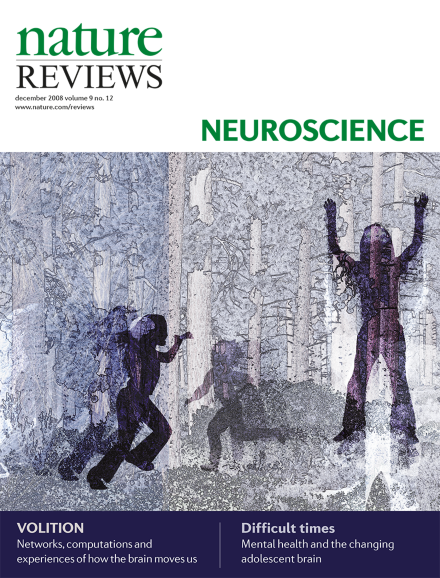
Recent studies have identified networks of brain areas that underlie voluntary action. Patrick Haggard reviews these circuits, describes the types of decision that are involved in making a voluntary action and discusses how volition is linked to conscious experience.
Many psychiatric disorders emerge in adolescence, when profound changes take place in the brain. Paus and colleagues provide an overview of the neurobiological changes that occur during adolescence and discuss their possible relationship to the emergence of psychopathology.
The rates of ADHD diagnosis have increased sharply in most countries around the world. This Perspective examines the current state of scientific research into ADHD and the key social and ethical concerns that are emerging from the use of stimulant drug treatments in children.