Thank you for visiting nature.com. You are using a browser version with limited support for CSS. To obtain
the best experience, we recommend you use a more up to date browser (or turn off compatibility mode in
Internet Explorer). In the meantime, to ensure continued support, we are displaying the site without styles
and JavaScript.
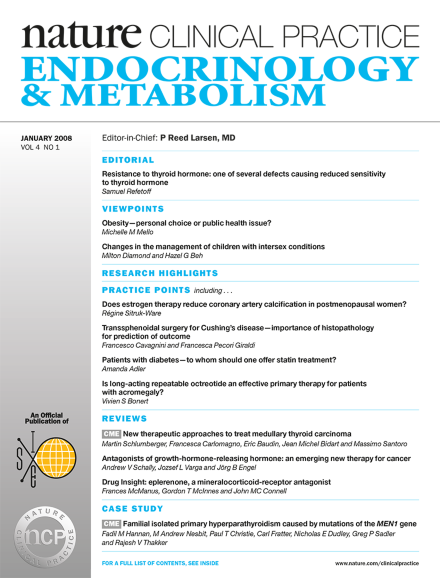
The prevalence of obesity in the US is increasing at a rapid rate. The author of this Viewpoint asks whether the government should introduce public health policies to address the obesity epidemic and, if so, what are the justifications for such intervention in the personal lifestyle choices of the American public?
Three broad recommendations have been made for the management of children with intersex conditions: halt all infant cosmetic genital surgery until evidence-based guidelines are available; conduct further research on the necessity of such surgery; and practice complete honesty with parents and patients. The authors discuss whether clinical practice has changed in response to these recommendations.
Although surgery cures most patients who have early-stage medullary thyroid carcinoma, disease can persist, recur or metastasize. This affects both quality of life and mortality. This article outlines current treatment strategies as well as various novel targets that are being investigated for therapies, especially for patients with distant metastases.
Growth-hormone-releasing hormone (GHRH) and its receptors are expressed in a wide variety of normal and malignant tissues. This article describes various GHRH antagonists, their mechanisms of action, andin vivostudies. These antagonists are a promising potential therapy for a wide range of cancers, and perhaps other diseases.
Aldosterone has many roles beyond water and sodium homeostasis, including blood pressure regulation. It is important in development of heart failure. Aldosterone binds the mineralocorticoid receptor. Eplerenone is a very specific antagonist of this receptor, and is used to treat heart failure and hypertension. It has many other potential applications, including management of ischemic heart disease and preventing progression of nephropathy.
Primary hyperparathyroidism is hereditary in 10% of patients. This article describes a patient with familial isolated hyperparathyroidism (FIHP) caused by a novel MEN1 missense mutation. The genetics, differential diagnosis and management of hereditary hyperparathyroidism are illustrated.