Table of contents
October 2007 Vol 6 No 10
In this issue
p765 | doi:10.1038/nrd2439
Editorial: Dealing with a data deficit
p767 | doi:10.1038/nrd2440
News and Analysis
Resolving the access dilemma | PDF (645 KB)
p769 | doi:10.1038/nrd2433
Steps on the road to personalized medicine | PDF (341 KB)
p770 | doi:10.1038/nrd2434
News in Brief
First complex follow-on protein product receives EU approval | First integrase inhibitor recommended for HIV | UK clinical trial guidelines updated | Pharmacovigilance through public–private partnership | US Patent Reform Act progresses | Pfizer biologics boost | PDF (1,125 KB)
p772 | doi:10.1038/nrd2435
Patent watch
New rules at the US patent office | Two new patent highways open | European Court of Justice rules on TRIPS patent protection | RAR and RXR modulators | PDF (393 KB)
p774 | doi:10.1038/nrd2436
From the analyst's couch
Non-insulin therapies for type 2 diabetes | PDF (233 KB)
p777 | doi:10.1038/nrd2420
Fresh from the Pipeline
Aliskiren | PDF (226 KB)
p779 | doi:10.1038/nrd2421
Research Highlights
Drug metabolism: Production line for hepatocytes | PDF (333 KB)
p781 | doi:10.1038/nrd2427
Cardiovascular disease: Reducing the pressure | PDF (357 KB)
p782 | doi:10.1038/nrd2426
Anticancer drugs: Forecasting drug responses | PDF (186 KB)
p782 | doi:10.1038/nrd2429
Cytokine hormones: Designed to linger | PDF (401 KB)
p783 | doi:10.1038/nrd2430
RNA interference: Targeted knockdown | PDF (133 KB)
p784 | doi:10.1038/nrd2428
In brief
G-protein-coupled receptors | Gene silencing | Protease inhibitors | Neurodegenerative diseases | PDF (118 KB)
p784 | doi:10.1038/nrd2431
Perspectives
Opinion
Growth of the Asian health-care market: global implications for the pharmaceutical industry
Richard J. Epstein
p785 | doi:10.1038/nrd2360
The digital information revolution has led to the rapid development of many countries, causing the pharmaceutical industry to face a new array of Asia-specific challenges. Epstein discusses how understanding Asia's diverse cultures, talents and markets will bring about success for the industry.
Reviews
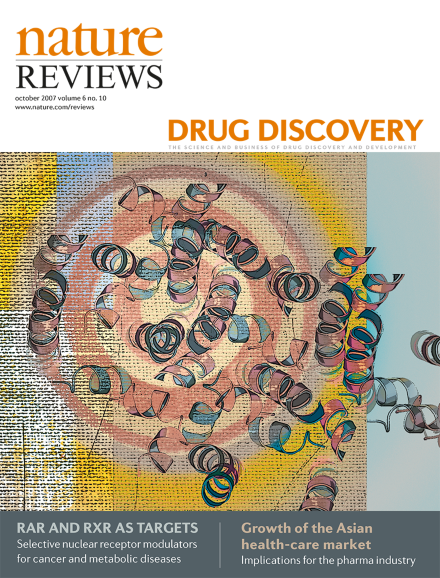
RAR and RXR modulation in cancer and metabolic disease
Lucia Altucci, Mark D. Leibowitz, Kathleen M. Ogilvie, Angel R. de Lera & Hinrich Gronemeyer
p793 | doi:10.1038/nrd2397
Retinoic acid receptors (RARs) are ligand-controlled transcription factors that function as heterodimers with retinoid X receptors (RXRs) to regulate cell growth and survival. This article discusses recent advances in the understanding of the biological role of RARs and RXRs and their implications for the design of selective receptor modulators for cancer and metabolic diseases.
Design of selective nuclear receptor modulators: RAR and RXR as a case study
Angel R. de Lera, William Bourguet, Lucia Altucci & Hinrich Gronemeyer
p811 | doi:10.1038/nrd2398
Retinoic acid receptors (RARs) are important drug targets for cancer therapy and prevention, and the potential of rexinoids for the treatment of metabolic diseases is increasingly being recognized. This article reviews recent structural data for RARs and retinoid X receptors (RXRs), discusses strategies in the design of selective RXR and RAR modulators, and consider lessons that can be learned for the design of selective nuclear-receptor modulators in general.
Modifying IGF1 activity: an approach to treat endocrine disorders, atherosclerosis and cancer
David R. Clemmons
p821 | doi:10.1038/nrd2359
In this Review, Clemmons discusses how strategies to utilize IGF1's growth stimulating and anabolic properties are being pursued to treat short stature, catabolism and diabetes, and highlights the potential benefit of IGF1 antagonism in cancer therapy.
Flying under the radar: the new wave of BCR–ABL inhibitors
Alfonso Quintás-Cardama, Hagop Kantarjian & Jorge Cortes
p834 | doi:10.1038/nrd2324
Chronic myeloid leukaemia caused by the mutant BCR–ABL kinase has been successfully treated with inhibitors of this kinase, such as imatinib, but mutations within the kinase can result in resistance to these drugs. Quintás-Cardama and colleagues discuss novel BCR–ABL inhibitors that have the potential to overcome such resistance.