Table of contents


Top

Focus

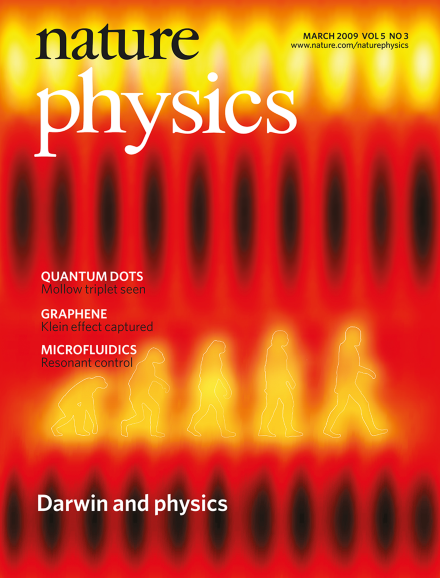
Darwin and physics

Top

Editorial

Focus: Darwin and physics

What's the big idea? p161

doi:10.1038/nphys1206

It is not obviously the business of a physics journal to mark the anniversary of a major development in biology. But the repercussions of Darwin's theory of evolution are relevant to all.


Top

Commentaries

Focus: Darwin and physics

A noble conception pp162 - 163

Michael Shermer

doi:10.1038/nphys1207

Science can explain many things in the natural world. Although the laws of gravity, the origin of galaxies and the Universe are commonly accepted, the theory of evolution is still questioned by some. There are clear reasons for why that is, and why it need not be so.


Focus: Darwin and physics

A quantum of natural selection pp164 - 166

Seth Lloyd

doi:10.1038/nphys1208

The modern evolutionary synthesis, which marries Darwin's theory of natural selection with Mendel's genetics, was developed around the same time as quantum mechanics. Is there any connection between the two?


Top

Thesis

Focus: Darwin and physics

Sense of history p167

Mark Buchanan

doi:10.1038/nphys1209


Top

Books and Arts

Focus: Darwin and physics

Modern classic pp169 - 170

Patrick Goymer reviews On the Origin of Species by Charles Darwin

doi:10.1038/nphys1210


Focus: Darwin and physics

Anniversary: Cause for celebration p170

Dan Csontos

doi:10.1038/nphys1211


Top

Research Highlights

Our choice from the recent literature p171

doi:10.1038/nphys1212


Top

News and Views

Quantum dots: Driven to perfection pp173 - 174

Charles Santori & Yoshihisa Yamamoto

doi:10.1038/nphys1215

In many ways, semiconductor quantum dots behave like natural atoms, but it has proved difficult to manipulate them using resonant laser light. That problem is now overcome.

Subject Categories: Condensed-matter physics | Quantum physics | Optical physics

See also: Letter by Nick Vamivakas et al. | Letter by Flagg et al.


Nuclear magnetic resonance: The benefits of travel p174

Alison Wright

doi:10.1038/nphys1205

Subject Categories: Techniques and instrumentation | Other physics


Kondo physics: What the noise is all about pp175 - 176

Reinhold Egger

doi:10.1038/nphys1214

Shot noise measurements in carbon nanotube quantum dots show many-body effects related to exotic Kondo models with both spin and orbital angular momentum, paving the way for studies on a rich class of strongly correlated transport phenomena.

Subject Categories: Condensed-matter physics | Nanotechnology

See also: Letter by Delattre et al.


Dark matter: Many birds, one stone pp176 - 177

Dan Hooper

doi:10.1038/nphys1216

A new theory for dark matter has the power to explain several experimental results simultaneously, even those seemingly at odds with each other.

Subject Category: Astrophysics


Microfluidics: Tuned-in flow control pp178 - 179

Howard A. Stone

doi:10.1038/nphys1213

Analogues of the resistors, capacitors and diodes of an electronic circuit could eliminate the need for bulky external pumps to control the flow of liquids in a microfluidic circuit.

Subject Categories: Fluid dynamics | Electronics, photonics and device physics

See also: Letter by Leslie et al.


Nanotechnology: Atomic waterwheels set in motion p179

David Gevaux

doi:10.1038/nphys1204

Subject Category: Nanotechnology


Top

Progress Article

Focus: Darwin and physics

Quantum Darwinism pp181 - 188

Wojciech Hubert Zurek

doi:10.1038/nphys1202

Quantum Darwinism describes the proliferation, in the environment, of multiple records of selected states of a quantum system – an approach that has resulted in considerable progress towards a solution of the quantum measurement problem.

Subject Category: Quantum physics


Top

Letters

Preparation of non-local superpositions of quasi-classical light states pp189 - 192

Alexei Ourjoumtsev, Franck Ferreyrol, Rosa Tualle-Brouri & Philippe Grangier

doi:10.1038/nphys1199

Quantum superpositions of coherent light waves offer several advantages for quantum-information processing compared to single photons. A novel scheme for generating these so-called Schrödinger-cat states circumvents problems arising from their fragility, which has been a key obstacle towards applications.

Subject Categories: Quantum physics | Optical physics | Techniques and instrumentation


Evidence for an oscillating soliton/vortex ring by density engineering of a Bose–Einstein condensate pp193 - 197

I. Shomroni, E. Lahoud, S. Levy & J. Steinhauer

doi:10.1038/nphys1177

Two intriguing shapes that appear in Bose–Einstein condensates are vortex rings and solitons. Experiments now suggest that there can be periodic oscillations between these qualitatively different structures.

Subject Categories: Atomic and molecular physics | Statistical physics, thermodynamics and nonlinear dynamics


Spin-resolved quantum-dot resonance fluorescence pp198 - 202

A. Nick Vamivakas, Yong Zhao, Chao-Yang Lu & Mete Atatüre

doi:10.1038/nphys1182

Two experiments observe the so-called 'Mollow triplet' in the emission spectrum of a quantum dot—originating from resonantly driving a dot transition—and demonstrate the potential of these systems to act as single-photon sources and as a readout modality for electron-spin states.

Subject Categories: Condensed-matter physics | Quantum physics | Optical physics

See also: News and Views by Santori & Yamamoto


Resonantly driven coherent oscillations in a solid-state quantum emitter pp203 - 207

E. B. Flagg, A. Muller, J. W. Robertson, S. Founta, D. G. Deppe, M. Xiao, W. Ma, G. J. Salamo & C. K. Shih

doi:10.1038/nphys1184

Two experiments observe the so-called Mollow triplet in the emission spectrum of a quantum dot—originating from resonantly driving a dot transition—and demonstrate the potential of these systems to act as single-photon sources, and as a readout modality for electron-spin states.

Subject Categories: Condensed-matter physics | Quantum physics | Optical physics

See also: News and Views by Santori & Yamamoto


Noisy Kondo impurities pp208 - 212

T. Delattre, C. Feuillet-Palma, L. G. Herrmann, P. Morfin, J.-M. Berroir, G. Fève, B. Plaçais, D. C. Glattli, M.-S. Choi, C. Mora & T. Kontos

doi:10.1038/nphys1186

Sensitive measurements of fluctuations in the current through carbon-nanotube-based quantum dots provide insight into the many-body physics of such systems.

Subject Categories: Condensed-matter physics | Nanotechnology

See also: News and Views by Egger


Imaging nanoscale Fermi-surface variations in an inhomogeneous superconductor pp213 - 216

W. D. Wise, Kamalesh Chatterjee, M. C. Boyer, Takeshi Kondo, T. Takeuchi, H. Ikuta, Zhijun Xu, Jinsheng Wen, G. D. Gu, Yayu Wang & E. W. Hudson

doi:10.1038/nphys1197

A variant on Fourier-transform scanning tunnelling spectroscopy enables spatial variations in the Fermi surface of bismuth-based cuprate superconductors to be probed. This technique reveals that these variations take place over nanometre distances.

Subject Category: Condensed-matter physics


Strength of the spin-fluctuation-mediated pairing interaction in a high-temperature superconductor pp217 - 221

T. Dahm, V. Hinkov, S. V. Borisenko, A. A. Kordyuk, V. B. Zabolotnyy, J. Fink, B. Büchner, D. J. Scalapino, W. Hanke & B. Keimer

doi:10.1038/nphys1180

Although spin fluctuations are believed to have an important role in the mechanism responsible for high-temperature superconductivity, it has been unclear whether the strength of their coupling with fermionic quasiparticles is sufficiently strong. Systematic analysis of angle-resolved photoemission and neutron spectra suggests it is.

Subject Category: Condensed-matter physics


Quantum interference and Klein tunnelling in graphene heterojunctions pp222 - 226

Andrea F. Young & Philip Kim

doi:10.1038/nphys1198

The observation of oscillations in the conductance characteristics of narrow graphene p–n-junctions confirms their ability to collimate ballistic carriers. Moreover, the phase of these oscillations at low magnetic field suggests the occurrence of the perfect transmission of carriers normal to the junction as a direct result of the Klein effect.

Subject Categories: Electronics, photonics and device physics | Condensed-matter physics | Nanotechnology


Observation of an Efimov-like trimer resonance in ultracold atom–dimer scattering pp227 - 230

S. Knoop, F. Ferlaino, M. Mark, M. Berninger, H. Schöbel, H.-C. Nägerl & R. Grimm

doi:10.1038/nphys1203

The observation of a trimer resonance in an ultracold mixture of caesium atoms and dimers confirms one of the key predictions of three-body physics in the limit of resonant two-body interactions, with possible implications for understanding few-body states in nuclear matter.

Subject Categories: Atomic and molecular physics | Nuclear physics


Frequency-specific flow control in microfluidic circuits with passive elastomeric features pp231 - 235

Daniel C. Leslie, Christopher J. Easley, Erkin Seker, James M. Karlinsey, Marcel Utz, Matthew R. Begley & James P. Landers

doi:10.1038/nphys1196

Frequency-specific components that passively control the flow in a channel in an analogous manner to that of the resistors, capacitors and diodes of an electronic circuit could eliminate the need to exert active control in microfluidic circuits with bulky external pumps.

Subject Categories: Fluid dynamics | Electronics, photonics and device physics

See also: News and Views by Stone


Top

Extra navigation

Subscribe to Nature Physics

Subscribe

Open Innovation Challenges

  • Biocide Formulation

    • Deadline: Nov 09 2009
    • Reward: $20,000 USD

    A formulation for enhanced binding of biocides to surfaces exposed to an aqueous environment is desi...

naturejobs

ADVERTISEMENT