Table of contents


Top

Editorial

Brave new world p81

doi:10.1038/nphys1188

The inauguration of President Obama signals hope — and hope for science.


Top

Thesis

Madness in the method p83

Mark Buchanan

doi:10.1038/nphys1189


Top

Research Highlights

Our choice from the recent literature p85

doi:10.1038/nphys1201


Top

News and Views

Iron-based superconductors: Timing is crucial pp87 - 88

Warren E. Pickett

doi:10.1038/nphys1192

Many studies into the properties of the recently discovered ferropnictide superconductors lead to seemingly contradictory interpretations. Such discrepancies could be explained by the emergence of temporally fluctuating excitations formed by the antiphase boundaries between local spin-density-wave domains.

Subject Category: Condensed-matter physics

See also: Article by Mazin & Johannes


Fluid dynamics: Bounce into chaos p88

Dan Csontos

doi:10.1038/nphys1187


Cosmology: Designs for an asymmetric universe pp89 - 90

David Wands

doi:10.1038/nphys1195

Puzzling anisotropies in the cosmic microwave background radiation across the sky are leading some researchers to contemplate cosmology in an asymmetric universe.

Subject Category: Astrophysics


Physics of violins: A little light music p90

Andreas Trabesinger

doi:10.1038/nphys1190


Rydberg atoms: There can be only one pp91 - 92

Matthias Weidemüller

doi:10.1038/nphys1193

In an ensemble of atoms with long-range dipolar interactions between them, only one atom can be excited at a time. This 'dipole blockade' has now been observed for two single atoms positioned at macroscopic distances.

Subject Categories: Atomic and molecular physics | Quantum physics

See also: Letter by Urban et al. | Letter by Gaëtan et al.


Plasma physics: A new spin on quantum plasmas pp92 - 93

Padma Kant Shukla

doi:10.1038/nphys1194

A model for dense degenerate plasmas that incorporates electron spin indicates that quantum effects can be seen even under conditions previously considered to be in the classical regime.

Subject Category: Plasma physics


Ultrafast science: Attosecond plasma optics pp93 - 94

Fabien Quéré

doi:10.1038/nphys1191

Using dense plasmas instead of atomic or molecular gases could enable the generation of attosecond light pulses with higher energy, shorter durations and more energetic photons.

See also: Letter by Nomura et al.


Top

Letters

A millisecond quantum memory for scalable quantum networks pp95 - 99

Bo Zhao, Yu-Ao Chen, Xiao-Hui Bao, Thorsten Strassel, Chih-Sung Chuu, Xian-Min Jin, Jörg Schmiedmayer, Zhen-Sheng Yuan, Shuai Chen & Jian-Wei Pan

doi:10.1038/nphys1153

Two independent experiments that demonstrate memories for single quantum excitations with storage times of the order of a millisecond—two orders of magnitude longer than reported so far—should help to bring practical long-distance quantum-communication networks a step closer.

Subject Categories: Atomic and molecular physics | Quantum physics


Long-lived quantum memory pp100 - 104

R. Zhao, Y. O. Dudin, S. D. Jenkins, C. J. Campbell, D. N. Matsukevich, T. A. B. Kennedy & A. Kuzmich

doi:10.1038/nphys1152

Two independent experiments that demonstrate memories for single quantum excitations with storage times on the order of a millisecond—two orders of magnitude longer than reported so far—should help to bring practical long-distance quantum-communication networks a step closer.

Subject Categories: Atomic and molecular physics | Quantum physics


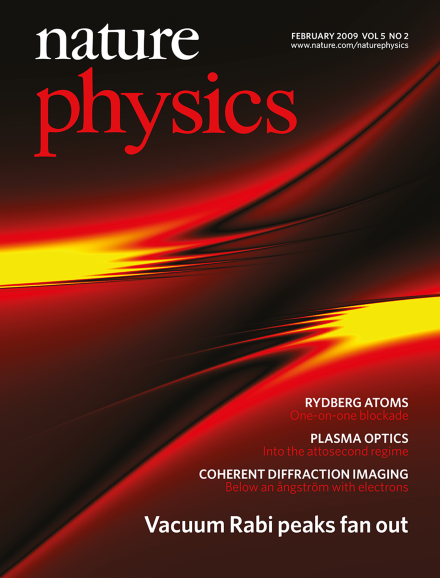
Nonlinear response of the vacuum Rabi resonance pp105 - 109

Lev S. Bishop, J. M. Chow, Jens Koch, A. A. Houck, M. H. Devoret, E. Thuneberg, S. M. Girvin & R. J. Schoelkopf

doi:10.1038/nphys1154

The exploration of the Jaynes–Cummings Hamiltonian in a circuit-QED system—where an 'artificial atom' made of a superconducting circuit is strongly coupled to a microwave field—provides direct evidence for nonlinearities due to quantum mechanics on the level of single atoms and photons.

Subject Categories: Quantum physics | Condensed-matter physics


Observation of Rydberg blockade between two atoms pp110 - 114

E. Urban, T. A. Johnson, T. Henage, L. Isenhower, D. D. Yavuz, T. G. Walker & M. Saffman

doi:10.1038/nphys1178

When two single Rydberg atoms—those having electrons in highly excited states—interact, one can be used to control the quantum state of the other. Two independent experiments now demonstrate a 'Rydberg blockade', an effect that might make long-range quantum gates between neutral atoms possible.

Subject Categories: Atomic and molecular physics | Quantum physics

See also: News and Views by Weidemüller


Observation of collective excitation of two individual atoms in the Rydberg blockade regime pp115 - 118

Alpha Gaëtan, Yevhen Miroshnychenko, Tatjana Wilk, Amodsen Chotia, Matthieu Viteau, Daniel Comparat, Pierre Pillet, Antoine Browaeys & Philippe Grangier

doi:10.1038/nphys1183

When two single Rydberg atoms—those with electrons in highly excited states—interact, one can be used to control the quantum state of the other. Two independent experiments demonstrate such 'Rydberg blockade', an effect that might make long-range quantum gates between neutral atoms possible.

Subject Categories: Atomic and molecular physics | Quantum physics

See also: News and Views by Weidemüller


Energy gaps in the failed high-Tc superconductor La1.875Ba0.125CuO4 pp119 - 123

Rui-Hua He, Kiyohisa Tanaka, Sung-Kwan Mo, Takao Sasagawa, Masaki Fujita, Tadashi Adachi, Norman Mannella, Kazuyoshi Yamada, Yoji Koike, Zahid Hussain & Zhi-Xun Shen

doi:10.1038/nphys1159

ARPES measurements of the 'failed' superconductor LBCO-1/8 suggest that its pseudogap phase consists of two distinct components. The result could be an important clue into the nature of this phase in the copper oxide superconductors.

Subject Category: Condensed-matter physics


Attosecond phase locking of harmonics emitted from laser-produced plasmas pp124 - 128

Y. Nomura, R. Hörlein, P. Tzallas, B. Dromey, S. Rykovanov, Zs. Major, J. Osterhoff, S. Karsch, L. Veisz, M. Zepf, D. Charalambidis, F. Krausz & G. D. Tsakiris

doi:10.1038/nphys1155

An experiment demonstrating the generation of subfemtosecond pulses of light through the interaction of laser light with a solid target underlines the potential of this approach to lead to a new generation of intense sources of attosecond pulses.

Subject Categories: Optical physics | Plasma physics

See also: News and Views by Quéré


Sub-ångström-resolution diffractive imaging of single nanocrystals pp129 - 133

W. J. Huang, J. M. Zuo, B. Jiang, K. W. Kwon & Moonsub Shim

doi:10.1038/nphys1161

Techniques for reconstructing an object's microstructure from its diffraction pattern have substantially improved the future imaging potential of next-generation X-ray sources. Yet the same techniques can already be applied to conventional electron microscopes, to extend their resolution to below an ångström.

Subject Categories: Techniques and instrumentation | Nanotechnology | Optical physics


Top

Articles

Simplifying quantum logic using higher-dimensional Hilbert spaces pp134 - 140

Benjamin P. Lanyon, Marco Barbieri, Marcelo P. Almeida, Thomas Jennewein, Timothy C. Ralph, Kevin J. Resch, Geoff J. Pryde, Jeremy L. O'Brien, Alexei Gilchrist & Andrew G. White

doi:10.1038/nphys1150

A general approach to simplifying quantum logic circuits—the 'programs' of quantum computers—is described and demonstrated on a platform based on photonic qubits.

Subject Categories: Quantum physics | Optical physics | Information theory and computation


A key role for unusual spin dynamics in ferropnictides pp141 - 145

I. I. Mazin & M. D. Johannes

doi:10.1038/nphys1160

Many studies on the properties of the recently discovered ferropnictide superconductors report seemingly contradictory results. A theoretical study suggests that these contradictions might be resolved by considering such materials as having a strongly magnetic ground state whose domain boundaries fluctuate, preventing their experimental detection.

Subject Category: Condensed-matter physics

See also: News and Views by Pickett


Diffraction-limited performance and focusing of high harmonics from relativistic plasmas pp146 - 152

B. Dromey, D. Adams, R. Hörlein, Y. Nomura, S. G. Rykovanov, D. C. Carroll, P. S. Foster, S. Kar, K. Markey, P. McKenna, D. Neely, M. Geissler, G. D. Tsakiris & M. Zepf

doi:10.1038/nphys1158

A systematic demonstration of the generation and focusing of laser-driven high-order harmonics to a near-diffraction-limited spot suggests that scaling this approach to ever higher intensities could be easier than first thought.

Subject Categories: Plasma physics | Optical physics


Tuning intermolecular interaction in long-range-ordered submonolayer organic films pp153 - 158

Christoph Stadler, Sören Hansen, Ingo Kröger, Christian Kumpf & Eberhard Umbach

doi:10.1038/nphys1176

The force between molecules deposited on a surface during the growth of an organic film is usually attractive. But for certain metal phthalocyanine molecules, this force can change with temperature from attractive to repulsive, resulting in unusual ordering behaviour.

Subject Categories: Nanotechnology | Materials physics | Polymer physics


Top

Corrigendum

Visualization of the interplay between high-temperature superconductivity, the pseudogap and impurity resonances p159

Kmalesh Chatterjee, M. C. Boyer, W. D. Wise, Takeshi Kondo, T. Takeuchi, H. Ikuta & E. W. Hudson

doi:10.1038/nphys1200


Top

Extra navigation

Subscribe to Nature Physics

Subscribe

Open Innovation Challenges

  • Biocide Formulation

    • Deadline: Nov 09 2009
    • Reward: $20,000 USD

    A formulation for enhanced binding of biocides to surfaces exposed to an aqueous environment is desi...

ADVERTISEMENT