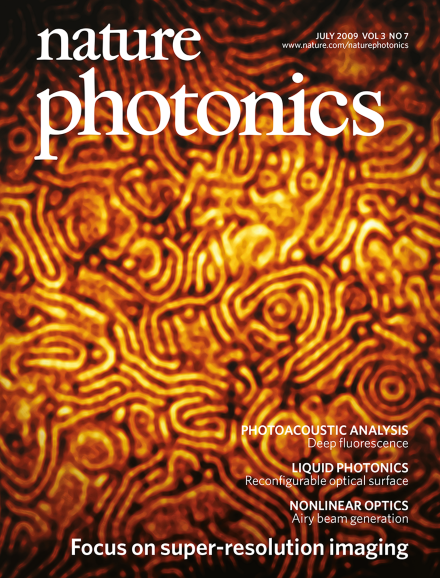
Table of contents
Super–resolution imaging
- Focus issue:
- July 2009 Volume 3 No 7 pp361-420
Optical imaging beyond the diffraction limit of light is revolutionizing sample analysis in the biological and physical sciences. In this special Focus Issue, a collection of articles are presented, detailing the fundamental physics, the different approaches and the applications where super-resolution imaging can be of help.
Editorial
Beyond the diffraction limit - p361
doi:10.1038/nphoton.2009.100
The emergence of imaging schemes capable of overcoming Abbe's diffraction barrier is revolutionizing optical microscopy.
Full Text - Beyond the diffraction limit | PDF (124 KB) - Beyond the diffraction limit
Commentaries
Subdiffraction resolution in continuous samples - pp362 - 364
Rainer Heintzmann & Mats G. L. Gustafsson
doi:10.1038/nphoton.2009.102
Super-resolution light microscopy methods either localize single molecular labels or treat the sample as a continuous object. The fundamental requirements for super-resolution in the continuum regime are spatially non-uniform illumination and a nonlinear photoresponse.
Full Text - Subdiffraction resolution in continuous samples | PDF (347 KB) - Subdiffraction resolution in continuous samples
Nano-imaging with STORM - pp365 - 367
Xiaowei Zhuang
doi:10.1038/nphoton.2009.101
Multicolour, three-dimensional stochastic optical reconstruction microscopy now makes it possible to image cellular structures with near molecular-scale resolution.
Full Text - Nano-imaging with STORM | PDF (1,401 KB) - Nano-imaging with STORM
Interviews
Eyes on super-resolution - pp368 - 369
doi:10.1038/nphoton.2009.103
Advanced imaging techniques have evolved to see beyond the diffraction limit. W. E. Moerner spoke to Nature Photonics about the techniques involved.
Full Text - Eyes on super-resolution | PDF (131 KB) - Eyes on super-resolution
Research Highlights
Our choice from the recent literature - pp370 - 371
doi:10.1038/nphoton.2009.104
Full Text - Our choice from the recent literature | PDF (277 KB) - Our choice from the recent literature
News and Views
Photovoltaic technology: Relay dye boosts efficiency - pp373 - 374
Daniel J. Farrell & Nicholas J. Ekins-Daukes
doi:10.1038/nphoton.2009.108
Resonant energy-relay between two dye species allows photovoltaic harvesting of photons across a wider spectral range. This technique has been exploited to boost the efficiency of dye-sensitized solar cells by 26%.
Full Text - Photovoltaic technologyRelay dye boosts efficiency | PDF (145 KB) - Photovoltaic technologyRelay dye boosts efficiency
Nonlinear optics: Engineering Airy beams - pp374 - 375
Valdas Pasiskevicius
doi:10.1038/nphoton.2009.107
The demonstration of Airy beam generation and all-optical control by quasi-phase matched nonlinear crystals looks set to help these unique beams realize their exciting potential in applications.
Full Text - Nonlinear opticsEngineering Airy beams | PDF (167 KB) - Nonlinear opticsEngineering Airy beams
Free electron lasers: First light from hard X-ray laser - pp375 - 377
Brian McNeil
doi:10.1038/nphoton.2009.110
The demonstration of lasing at 1.5 Å at the LCLS facility in the US marks an important landmark for free electron lasers.
Full Text - Free electron lasersFirst light from hard X-ray laser | PDF (344 KB) - Free electron lasersFirst light from hard X-ray laser
Optical components: LEGO lightens photonics - pp377 - 378
David Pile
doi:10.1038/nphoton.2009.105
Researchers in Japan have shown that it is possible to use standard 'off-the-shelf' plastic toy parts to construct low-cost and light-weight optical components.
Full Text - Optical componentsLEGO lightens photonics | PDF (225 KB) - Optical componentsLEGO lightens photonics
Photoacoustic tomography: Sounding out fluorescent proteins - pp378 - 379
Peter Burgholzer, Hubert Grün & Alois Sonnleitner
doi:10.1038/nphoton.2009.109
Researchers from Munich and Boston have shown that multispectral photoacoustic tomography can image fluorescent proteins buried deep in highly scattering living organisms.
Full Text - Photoacoustic tomographySounding out fluorescent proteins | PDF (232 KB) - Photoacoustic tomographySounding out fluorescent proteins
Light-emitting nanocrystals: An end to blinking - p380
Oliver Graydon
doi:10.1038/nphoton.2009.106
Full Text - Light-emitting nanocrystalsAn end to blinking | PDF (107 KB) - Light-emitting nanocrystalsAn end to blinking
Progress Article
Diffraction-unlimited three-dimensional optical nanoscopy with opposing lenses - pp381 - 387
Stefan W. Hell, Roman Schmidt & Alexander Egner
doi:10.1038/nphoton.2009.112
Abstract - | Full Text - Diffraction-unlimited three-dimensional optical nanoscopy with opposing lenses | PDF (863 KB) - Diffraction-unlimited three-dimensional optical nanoscopy with opposing lenses
Review
Plasmonics for near-field nano-imaging and superlensing - pp388 - 394
Satoshi Kawata, Yasushi Inouye & Prabhat Verma
doi:10.1038/nphoton.2009.111
Diffraction of light prevents optical microscopes from having spatial resolution beyond a value comparable to the wavelength of the probing light. This essentially means that visible light cannot image nanomaterials. Here we review the mechanism for going beyond this diffraction limit and discuss how manipulation of light by means of surface plasmons propagating along the metal surface can help to achieve this. The interesting behaviour of light under the influence of plasmons not only allows superlensing, in which perfect imaging is possible through a flat thin metal film, but can also provide nano-imaging of practical samples by using a localized surface plasmon mode at the tip of a metallic nanoprobe. We also discuss the current research status and some intriguing future possibilities.
Full Text - Plasmonics for near-field nano-imaging and superlensing | PDF (630 KB) - Plasmonics for near-field nano-imaging and superlensing
Letters
Nonlinear generation and manipulation of Airy beams - pp395 - 398
Tal Ellenbogen, Noa Voloch-Bloch, Ayelet Ganany-Padowicz & Ady Arie
doi:10.1038/nphoton.2009.95
Airy beams have so far been generated by linear diffractive elements. Now, scientists show that they can also be created by a nonlinear process, opening the door to all-optical beam control and production at wavelengths unavailable by conventional methods.
Abstract - | Full Text - Nonlinear generation and manipulation of Airy beams | PDF (453 KB) - Nonlinear generation and manipulation of Airy beams
Subject Categories: Fundamental optical physics | Nonlinear optics
See also: News and Views by Pasiskevicius
Optical entanglement of co-propagating modes - pp399 - 402
J. Janousek, K. Wagner, J-F. Morizur, N. Treps, P. K. Lam, C. C. Harb & H-A. Bachor
doi:10.1038/nphoton.2009.97
Optical entanglement — a key requirement for many quantum communication protocols — is typically formed between two distinct beams, requiring repeated combination of complex resources, which becomes increasingly difficult as the number of entangled information channels increases. Here entanglement between two spatial modes within one beam is demonstrated.
Abstract - | Full Text - Optical entanglement of co-propagating modes | PDF (279 KB) - Optical entanglement of co-propagating modes
Subject Categories: Quantum optics | Fundamental optical physics
Voltage-programmable liquid optical interface - pp403 - 405
C. V. Brown, G. G. Wells, M. I. Newton & G. McHale
doi:10.1038/nphoton.2009.99
Voltage-programmable liquid surface profiles with large amplitudes resulting from dielectrophoresis are demonstrated. The oil interface formed can be ultrastable and static, or rapidly switchable, as shown in the case of a modulated diffraction grating. The scheme provides the possibility for responsive and polarization-insensitive transmission and reflection devices, and for optical interfaces with arbitrary surface profiles.
Abstract - | Full Text - Voltage-programmable liquid optical interface | PDF (297 KB) - Voltage-programmable liquid optical interface | Supplementary information
Subject Category: Optoelectronic devices and components
Articles
Increased light harvesting in dye-sensitized solar cells with energy relay dyes - pp406 - 411
Brian E. Hardin, Eric T. Hoke, Paul B. Armstrong, Jun-Ho Yum, Pascal Comte, Tomás Torres, Jean M. J. Fréchet, Md Khaja Nazeeruddin, Michael Grätzel & Michael D. McGehee
doi:10.1038/nphoton.2009.96
The power-conversion efficiency of dye-sensitized solar cells is increased by 26% by using energy relay dyes. The scheme aids the absorption of high-energy photons that undergo Förster resonant energy transfer to a sensitizing dye, and may offer a viable pathway for developing more efficient dye-sensitized solar cells.
Abstract - | Full Text - Increased light harvesting in dye-sensitized solar cells with energy relay dyes | PDF (411 KB) - Increased light harvesting in dye-sensitized solar cells with energy relay dyes | Supplementary information
Subject Category: Solar energy and photovoltaic technology
See also: News and Views by Farrell & Ekins-Daukes
Multispectral opto-acoustic tomography of deep-seated fluorescent proteins in vivo - pp412 - 417
Daniel Razansky, Martin Distel, Claudio Vinegoni, Rui Ma, Norbert Perrimon, Reinhard W. Köster & Vasilis Ntziachristos
doi:10.1038/nphoton.2009.98
Opto-acoustic imaging of fluorescent proteins deep within living organisms (Drosophila melanogaster and zebrafish) is reported. The approach uses multiple wavelength illumination of the sample to generate ultrasound waves which are then detected and converted into images.
Abstract - | Full Text - Multispectral opto-acoustic tomography of deep-seated fluorescent proteins in vivo | PDF (581 KB) - Multispectral opto-acoustic tomography of deep-seated fluorescent proteins in vivo | Supplementary information
Subject Category: Imaging and sensing
See also: News and Views by Burgholzer et al.
Product Focus
Optical adhesives - pp418 - 419
Neil Savage
doi:10.1038/nphoton.2009.113
The encapsulation of LEDs, termination of optical fibres and assembly of complex lens systems are all tasks that can be accomplished by the use of special optical adhesives, explains Neil Savage.
Full Text - Optical adhesives | PDF (234 KB) - Optical adhesives
Interview
Programmable liquid optical interfaces - p420
Interview with Carl Brown
doi:10.1038/nphoton.2009.114
Nature Photonics spoke to Carl Brown from Nottingham Trent University about the creation of a voltage-programmable liquid-oil surface that can rapidly switch and deflect light beams.
Full Text - Programmable liquid optical interfaces | PDF (122 KB) - Programmable liquid optical interfaces