Table of contents
May 2009, Volume 3 No 5 pp237-304
- Editorial
- Commentary
- Research Highlights
- News and Views
- Errata
- Technology Focus
- Letters
- Articles
- Erratum
- Corrigendum
- Interview
Editorial
Combating plagiarism - p237
doi:10.1038/nphoton.2009.48
Accountability of coauthors for scientific misconduct, guest authorship and deliberate or negligent citation plagiarism, highlight the need for accurate author contribution statements.
Full Text - Combating plagiarism | PDF (1,756 KB) - Combating plagiarism
Commentary
Future optical technologies for telescopes - pp239 - 241
Colin Cunningham
doi:10.1038/nphoton.2009.49
New optical technologies have revolutionized astronomy, from the invention of the telescope 400 years ago to more recent developments of adaptive optics and segmented mirrors. The next disruptive technologies could well emerge from integrated photonic devices.
Full Text - Future optical technologies for telescopes | PDF (443 KB) - Future optical technologies for telescopes
Research Highlights
Our choice from the latest literature - pp242 - 243
doi:10.1038/nphoton.2009.50
Full Text - Our choice from the latest literature | PDF (160 KB) - Our choice from the latest literature
News and Views
Antimatter: Abundant positron production - pp245 - 246
Carsten Müller & Christoph H. Keitel
doi:10.1038/nphoton.2009.56
Researchers at Lawrence Livermore National Laboratory have generated billions of positrons, forming the highest antimatter densities ever created on earth, by using superintense short laser pulses.
Full Text - AntimatterAbundant positron production | PDF (125 KB) - AntimatterAbundant positron production
Laser physics: Random lasers explained? - pp246 - 248
Diederik S. Wiersma
doi:10.1038/nphoton.2009.53
Random lasers can be made simply by grinding a laser crystal and optically pumping the resulting powder. The physics behind the resulting laser emission is rich but has led to much controversy. New experiments may now settle the debate behind their operation.
Full Text - Laser physicsRandom lasers explained? | PDF (195 KB) - Laser physicsRandom lasers explained?
Displays: Microfluidic electronic paper - pp248 - 249
Paul Drzaic
doi:10.1038/nphoton.2009.55
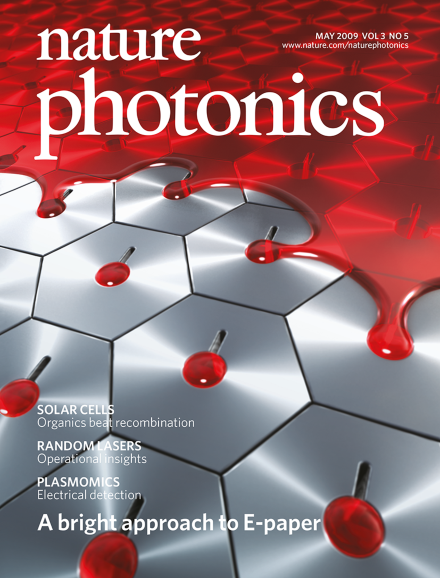
Pigmented inks in a microfluidic structure provide a new approach for fabricating bright, colourful electronic paper with a reflectivity of greater than 50%. The challenge now is to combine the scheme with fully functioning drive electronics.
Full Text - DisplaysMicrofluidic electronic paper | PDF (115 KB) - DisplaysMicrofluidic electronic paper
Condensed-matter physics: Transparent sodium - p250
David Pile
doi:10.1038/nphoton.2009.51
Full Text - Condensed-matter physicsTransparent sodium | PDF (122 KB) - Condensed-matter physicsTransparent sodium
Organic solar cells: Overcoming recombination - pp250 - 252
Michael D. McGehee
doi:10.1038/nphoton.2009.54
The construction of a polymer solar cell that can successfully collect an electron and hole for almost every incident photon suggests that great improvements in the efficiency of organic photovoltaics should be possible.
Full Text - Organic solar cellsOvercoming recombination | PDF (372 KB) - Organic solar cellsOvercoming recombination
Materials: Ultraviolet-emitting gallium nitride fractals - p252
David Pile
doi:10.1038/nphoton.2009.52
Full Text - MaterialsUltraviolet-emitting gallium nitride fractals | PDF (267 KB) - MaterialsUltraviolet-emitting gallium nitride fractals
Errata
Signal analyser on an optical chip - p253
Christophe Dorrer
doi:10.1038/nphoton.2009.70
Full Text - Signal analyser on an optical chip | PDF (96 KB) - Signal analyser on an optical chip
Letters
Co-existence of strongly and weakly localized random laser modes - pp279 - 282
Johannes Fallert, Roman J. B. Dietz, Janos Sartor, Daniel Schneider, Claus Klingshirn & Heinz Kalt
doi:10.1038/nphoton.2009.67
Whether the electromagnetic fields in random lasers are localized or extended is a topic of ongoing debate. Now, the localization of modes in micro-structured ZnO powder is experimentally determined and lasing from both kinds of modes (localized and extended) shown to exist simultaneously.
Abstract - | Full Text - Co-existence of strongly and weakly localized random laser modes | PDF (349 KB) - Co-existence of strongly and weakly localized random laser modes
Subject Categories: Lasers, LEDs and light sources | Fundamental optical physics
See also: News and Views by Wiersma
Electrical detection of confined gap plasmons in metal–insulator–metal waveguides - pp283 - 286
Pieter Neutens, Pol Van Dorpe, Iwijn De Vlaminck, Liesbet Lagae & Gustaaf Borghs
doi:10.1038/nphoton.2009.47
Electrical detection and characterization of gap plasmons is achieved by means of an integrated metal–semiconductor–metal photodetector. Integration of electro–optical components in metallic waveguides may lead to active high-bandwidth on-chip nano-optical circuits.
Abstract - | Full Text - Electrical detection of confined gap plasmons in metal–insulator–metal waveguides | PDF (557 KB) - Electrical detection of confined gap plasmons in metal–insulator–metal waveguides
Subject Categories: Nanophotonics | Optoelectronic devices and components | Plasmonics
Controlling the near-field oscillations of loaded plasmonic nanoantennas - pp287 - 291
M. Schnell, A. García-Etxarri, A. J. Huber, K. Crozier, J. Aizpurua & R. Hillenbrand
doi:10.1038/nphoton.2009.46
Evolution of the infrared near-fields of progressively loaded gap antennas is probed using near-field microscopy. The amplitude and phase is shown to be controlled by the antenna loading and the changes can be understood within the framework of circuit theory.
Abstract - | Full Text - Controlling the near-field oscillations of loaded plasmonic nanoantennas | PDF (2,004 KB) - Controlling the near-field oscillations of loaded plasmonic nanoantennas | Supplementary information
Subject Categories: Nanophotonics | Plasmonics
Articles
Electrofluidic displays using Young–Laplace transposition of brilliant pigment dispersions - pp292 - 296
J. Heikenfeld, K. Zhou, E. Kreit, B. Raj, S. Yang, B. Sun, A. Milarcik, L. Clapp & R. Schwartz
doi:10.1038/nphoton.2009.68
An ambient light display based on electrofluidic control of coloured pigment fluids is reported. Electromechanical pressure is used to move the pigment from a reservoir to the entire surface of a pixel on a timescale of tens of milliseconds. The display has a white light reflectivity of 55%.
Abstract - | Full Text - Electrofluidic displays using Young–Laplace transposition of brilliant pigment dispersions | PDF (1,489 KB) - Electrofluidic displays using Young–Laplace transposition of brilliant pigment dispersions | Supplementary information
Subject Category: Displays
See also: News and Views by Drzaic
Bulk heterojunction solar cells with internal quantum efficiency approaching 100% - pp297 - 302
Sung Heum Park, Anshuman Roy, Serge Beaupré, Shinuk Cho, Nelson Coates, Ji Sun Moon, Daniel Moses, Mario Leclerc, Kwanghee Lee & Alan J. Heeger
doi:10.1038/nphoton.2009.69
A polymer solar-cell based on a bulk hetereojunction design with an internal quantum efficiency of over 90% across the visible spectrum (425 nm to 575 nm) is reported. The device exhibits a power-conversion efficiency of 6% under standard air-mass 1.5 global illumination tests.
Abstract - | Full Text - Bulk heterojunction solar cells with internal quantum efficiency approaching 100% | PDF (1,735 KB) - Bulk heterojunction solar cells with internal quantum efficiency approaching 100% | Supplementary information
Subject Category: Solar energy and photovoltaic technology
See also: News and Views by McGehee
Erratum
Heat-assisted magnetic recording by a near-field transducer with efficient optical energy transfer - p303
W. A. Challener, Chubing Peng, A. V. Itagi, D. Karns, Wei Peng, Yingguo Peng, XiaoMin Yang, Xiaobin Zhu, N. J. Gokemeijer, Y.-T. Hsia, G. Ju, Robert E. Rottmayer, Michael A. Seigler & E. C. Gage
doi:10.1038/nphoton.2009.71
Full Text - Heat-assisted magnetic recording by a near-field transducer with efficient optical energy transfer | PDF (40 KB) - Heat-assisted magnetic recording by a near-field transducer with efficient optical energy transfer
Corrigendum
Complete optical isolation created by indirect interband photonic transitions - p303
Zongfu Yu & Shanhui Fan
doi:10.1038/nphoton.2009.73
Full Text - Complete optical isolation created by indirect interband photonic transitions | PDF (184 KB) - Complete optical isolation created by indirect interband photonic transitions
Interview
Bright future for electronic paper - p304
Interview with Jason Heikenfeld
doi:10.1038/nphoton.2009.66
A prototype display technology that electromechanically transports colourful aqueous dispersed pigments over the surface of mirror-like pixels is a promising new approach to making electronic paper with high reflectivity and contrast. Nature Photonics spoke to Jason Heikenfeld to learn more.
Full Text - Bright future for electronic paper | PDF (147 KB) - Bright future for electronic paper