Table of contents
June 2009, Volume 8 No 6 pp439-533
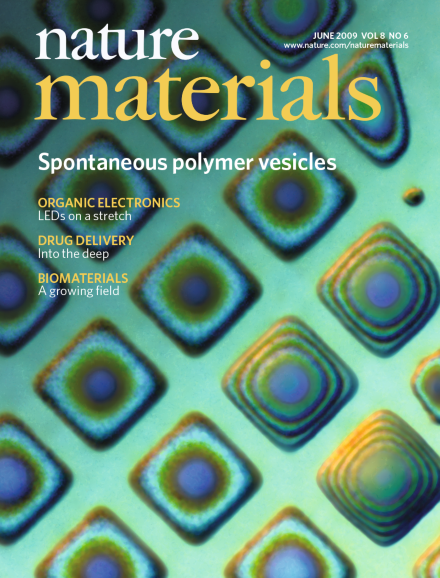
About the coverEditorial
Boom time for biomaterials - p439
doi:10.1038/nmat2451
Rapid developments are afoot in the field of biomaterials, and are likely to have major effects on patient care soon. But science isn't the only thing defining the pace of progress.
Full Text - Boom time for biomaterials | PDF (157 KB) - Boom time for biomaterials
Correspondence
Decisions on the European Spallation Source - p440
Dimitri N. Argyriou & Heloisa Nunes Bordallo
doi:10.1038/nmat2464
Full Text - Decisions on the European Spallation Source | PDF (93 KB) - Decisions on the European Spallation Source
Commentary
Biology takes centre stage - pp441 - 443
James W. Burns
doi:10.1038/nmat2462
Abstract - | Full Text - Biology takes centre stage | PDF (418 KB) - Biology takes centre stage
Interview
The evolution of biomaterials - pp444 - 445
doi:10.1038/nmat2447
Robert Langer has spent more than 30 years working with biomaterials and has seen their development from simple implants to complex multifunctional interfaces with the body. He shares his vision of the field's origins and what the future holds with Nature Materials.
Full Text - The evolution of biomaterials | PDF (294 KB) - The evolution of biomaterials
Research Highlights
Our choice from the recent literature - p446
doi:10.1038/nmat2452
Full Text - Our choice from the recent literature | PDF (230 KB) - Our choice from the recent literature
News and Views
Drug delivery: Old polymer learns new tracts - pp447 - 448
Michael J. Campolongo & Dan Luo
doi:10.1038/nmat2456
Sustained gene knockdown by the aid of a well-known biodegradable polymer has shown that old materials can still be used to solve new problems.
Full Text - Drug deliveryOld polymer learns new tracts | PDF (487 KB) - Drug deliveryOld polymer learns new tracts
See also: Article by Woodrow et al.
Material witness: What makes nanomachines work? - p448
Philip Ball
doi:10.1038/nmat2450
Full Text - Material witnessWhat makes nanomachines work? | PDF (115 KB) - Material witnessWhat makes nanomachines work?
Polymer films: Just spray it - pp449 - 450
Merlin Bruening & David Dotzauer
doi:10.1038/nmat2454
Spray-coating of multilayer films on fibre mats yields conformal coatings, opening up new possibilities for the fabrication of protective clothing and reactive membranes.
Full Text - Polymer filmsJust spray it | PDF (347 KB) - Polymer filmsJust spray it
See also: Article by Krogman et al.
When small is better - pp450 - 451
Mark A. Green
doi:10.1038/nmat2457
Nanoparticles containing a silver iodine core and a polymer shell have superionic conductance even near room temperature, showing promise for a new generation of electrochemical devices.
Full Text - When small is better | PDF (291 KB) - When small is better
See also: Letter by Makiura et al.
Biomaterials: Spotlight on hydrogels - pp451 - 453
Matthias P. Lutolf
doi:10.1038/nmat2458
By using light to control the degradation of hydrogel components in space and time, researchers have generated a tool to help them reconstruct functional biological tissues in a culture dish.
Full Text - BiomaterialsSpotlight on hydrogels | PDF (391 KB) - BiomaterialsSpotlight on hydrogels
Tumour targeting: Nanoantennas heat up - pp453 - 454
Weian Zhao & Jeffrey M. Karp
doi:10.1038/nmat2463
Advances in the functionality of multifunctional nanoparticles push their potential for the remote detection and treatment of cancer nearer to real-life patient care.
Full Text - Tumour targetingNanoantennas heat up | PDF (249 KB) - Tumour targetingNanoantennas heat up
Review
Complexity in biomaterials for tissue engineering - pp457 - 470
Elsie S. Place, Nicholas D. Evans & Molly M. Stevens
doi:10.1038/nmat2441
Abstract - | Full Text - Complexity in biomaterials for tissue engineering | PDF (1,427 KB) - Complexity in biomaterials for tissue engineering | Supplementary information
Letters
Similarities between structural distortions under pressure and chemical doping in superconducting BaFe2As2 - pp471 - 475
Simon A. J. Kimber, Andreas Kreyssig, Yu-Zhong Zhang, Harald O. Jeschke, Roser Valentí, Fabiano Yokaichiya, Estelle Colombier, Jiaqiang Yan, Thomas C. Hansen, Tapan Chatterji, Robert J. McQueeney, Paul C. Canfield, Alan I. Goldman & Dimitri N. Argyriou
doi:10.1038/nmat2443
Fe-based superconductors have attracted tremendous interest recently. New evidence on BaFe2As2 shows that chemical doping and pressure, both of which induce superconductivity, distort the lattice in similar ways. The result provides important information in the quest for an understanding of the mechanism behind superconductivity.
First Paragraph - | Full Text - Similarities between structural distortions under pressure and chemical doping in superconducting BaFe2As2 | PDF (837 KB) - Similarities between structural distortions under pressure and chemical doping in superconducting BaFe2As2 | Supplementary information
Subject Categories: Magnetic materials | Superconductors
Size-controlled stabilization of the superionic phase to room temperature in polymer-coated AgI nanoparticles - pp476 - 480
Rie Makiura, Takayuki Yonemura, Teppei Yamada, Miho Yamauchi, Ryuichi Ikeda, Hiroshi Kitagawa, Kenichi Kato & Masaki Takata
doi:10.1038/nmat2449
Silver iodide is a well-known ionic conductor. However, it shows superionic conductivity only in its high-temperature phase (above
150 °C). It is now demonstrated that various sizes of nanoparticles can be synthesized for which the superionic phase is stable down to
30 °C. The results suggest promising applications in silver-ion-based electrochemical devices.
First Paragraph - | Full Text - Size-controlled stabilization of the superionic phase to room temperature in polymer-coated AgI nanoparticles | PDF (422 KB) - Size-controlled stabilization of the superionic phase to room temperature in polymer-coated AgI nanoparticles | Supplementary information
Subject Categories: Materials for energy | Nanoscale materials
See also: News and Views by Green
Controlling interpenetration in metal–organic frameworks by liquid-phase epitaxy - pp481 - 484
Osama Shekhah, Hui Wang, Markos Paradinas, Carmen Ocal, Björn Schüpbach, Andreas Terfort, Denise Zacher, Roland A. Fischer & Christof Wöll
doi:10.1038/nmat2445
Metal–organic frameworks are highly porous materials that are promising for drug release and gas storage. A liquid-phase-epitaxy approach that prevents interpenetration and retains the pore size is now proposed.
First Paragraph - | Full Text - Controlling interpenetration in metal–organic frameworks by liquid-phase epitaxy | PDF (1,104 KB) - Controlling interpenetration in metal–organic frameworks by liquid-phase epitaxy | Supplementary information
Subject Categories: Porous materials | Design synthesis and processing
Articles
Electric modulation of conduction in multiferroic Ca-doped BiFeO3 films - pp485 - 493
C.-H. Yang, J. Seidel, S. Y. Kim, P. B. Rossen, P. Yu, M. Gajek, Y. H. Chu, L. W. Martin, M. B. Holcomb, Q. He, P. Maksymovych, N. Balke, S. V. Kalinin, A. P. Baddorf, S. R. Basu, M. L. Scullin & R. Ramesh
doi:10.1038/nmat2432
Multiferroics offer intriguing opportunities for sensing and information storage applications, although their integration into electronic devices has been difficult owing to a lack of suitable electronic control. Electric modulation of conduction is now achieved for a doped multiferroic, resulting in complete control over the ferroelectric state itself.
Abstract - | Full Text - Electric modulation of conduction in multiferroic Ca-doped BiFeO3 films | PDF (1,372 KB) - Electric modulation of conduction in multiferroic Ca-doped BiFeO3 films | Supplementary information
Subject Categories: Electronic materials | Magnetic materials
Stretchable active-matrix organic light-emitting diode display using printable elastic conductors - pp494 - 499
Tsuyoshi Sekitani, Hiroyoshi Nakajima, Hiroki Maeda, Takanori Fukushima, Takuzo Aida, Kenji Hata & Takao Someya
doi:10.1038/nmat2459
Stretchable electronics enables applications on arbitrary curved surfaces or on movable parts to be made. Based on a new technique for printing with carbon nanotube pastes, stretchable active matrix displays containing integrated electronic circuits are now realized.
Abstract - | Full Text - Stretchable active-matrix organic light-emitting diode display using printable elastic conductors | PDF (820 KB) - Stretchable active-matrix organic light-emitting diode display using printable elastic conductors | Supplementary information
Subject Categories: Polymers | Electronic materials | Optical, photonic and optoelectronic materials
A highly ordered nanostructured carbon–sulphur cathode for lithium–sulphur batteries - pp500 - 506
Xiulei Ji, Kyu Tae Lee & Linda F. Nazar
doi:10.1038/nmat2460
The high capacity and energy densities of lithium sulphur batteries make them promising for applications, but their widespread realization has been hindered by problems at the interface between the cell components. A conductive mesoporous carbon–sulphur cathode framework capable of constraining sulphur growth and generating electrical contact to the insulating sulphur is now reported.
Abstract - | Full Text - A highly ordered nanostructured carbon–sulphur cathode for lithium–sulphur batteries | PDF (1,972 KB) - A highly ordered nanostructured carbon–sulphur cathode for lithium–sulphur batteries | Supplementary information
Subject Categories: Materials for energy | Nanoscale materials
Templated formation of giant polymer vesicles with controlled size distributions - pp507 - 511
Jonathan R. Howse, Richard A. L. Jones, Giuseppe Battaglia, Robert E. Ducker, Graham J. Leggett & Anthony J. Ryan
doi:10.1038/nmat2446
The size distribution of polymer vesicles and phospholipids is usually polydisperse as there are no selection rules for the overall size. A method combining photolithography and molecular self-assembly can now produce giant polymer vesicles with controlled and narrow size distributions.
Abstract - | Full Text - Templated formation of giant polymer vesicles with controlled size distributions | PDF (1,148 KB) - Templated formation of giant polymer vesicles with controlled size distributions
Subject Category: Polymers
Spraying asymmetry into functional membranes layer-by-layer - pp512 - 518
Kevin C. Krogman, Joseph L. Lowery, Nicole S. Zacharia, Gregory C. Rutledge & Paula T. Hammond
doi:10.1038/nmat2430
A process based on spray-assisted layer-by-layer deposition produces conformal coatings on individual fibres within the bulk porous substrate. Additional processing creates a sublayer with properties that differ from the substrate. The method is used to fabricate a material that acts as both a toxin barrier and a photocatalyst.
Abstract - | Full Text - Spraying asymmetry into functional membranes layer-by-layer | PDF (1,866 KB) - Spraying asymmetry into functional membranes layer-by-layer | Supplementary information
Subject Categories: Separation materials | Catalytic materials | Design synthesis and processing | Structural materials
See also: News and Views by Bruening & Dotzauer
Free-standing nanoparticle superlattice sheets controlled by DNA - pp519 - 525
Wenlong Cheng, Michael J. Campolongo, Judy J. Cha, Shawn J. Tan, Christopher C. Umbach, David A. Muller & Dan Luo
doi:10.1038/nmat2440
Free-standing nanoparticle superlattices offer interesting possibilities for the design of devices free from undesired effects of substrates. DNA can now be used to obtain superlattices with control over interparticle spacing, offering an alternative perspective on the synthesis of nanoparticle solids.
Abstract - | Full Text - Free-standing nanoparticle superlattice sheets controlled by DNA | PDF (1,508 KB) - Free-standing nanoparticle superlattice sheets controlled by DNA | Supplementary information
Subject Categories: Molecular electronics | Nanoscale materials
Intravaginal gene silencing using biodegradable polymer nanoparticles densely loaded with small-interfering RNA - pp526 - 533
Kim A. Woodrow, Yen Cu, Carmen J. Booth, Jennifer K. Saucier-Sawyer, Monica J. Wood & W. Mark Saltzman
doi:10.1038/nmat2444
Concerns over safety and the inability to control release have hampered progress towards instilling siRNA into mucosal tissue for protection against and treatment of human disease. Nanoparticles made from FDA-approved polymers have now been loaded with large amounts of siRNA and topically applied to vaginal mucosa leading to sustained gene silencing.
Abstract - | Full Text - Intravaginal gene silencing using biodegradable polymer nanoparticles densely loaded with small-interfering RNA | PDF (1,631 KB) - Intravaginal gene silencing using biodegradable polymer nanoparticles densely loaded with small-interfering RNA | Supplementary information
Subject Categories: Polymers | Biomedical materials | Nanoscale materials
See also: News and Views by Campolongo & Luo