Table of contents
February 2009, Volume 8 No 2 pp81-159
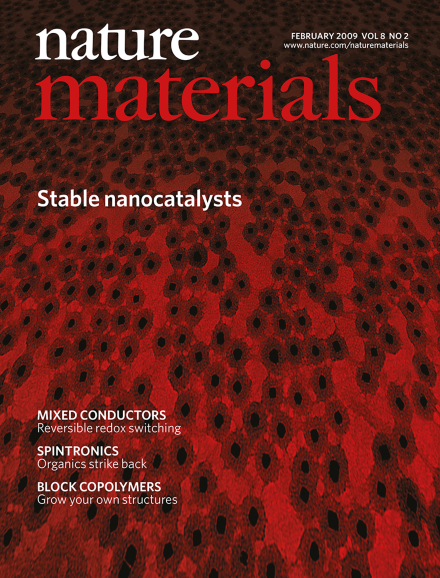
About the coverEditorial
A pledge for immediate action - p81
doi:10.1038/nmat2360
Drastic measures aimed at reducing carbon emissions must be taken now to avoid the devastating effects of global warming on our future.
Full Text - A pledge for immediate action | PDF (127 KB) - A pledge for immediate action
Commentary
An inconvenient truth about thermoelectrics - pp83 - 85
Cronin B. Vining
doi:10.1038/nmat2361
Despite recent advances, thermoelectric energy conversion will never be as efficient as steam engines. That means thermoelectrics will remain limited to applications served poorly or not at all by existing technology. Bad news for thermoelectricians, but the climate crisis requires that we face bad news head on.
Full Text - An inconvenient truth about thermoelectrics | PDF (345 KB) - An inconvenient truth about thermoelectrics
Research Highlights
Our choice from the recent literature - p86
doi:10.1038/nmat2369
Full Text - Our choice from the recent literature | PDF (199 KB) - Our choice from the recent literature
News and Views
Nanocatalysis: More than speed - pp87 - 88
Andrew J. Gellman & Nisha Shukla
doi:10.1038/nmat2363
The role of catalysts is greater than simply increasing the rate of a reaction. Modifying nanoparticles enhances two significant catalyst attributes: selectivity and thermal stability.
Full Text - NanocatalysisMore than speed | PDF (141 KB) - NanocatalysisMore than speed
See also: Article by Joo et al.
Mixed conductors: The bridge to redox switches - pp88 - 89
Jürgen Janek
doi:10.1038/nmat2364
The chain-forming tendency of chalcogens like tellurium can be used as an efficient internal redox system capable of switching electronic conduction from n-type to p-type through small temperature changes.
Full Text - Mixed conductorsThe bridge to redox switches | PDF (134 KB) - Mixed conductorsThe bridge to redox switches
See also: Article by Nilges et al.
Polymer self-assembly: Micelles make a living - pp89 - 91
Stuart J. Rowan
doi:10.1038/nmat2365
Controlled assembly of diblock copolymers in which one of the blocks is crystalline enables the growth of a series of complex nano-architectures in a controlled fashion.
Full Text - Polymer self-assemblyMicelles make a living | PDF (252 KB) - Polymer self-assemblyMicelles make a living
See also: Article by Gädt et al.
Spintronics: Organics strike back - pp91 - 93
Valy Vardeny
doi:10.1038/nmat2366
The spin injection efficiency from a ferromagnetic electrode into an organic layer has been successfully probed by two purpose-made techniques. The observed spin diffusion lengths of tens of nanometres hold promise for potential spintronics applications.
Full Text - SpintronicsOrganics strike back | PDF (160 KB) - SpintronicsOrganics strike back
See also: Article by Drew et al. | Article by Cinchetti et al.
Material witness: What's philosophy got to do with it? - p93
Philip Ball
doi:10.1038/nmat2362
Full Text - Material witnessWhat's philosophy got to do with it? | PDF (108 KB) - Material witnessWhat's philosophy got to do with it?
Letter
In situ observation of dislocation nucleation and escape in a submicrometre aluminium single crystal - pp95 - 100
Sang Ho Oh, Marc Legros, Daniel Kiener & Gerhard Dehm
doi:10.1038/nmat2370
Nanocrystalline materials show significantly different mechanical properties than their bulk counterparts. An in situ microscopy study of Al nanocrystals is now able to directly observe the role of dislocations in tensile deformation and uncover a sensitivity to the strain rate.
First Paragraph - | Full Text - In situ observation of dislocation nucleation and escape in a submicrometre aluminium single crystal | PDF (1,120 KB) - In situ observation of dislocation nucleation and escape in a submicrometre aluminium single crystal | Supplementary information
Articles
Reversible switching between p- and n-type conduction in the semiconductor Ag10Te4Br3 - pp101 - 108
Tom Nilges, Stefan Lange, Melanie Bawohl, Jens Markus Deckwart, Martin Janssen, Hans-Dieter Wiemhöfer, Rodolphe Decourt, Bernard Chevalier, Julia Vannahme, Hellmut Eckert & Richard Weihrich
doi:10.1038/nmat2358
Switching between n- and p-type conduction in a semiconductor can be done through doping. A fundamentally different behaviour has now been observed in Ag10Te4Br3, as a transition from ionic to electronic conduction is achieved simply by heating, which could be used for switches or in novel electronic devices.
Abstract - | Full Text - Reversible switching between p- and n-type conduction in the semiconductor Ag10Te4Br3 | PDF (5,025 KB) - Reversible switching between p- and n-type conduction in the semiconductor Ag10Te4Br3 | Supplementary information
Subject Categories: Electronic materials | Semiconductors
See also: News and Views by Janek
Direct measurement of the electronic spin diffusion length in a fully functional organic spin valve by low-energy muon spin rotation - pp109 - 114
A. J. Drew, J. Hoppler, L. Schulz, F. L. Pratt, P. Desai, P. Shakya, T. Kreouzis, W. P. Gillin, A. Suter, N. A. Morley, V. K. Malik, A. Dubroka, K. W. Kim, H. Bouyanfif, F. Bourqui, C. Bernhard, R. Scheuermann, G. J. Nieuwenhuys, T. Prokscha & E. Morenzoni
doi:10.1038/nmat2333
One of the challenges posed by spin manipulation in organic semiconductors is the difficulty of measuring the spin polarization and the spin diffusion length. This is now elegantly achieved by a low-energy muon spin rotation.
Abstract - | Full Text - Direct measurement of the electronic spin diffusion length in a fully functional organic spin valve by low-energy muon spin rotation | PDF (759 KB) - Direct measurement of the electronic spin diffusion length in a fully functional organic spin valve by low-energy muon spin rotation | Supplementary information
Subject Categories: Molecular electronics | Semiconductors | Optical, photonic and optoelectronic materials
See also: News and Views by Vardeny
Determination of spin injection and transport in a ferromagnet/organic semiconductor heterojunction by two-photon photoemission - pp115 - 119
Mirko Cinchetti, Kathrin Heimer, Jan-Peter Wüstenberg, Oleksiy Andreyev, Michael Bauer, Stefan Lach, Christiane Ziegler, Yongli Gao & Martin Aeschlimann
doi:10.1038/nmat2334
One of the challenges posed by spin manipulation in organic semiconductors is the difficulty of measuring the spin injection from a ferromagnetic contact and the subsequent spin diffusion length. This is now elegantly achieved by a two-photon photoemission experiment.
Abstract - | Full Text - Determination of spin injection and transport in a ferromagnet/organic semiconductor heterojunction by two-photon photoemission | PDF (672 KB) - Determination of spin injection and transport in a ferromagnet/organic semiconductor heterojunction by two-photon photoemission | Supplementary information
Subject Categories: Molecular electronics | Semiconductors | Optical, photonic and optoelectronic materials
See also: News and Views by Vardeny
Conjugated dicarboxylate anodes for Li-ion batteries - pp120 - 125
M. Armand, S. Grugeon, H. Vezin, S. Laruelle, P. Ribière, P. Poizot & J.-M. Tarascon
doi:10.1038/nmat2372
Present Li-ion batteries for portable electronics are based on inorganic electrodes made through non-ecological processes. Sustainable conjugated dicarboxylate organic salt anodes showing advantageous reversible capacities and thermal stability are now reported.
Abstract - | Full Text - Conjugated dicarboxylate anodes for Li-ion batteries | PDF (3,220 KB) - Conjugated dicarboxylate anodes for Li-ion batteries
Subject Category: Materials for energy
Thermally stable Pt/mesoporous silica core–shell nanocatalysts for high-temperature reactions - pp126 - 131
Sang Hoon Joo, Jeong Young Park, Chia-Kuang Tsung, Yusuke Yamada, Peidong Yang & Gabor A. Somorjai
doi:10.1038/nmat2329
Colloidal synthesis can help to precisely control the shape and composition of catalytic metal nanoparticles, but it has so far proved difficult to use these particles in high-temperature reactions. Core–shell structures capable of isolating Pt-mesoporous silica nanoparticles have now been shown to be catalytically active for ethylene hydrogenation and CO oxidation at high temperature.
Abstract - | Full Text - Thermally stable Pt/mesoporous silica core–shell nanocatalysts for high-temperature reactions | PDF (1,117 KB) - Thermally stable Pt/mesoporous silica core–shell nanocatalysts for high-temperature reactions | Supplementary information
Subject Categories: Catalytic materials | Nanoscale materials | Porous materials | Surface and thin films
See also: News and Views by Gellman & Shukla
Tuning selectivity in catalysis by controlling particle shape - pp132 - 138
Ilkeun Lee, Françoise Delbecq, Ricardo Morales, Manuel A. Albiter & Francisco Zaera
doi:10.1038/nmat2371
The selective formation of cis olefins would reduce the production of unhealthy trans fats during the partial hydrogenation of edible oils. Single-crystal surfaces with well-defined supported nanoparticle catalysts now show that platinum (111) surfaces can selectively promote the non-thermodynamic isomerization of trans olefins to their cis counterparts.
Abstract - | Full Text - Tuning selectivity in catalysis by controlling particle shape | PDF (2,022 KB) - Tuning selectivity in catalysis by controlling particle shape
Subject Categories: Catalytic materials | Nanoscale materials | Surface and thin films
See also: News and Views by Gellman & Shukla
Polymer chain dynamics and glass transition in athermal polymer/nanoparticle mixtures - pp139 - 143
Hyunjoon Oh & Peter F. Green
doi:10.1038/nmat2354
Tailoring the properties of polymer nanocomposites—polymers incorporating nanoparticles—is essential to develop biomedical, or even electronic, applications. It is now shown that accurate control of the nanoparticle concentration in nanocomposites prepared from athermal mixtures considerably varies the physical properties with respect to the host polymer.
Abstract - | Full Text - Polymer chain dynamics and glass transition in athermal polymer/nanoparticle mixtures | PDF (818 KB) - Polymer chain dynamics and glass transition in athermal polymer/nanoparticle mixtures
Subject Categories: Composites | Nanoscale materials
Complex and hierarchical micelle architectures from diblock copolymers using living, crystallization-driven polymerizations - pp144 - 150
Torben Gädt, Nga Sze Ieong, Graeme Cambridge, Mitchell A. Winnik & Ian Manners
doi:10.1038/nmat2356
A synthetic tool that uses living polymerizations driven by epitaxial crystallization is shown to create a range of complex micelle architectures made from diblock copolymers. Platelet micelles act as initiators for the formation of scarf-like structures with micellar tassels of controlled length, grown from specific locations.
Abstract - | Full Text - Complex and hierarchical micelle architectures from diblock copolymers using living, crystallization-driven polymerizations | PDF (2,837 KB) - Complex and hierarchical micelle architectures from diblock copolymers using living, crystallization-driven polymerizations | Supplementary information
Subject Categories: Polymers | Nanoscale materials
See also: News and Views by Rowan
Infection-mimicking materials to program dendritic cells in situ - pp151 - 158
Omar A. Ali, Nathaniel Huebsch, Lan Cao, Glenn Dranoff & David J. Mooney
doi:10.1038/nmat2357
Cancer vaccines developed so far typically rely on cell manipulation techniques in the laboratory followed by re-introduction of the cells into the patient. Now, a polymeric material is shown to program and control the trafficking of immune cells in situ, resulting in specific and protective anti-tumour properties.
Abstract - | Full Text - Infection-mimicking materials to program dendritic cells in situ | PDF (861 KB) - Infection-mimicking materials to program dendritic cells in situ | Supplementary information
Subject Categories: Polymers | Biological materials | Biomedical materials
Corrigendum
Atomistic simulations of spinodal phase separation preceding polymer crystallization - p159
Richard H. Gee, Naida Lacevic & Laurence E. Fried
doi:10.1038/nmat2355
Full Text - Atomistic simulations of spinodal phase separation preceding polymer crystallization | PDF (120 KB) - Atomistic simulations of spinodal phase separation preceding polymer crystallization