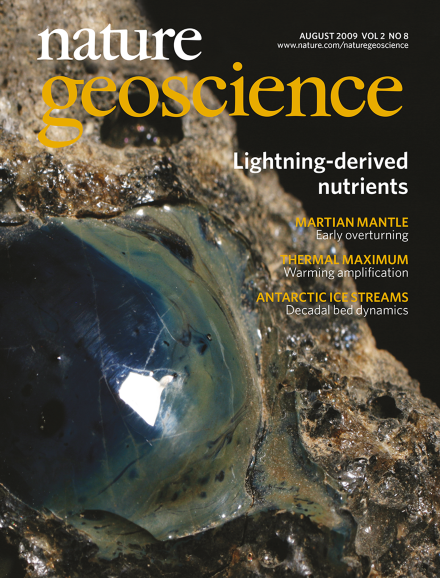
Table of contents
Editorials
Means and ends - p529
doi:10.1038/ngeo599
Palaeoclimate research increasingly portrays itself as a means to understanding future climate change. It would serve the science and scientists better to regard the study of the past as an end in its own right.
On track for citations - p529
doi:10.1038/ngeo606
Nature Geoscience has entered Thomson Reuters's Journal Citation Report, but so far only the 'immediacy index' has been calculated.
Full Text - On track for citations | PDF (80 KB) - On track for citations
Correspondence
Pre-eruptive uplift in the Emeishan? - pp530 - 531
Bin He, Yigang Xu & Ian Campbell
doi:10.1038/ngeo594
Full Text - Pre-eruptive uplift in the Emeishan? | PDF (198 KB) - Pre-eruptive uplift in the Emeishan?
Pre-eruptive uplift in the Emeishan? - pp531 - 532
Ingrid Ukstins Peate & Scott Edward Bryan
doi:10.1038/ngeo600
Full Text - Pre-eruptive uplift in the Emeishan? | PDF (109 KB) - Pre-eruptive uplift in the Emeishan?
Commentary
A black-carbon mitigation wedge - pp533 - 534
Andrew P. Grieshop, Conor C. O. Reynolds, Milind Kandlikar & Hadi Dowlatabadi
doi:10.1038/ngeo595
Comprehensive abatement strategies will be needed to limit global warming. A drastic reduction of black-carbon emissions could provide near-immediate relief with important co-benefits.
Full Text - A black-carbon mitigation wedge | PDF (101 KB) - A black-carbon mitigation wedge
Books and Arts
Acts of God? - p535
Alan Cutler reviews Geology and Religion: A History of Harmony and Hostility by M. Kölbl-Ebert
doi:10.1038/ngeo585
Research Highlights
Our choice from the recent literature - p536
doi:10.1038/ngeo596
Full Text - Our choice from the recent literature | PDF (183 KB) - Our choice from the recent literature
News and Views
Palaeoclimate: Enigmatic Earth - pp537 - 538
David J. Beerling
doi:10.1038/ngeo582
Global warming 55 million years ago was accompanied by a massive injection of carbon into the ocean-atmosphere system, but the resulting climatic warming was much greater than expected from the modelled rise in atmospheric carbon dioxide alone.
Full Text - PalaeoclimateEnigmatic Earth | PDF (170 KB) - PalaeoclimateEnigmatic Earth
Subject Category: Palaeoclimate and palaeoceanography
See also: Letter by Zeebe et al.
Biogeochemistry: Sparking an unusual nutrient - pp538 - 539
Alan W. Schwartz
doi:10.1038/ngeo584
Modern terrestrial microbes have shown a puzzling ability to use reduced forms of phosphorus not commonly found on Earth. An examination of glasses formed in the ground by lightning suggests that lightning strikes can generate these phosphorus species.
Full Text - BiogeochemistrySparking an unusual nutrient | PDF (133 KB) - BiogeochemistrySparking an unusual nutrient
Subject Category: Biogeochemistry
See also: Letter by Pasek & Block
Volcanism: Eruptions and extinctions - pp539 - 540
Nicholas Christie-Blick
doi:10.1038/ngeo598
Fossils from southern China provide evidence for a mass extinction during middle Permian time, 260 million years ago. The close association of this event with an outpouring of lava, initially into the sea, indicates that explosive volcanism may have been the cause.
Full Text - VolcanismEruptions and extinctions | PDF (822 KB) - VolcanismEruptions and extinctions
Subject Category: Volcanology, mineralogy and petrology
Tectonics: Pulling plates apart - pp541 - 542
Joann M. Stock
doi:10.1038/ngeo597
The Salton Sea is located in a sedimentary basin at the southern termination of the San Andreas fault. High-resolution seismic data indicate that the basin formed and grew by active subsidence at its southern end.
Full Text - TectonicsPulling plates apart | PDF (329 KB) - TectonicsPulling plates apart
Subject Category: Structural geology, tectonics and geodynamics
See also: Letter by Brothers et al.
Cartography: Terra cognita - p542
Heike Langenberg
doi:10.1038/ngeo603
Full Text - CartographyTerra cognita | PDF (179 KB) - CartographyTerra cognita
Progress Article
Insights into deep carbon derived from noble gases - pp543 - 547
B. Sherwood Lollar & C. J. Ballentine
doi:10.1038/ngeo588
Science and society are faced with two challenges that are inextricably linked: fossil-fuel energy dependence and rising levels of atmospheric carbon dioxide. Coupling of noble gas and carbon chemistry provides an innovative approach to understanding the deep terrestrial carbon cycle.
Abstract - Insights into deep carbon derived from noble gases | Full Text - Insights into deep carbon derived from noble gases | PDF (166 KB) - Insights into deep carbon derived from noble gases
Letters
Early martian mantle overturn inferred from isotopic composition of nakhlite meteorites - pp548 - 552
V. Debaille, A. D. Brandon, C. O'Neill, Q.-Z. Yin & B. Jacobsen
doi:10.1038/ngeo579
Following the crystallization of a magma ocean, the martian mantle probably underwent an overturning event, but its initiation, timing and geochemical consequences are poorly constrained. Isotopic data for martian meteorites and numerical simulations provide strong evidence for early overturning in the martian mantle.
First Paragraph - Early martian mantle overturn inferred from isotopic composition of nakhlite meteorites | Full Text - Early martian mantle overturn inferred from isotopic composition of nakhlite meteorites | PDF (957 KB) - Early martian mantle overturn inferred from isotopic composition of nakhlite meteorites | Supplementary information
Lightning-induced reduction of phosphorus oxidation state - pp553 - 556
Matthew Pasek & Kristin Block
doi:10.1038/ngeo580
Phosphorus is frequently the limiting nutrient in marine and terrestrial ecosystems. Analysis of lightning-derived glassy compounds from North America, Africa and Australia suggests that cloud-to-ground lightning increases the bioavailability of this nutrient.
First Paragraph - Lightning-induced reduction of phosphorus oxidation state | Full Text - Lightning-induced reduction of phosphorus oxidation state | PDF (861 KB) - Lightning-induced reduction of phosphorus oxidation state | Supplementary information
Asian dust transported one full circuit around the globe - pp557 - 560
Itsushi Uno, Kenta Eguchi, Keiya Yumimoto, Toshihiko Takemura, Atsushi Shimizu, Mitsuo Uematsu, Zhaoyan Liu, Zifa Wang, Yukari Hara & Nobuo Sugimoto
doi:10.1038/ngeo583
Mineral dust can be transported long distances in the lower atmosphere. Satellite measurements and model simulations show that dust generated during a storm in the Taklimakan Desert, China, in 2007 was transported more than once around the globe.
First Paragraph - Asian dust transported one full circuit around the globe | Full Text - Asian dust transported one full circuit around the globe | PDF (1,885 KB) - Asian dust transported one full circuit around the globe | Supplementary information
Considerable methane fluxes to the atmosphere from hydrocarbon seeps in the Gulf of Mexico - pp561 - 565
Evan A. Solomon, Miriam Kastner, Ian R. MacDonald & Ira Leifer
doi:10.1038/ngeo574
The flux of methane—a greenhouse gas—from submarine hydrocarbon seeps to the atmosphere is not well quantified. Direct measurements of methane concentrations and isotopic depth profiles in deepwater hydrocarbon plumes indicate that a significant amount of methane from deep-ocean sources could reach the surface ocean.
First Paragraph - Considerable methane fluxes to the atmosphere from hydrocarbon seeps in the Gulf of Mexico | Full Text - Considerable methane fluxes to the atmosphere from hydrocarbon seeps in the Gulf of Mexico | PDF (786 KB) - Considerable methane fluxes to the atmosphere from hydrocarbon seeps in the Gulf of Mexico | Supplementary information
Methane-derived hydrocarbons produced under upper-mantle conditions - pp566 - 570
Anton Kolesnikov, Vladimir G. Kutcherov & Alexander F. Goncharov
doi:10.1038/ngeo591
It has been proposed that hydrocarbons could be produced abiogenically under the high pressure, high temperature conditions characteristic of the upper mantle. In situ Raman spectroscopy indicates that methane forms saturated hydrocarbons, containing two to four carbons, when exposed to upper-mantle conditions.
First Paragraph - Methane-derived hydrocarbons produced under upper-mantle conditions | Full Text - Methane-derived hydrocarbons produced under upper-mantle conditions | PDF (681 KB) - Methane-derived hydrocarbons produced under upper-mantle conditions | Supplementary information
Constraints on future sea-level rise from past sea-level change - pp571 - 575
Mark Siddall, Thomas F. Stocker & Peter U. Clark
doi:10.1038/ngeo587
Sea level fluctuated substantially over the past 22,000 years. A simple model based on these fluctuations estimates between 7 and 86 cm of sea-level rise by the end of the twenty-first century—in agreement with climate model projections.
First Paragraph - Constraints on future sea-level rise from past sea-level change | Full Text - Constraints on future sea-level rise from past sea-level change | PDF (666 KB) - Constraints on future sea-level rise from past sea-level change | Supplementary information
Carbon dioxide forcing alone insufficient to explain Palaeocene–Eocene Thermal Maximum warming - pp576 - 580
Richard E. Zeebe, James C. Zachos & Gerald R. Dickens
doi:10.1038/ngeo578
About 55 million years ago global surface temperatures increased by 5–9 °C within a few thousand years, following a pulse of carbon released to the atmosphere. Analysis of existing data with a carbon cycle model indicates that this carbon pulse was too small to cause the full amount of warming at accepted values for climate sensitivity.
First Paragraph - Carbon dioxide forcing alone insufficient to explain Palaeocene-Eocene Thermal Maximum warming | Full Text - Carbon dioxide forcing alone insufficient to explain Palaeocene–Eocene Thermal Maximum warming | PDF (711 KB) - Carbon dioxide forcing alone insufficient to explain Palaeocene–Eocene Thermal Maximum warming | Supplementary information
Tectonic evolution of the Salton Sea inferred from seismic reflection data - pp581 - 584
D. S. Brothers, N. W. Driscoll, G. M. Kent, A. J. Harding, J. M. Babcock & R. L. Baskin
doi:10.1038/ngeo590
The Salton Sea is an evolving pull-apart basin located between the San Andreas and Imperial faults in Southern California. Seismic and geological data reveal a rapidly subsiding southern sub-basin that is bounded by a hinge zone to the north, and northwest-dipping normal faults to the south.
First Paragraph - Tectonic evolution of the Salton Sea inferred from seismic reflection data | Full Text - Tectonic evolution of the Salton Sea inferred from seismic reflection data | PDF (8,934 KB) - Tectonic evolution of the Salton Sea inferred from seismic reflection data | Supplementary information
Articles
Formation of mega-scale glacial lineations observed beneath a West Antarctic ice stream - pp585 - 588
E. C. King, R. C. A. Hindmarsh & C. R. Stokes
doi:10.1038/ngeo581
Most discharge from large ice sheets takes place through fast-flowing ice streams. A combination of radar and seismic data reveal megascale glacial lineations at the bed of a West Antarctic ice stream that undergo significant change by erosion and deposition on decadal timescales.
Abstract - Formation of mega-scale glacial lineations observed beneath a West Antarctic ice stream | Full Text - Formation of mega-scale glacial lineations observed beneath a West Antarctic ice stream | PDF (837 KB) - Formation of mega-scale glacial lineations observed beneath a West Antarctic ice stream
See also: related Backstory
Floral changes across the Triassic/Jurassic boundary linked to flood basalt volcanism - pp589 - 594
B. van de Schootbrugge, T. M. Quan, S. Lindström, W. Püttmann, C. Heunisch, J. Pross, J. Fiebig, R. Petschick, H.-G. Röhling, S. Richoz, Y. Rosenthal & P. G. Falkowski
doi:10.1038/ngeo577
The extinction at the Triassic/Jurassic boundary is one of the five largest in Earth's history. Microfossil and organic geochemical analyses link the vegetation turnover in Europe to the release of pollutants and toxic compounds from flood basalt volcanism in the central Atlantic Ocean.
Abstract - Floral changes across the Triassic/Jurassic boundary linked to flood basalt volcanism | Full Text - Floral changes across the Triassic/Jurassic boundary linked to flood basalt volcanism | PDF (2,680 KB) - Floral changes across the Triassic/Jurassic boundary linked to flood basalt volcanism | Supplementary information
Corrigendum
Biophysical controls on organic carbon fluxes in fluvial networks - p595
Tom J. Battin, Louis A. Kaplan, Stuart Findlay, Charles S. Hopkinson, Eugenia Marti, Aaron I. Packman, J. Denis Newbold & Francesc Sabater
doi:10.1038/ngeo602
Full Text - Biophysical controls on organic carbon fluxes in fluvial networks | PDF (87 KB) - Biophysical controls on organic carbon fluxes in fluvial networks
Backstory
Bed of ice - p596
doi:10.1038/ngeo586
Edward King and colleagues towed a radar system over Antarctic ice, and whiled away Christmas in a tent, in their quest to understand glacier sliding.
Full Text - Bed of ice | PDF (136 KB) - Bed of ice
See also: Article by King et al.
Salton surprise - pE13
doi:10.1038/ngeo593
Daniel Brothers and colleagues had a run in with some killer bees while trying to understand tectonic deformation.
Full Text - Salton surprise | PDF (339 KB) - Salton surprise
See also: Letter by Brothers et al.