Table of contents


Top

Editorial

Darwin's geology p81

doi:10.1038/ngeo436

The Charles Darwin bicentennial celebrates the man who recognized natural selection and changed the world's views on evolution. However, his contributions to geology should not be overlooked.


Top

Feature

Land and wine pp82 - 84

Michael A. White, Philip Whalen & Gregory V. Jones

doi:10.1038/ngeo429

Competition from the New World, a changing climate and technological advances have threatened the Burgundian notion that the quality of wine depends on regional geography and culture. Only flexibility can keep the concept of terroir alive.


Top

Books and Arts

Simply wrong p85

Fred T. Mackenzie reviews The Long Thaw: How humans are changing the next 100,000 years of Earth's climate by David Archer

doi:10.1038/ngeo426


Top

Research Highlights


Top

News and Views

Earthquakes: Imperfect dominoes pp87 - 88

Roland Bürgmann

doi:10.1038/ngeo422

Within just three years, a 2,000-km stretch of the plate boundary tracing the Indonesian archipelago slipped in four earthquakes. Studies of past and present seismic activity in the region show a complex, but organized pattern of earthquake supercycles, the latest of which has not been completed.

Subject Categories: Seismology | Structural geology, tectonics and geodynamics


Atmospheric Chemistry: Wyoming winter smog pp88 - 89

Joseph Pinto

doi:10.1038/ngeo430

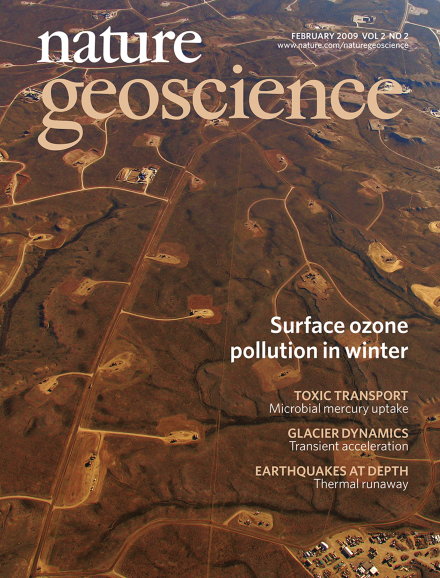
Surface ozone levels are expected to be high in polluted regions during summer months. Observations from Wyoming in February 2008 indicate that equally high concentrations of ozone can be produced during winter.

Subject Category: Atmospheric science

See also: Letter by Schnell et al.


Mass Extinctions: Noxious traps p90

Ninad Bondre

doi:10.1038/ngeo431


Palaeoceanography: Polar twins pp91 - 92

Gerald H. Haug & Daniel M. Sigman

doi:10.1038/ngeo423

Ice ages in the North Pacific Ocean and the Southern Ocean were marked by low productivity. Accumulating evidence indicates that strong stratification restricted the supply of nutrients from the deep ocean to the algae of the sunlit surface in these regions.

Subject Category: Palaeoclimate and palaeoceanography


Biogeochemistry: Mercury methylation made easy pp92 - 93

Richard Sparling

doi:10.1038/ngeo428

The exact mechanism used by microorganisms to produce the neurotoxin methyl mercury is unclear. The latest laboratory studies point to the amino acid cysteine as an important aid for the uptake of inorganic mercury and its transformation to methyl mercury in Geobacter sulfurreducens.

Subject Category: Biogeochemistry

See also: Letter by Schaefer & Morel


Glaciology: From the front pp93 - 94

Stephen Price

doi:10.1038/ngeo424

The causes of recent dynamic thinning of Greenland's outlet glaciers have been debated. Realistic simulations suggest that changes at the marine fronts of these glaciers are to blame, implying that dynamic thinning will cease once the glaciers retreat to higher ground.

Subject Category: Cryospheric science

See also: Letter by Nick et al.


Top

Review

The influence of climate on the tectonic evolution of mountain belts pp97 - 104

Kelin X. Whipple

doi:10.1038/ngeo413

Field studies and experimental research during the past two decades have provided considerable evidence for a significant influence of climate on tectonics. Recent advances suggest that model predictions can guide future fieldwork aimed at substantiating this view.

Subject Categories: Geomorphology | Structural geology, tectonics and geodynamics


Top

Letters

Long-term ocean oxygen depletion in response to carbon dioxide emissions from fossil fuels pp105 - 109

Gary Shaffer, Steffen Malskær Olsen & Jens Olaf Pepke Pedersen

doi:10.1038/ngeo420

Continued global warming could persist far into the future, because natural processes require decades to hundreds of thousands of years to remove carbon dioxide produced by fossil-fuel burning from the atmosphere. A 100,000-year simulation indicates that severe ocean oxygen depletion could last for thousands of years.

Subject Categories: Climate science | Biogeochemistry | Oceanography


Large-scale changes in Greenland outlet glacier dynamics triggered at the terminus pp110 - 114

Faezeh M. Nick, Andreas Vieli, Ian M. Howat & Ian Joughin

doi:10.1038/ngeo394

The recent, dramatic retreat of many outlet glaciers of the Greenland ice sheet has raised concerns over Greenland's contribution to future sea-level rise. Simulations with a numerical ice-flow model indicate that the recent rates of mass loss in Greenland's outlet glaciers are transient and should not be extrapolated into the future.

Subject Categories: Cryospheric science | Climate science

See also: News and Views by Price


Decline of fog, mist and haze in Europe over the past 30 years pp115 - 119

Robert Vautard, Pascal Yiou & Geert Jan van Oldenborgh

doi:10.1038/ngeo414

Surface solar radiation has undergone decadal variations, producing global 'dimming' and 'brightening' effects, probably owing to changes in aerosol burden and clouds. An analysis of multidecadal data of horizontal visibility shows that the occurrence of fog, mist and haze has declined in Europe over the past 30 years.

Subject Categories: Atmospheric science | Climate science


Rapid photochemical production of ozone at high concentrations in a rural site during winter pp120 - 122

Russell C. Schnell, Samuel J. Oltmans, Ryan R. Neely, Maggie S. Endres, John V. Molenar & Allen B. White

doi:10.1038/ngeo415

Photochemical ozone production near the Earth's surface is considered to be a summertime, urban phenomenon. However, air-quality measurements in the rural Upper Green River Basin, Wyoming, show rapid, diurnal photochemical production of ozone during air temperatures as low as -17 °C.

Subject Category: Atmospheric science

See also: related Backstory | News and Views by Pinto


High methylation rates of mercury bound to cysteine by Geobacter sulfurreducens pp123 - 126

Jeffra K. Schaefer & François M. M. Morel

doi:10.1038/ngeo412

Methylmercury bioaccumulates in aquatic food chains and can cross the blood–brain barrier, making this organometallic compound a much more worrisome pollutant than inorganic mercury. Experimental evidence now indicates that mercury methylation by the bacterium Geobacter sulfurreducens can be greatly enhanced in the presence of the amino-acid cysteine.

Subject Categories: Biogeochemistry | Ecology

See also: News and Views by Sparling


Constraints on the magnitude and patterns of ocean cooling at the Last Glacial Maximum pp127 - 132

MARGO Project Members*

doi:10.1038/ngeo411

A quantitative reconstruction of the global climate during the last glacial maximum was published in the early 1980s. A synthesis of global sea-surface temperature reconstructions shows global cooling of the tropical oceans and strong longitudinal temperature-gradients.

Subject Category: Palaeoclimate and palaeoceanography


Timing of crystallization of the lunar magma ocean constrained by the oldest zircon pp133 - 136

A. Nemchin, N. Timms, R. Pidgeon, T. Geisler, S. Reddy & C. Meyer

doi:10.1038/ngeo417

The primitive Moon was covered with a thick layer of melt known as the lunar magma ocean, whose crystallization resulted in the Moon's surface as it is observed today. Dating of the oldest zircon so far in lunar rocks indicates that much of the magma was probably crystallized within 100 million years of the Moon's formation.

Subject Category: Planetary science


Generation of intermediate-depth earthquakes by self-localizing thermal runaway pp137 - 140

Timm John, Sergei Medvedev, Lars H. Rüpke, Torgeir B. Andersen, Yuri Y. Podladchikov & Håkon Austrheim

doi:10.1038/ngeo419

The conditions leading to rock failure during intermediate-depth earthquakes in subduction zones are not clear, particularly in the absence of free fluid. Field observations and numerical simulations indicate that thermal weakening due to high-temperature shear instabilities may trigger earthquakes under such circumstances.

Subject Categories: Seismology | Structural geology, tectonics and geodynamics

See also: related Backstory


Interplate seismogenic zones along the Kuril–Japan trench inferred from GPS data inversion pp141 - 144

Chihiro Hashimoto, Akemi Noda, Takeshi Sagiya & Mitsuhiro Matsu'ura

doi:10.1038/ngeo421

Stress accumulation between earthquakes results from slip that is insufficient to fully accommodate plate movement. An inverse analysis of GPS data from the Kuril–Japan trench reveals a trench-parallel belt of stress accumulation with six peaks in the depth range of 10–40 km, suggesting potential source regions for future earthquakes.

Subject Categories: Seismology | Structural geology, tectonics and geodynamics


Top

Article

Climate sensitivity to the carbon cycle modulated by past and future changes in ocean chemistry pp145 - 150

Philip Goodwin, Richard G. Williams, Andy Ridgwell & Michael J. Follows

doi:10.1038/ngeo416

The carbon cycle plays a central role in climate change. An analytical framework shows that the influence of atmospheric carbon dioxide concentrations on climate is more sensitive to carbon perturbations now than it has been over much of the preceding 400 million years.

Subject Categories: Climate science | Biogeochemistry | Oceanography


Top

Erratum

Tidal flow in satellite oceans p95

Bruce G. Bills

doi:10.1038/ngeo418


Top

Backstory

Cold case p152

doi:10.1038/ngeo425

Russell Schnell and colleagues trawled through meteorological datasets to solve the mystery of the winter ozone anomalies in Wyoming.

See also: Letter by Schnell et al.


Mapping movements in the deep pE2

doi:10.1038/ngeo427

Timm John and colleagues soaked up the beauty, and rain, of Western Norway while attempting to unlock the secrets of deep earthquakes.

See also: Letter by John et al.


Top

Extra navigation

Subscribe to Nature Geoscience

Subscribe

ADVERTISEMENT