Table of contents


Top

Editorial

Looking polewards p141

doi:10.1038/ngeo150


Top

Correspondence

Effect of the Sumatran mega-earthquake on the global magnitude cut-off and event rate p142

Ian G. Main, Lun Li, John McCloskey & Mark Naylor

doi:10.1038/ngeo141


Top

Feature

Science, geopolitics and the governance of Antarctica pp143 - 145

Simon Naylor, Martin Siegert, Katrina Dean & Simone Turchetti

doi:10.1038/ngeo138


Top

Books and Arts

Maps don't lie p147

Ninad Bondre reviews Cartographia by Vincent Virga & The Library of Congress

doi:10.1038/ngeo144


Students, seals and science pp147 - 148

Amy Leventer reviews The Lost Seal by Diane McKnight

doi:10.1038/ngeo145


Top

Erratum

Gender imbalance in US geoscience academia p148

Mary Anne Holmes, Suzanne O'Connell, Connie Frey & Lois Ongley

doi:10.1038/ngeo148


Top

Research Highlights


Top

News and Views

Planetary science: A glimpse of martian plumbing pp151 - 152

Jonathan D. A. Clarke

doi:10.1038/ngeo146

Subject Category: Planetary science


Glaciology: The last stampede of a glacial lake pp152 - 153

Martin Jakobsson

doi:10.1038/ngeo147

Subject Category: Cryospheric science


Climate science: Predicting dry lands p153

Alicia Newton

doi:10.1038/ngeo143

Subject Category: Climate science


Seismology: A giant subducting sausage pp154 - 155

Linda M. Warren

doi:10.1038/ngeo142

Subject Category: Seismology


Planetary science: Message from Mercury p155

Alicia Newton

doi:10.1038/ngeo139

Subject Category: Planetary science


Geomorphology: Survive or subside? pp156 - 157

John W. Day & Liviu Giosan

doi:10.1038/ngeo137

Subject Category: Geomorphology


Geodynamics: Layer cake or plum pudding? pp157 - 158

Paul J. Tackley

doi:10.1038/ngeo134

Subject Category: Structural geology, tectonics and geodynamics


Top

Review

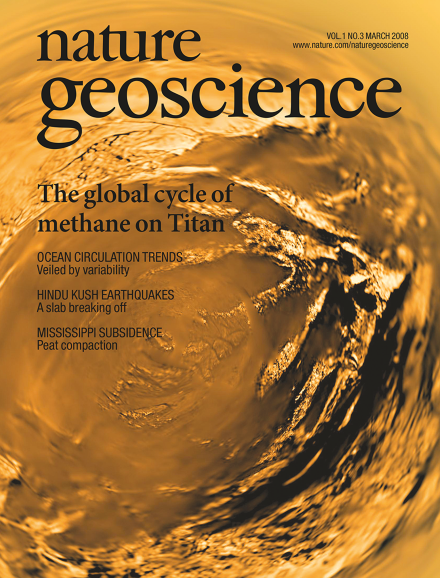
The methane cycle on Titan pp159 - 164

Jonathan I. Lunine & Sushil K. Atreya

doi:10.1038/ngeo125

Despite Titan's cold temperatures (about 93.7 K at the equator), fluvial and atmospheric processes are active on this moon of Saturn, with methane playing a similar role to water on Earth. However, Titan lacks a global methane ocean, and rainfall appears to be episodic.

Subject Category: Planetary science


Top

Letters

Mass and volume transport variability in an eddy-filled ocean pp165 - 168

Carl Wunsch

doi:10.1038/ngeo126

Eddy activity in the North Atlantic ocean produces fluctuations in ocean-wide volume transport on the order of 20times106 cubic metres per second, on multi-year timescales. Such background noise makes it impossible to detect possible trends in the ocean circulation due to a changing climate without multi-decadal observations in three spatial dimensions.

Subject Categories: Climate science | Oceanography


Significant contribution of the 18.6 year tidal cycle to regional coastal changes pp169 - 172

N. Gratiot, E. J. Anthony, A. Gardel, C. Gaucherel, C. Proisy & J. T. Wells

doi:10.1038/ngeo127

Over the last twenty years, changes in the shoreline between the Amazon and Orinoco rivers have largely been controlled by the 18.6 year tidal cycle. By 2015 AD, the tidal cycle will account for 90 metres of shoreline retreat in French Guiana and 6 centimetres of sea level rise.

Subject Categories: Geomorphology | Oceanography


Mississippi Delta subsidence primarily caused by compaction of Holocene strata pp173 - 176

Torbjörn E. Törnqvist, Davin J. Wallace, Joep E. A. Storms, Jakob Wallinga, Remke L. van Dam, Martijn Blaauw, Mayke S. Derksen, Cornelis J. W. Klerks, Camiel Meijneken & Els M. A. Snijders

doi:10.1038/ngeo129

Extensive damage to coastal Louisiana from Hurricane Katrina in 2005 was largely attributed to high rates of relative sea-level rise caused by coastal subsidence. An examination of the underlying Holocene sediments shows that the compaction of peat-rich deposits contributes significantly to Mississippi Delta subsidence rates of up to 5 mm per year.

Subject Category: Geomorphology

See also: News and Views by Day & Giosan | related Backstory


Columbia River flood basalts from a centralized crustal magmatic system pp177 - 180

J. A. Wolff, F. C. Ramos, G. L. Hart, J. D. Patterson & A. D. Brandon

doi:10.1038/ngeo124

The Columbia River Basalt Group in the northwestern United States, derived from flood basalt eruptions that occurred 16 million years ago, exhibits variability in geography and trace element geochemistry that has led to a number of proposed magma origins. However, the geochemical variability can be explained by a relatively simple model in which magma is derived from a mantle plume that assimilated continental crust in a centralized magma system.

Subject Category: Volcanology, mineralogy and petrology


Ancient groundwater flow in the Valles Marineris on Mars inferred from fault trace ridges pp181 - 183

Allan H. Treiman

doi:10.1038/ngeo131

Long linear ridges in the Valles Marineris region of Mars most likely represent fault zones that have been cemented by water-deposited minerals. This implies that water in the Martian crust could have traversed long distances via faults and fractures.

Subject Category: Planetary science

See also: News and Views by Clarke


The subglacial origin of the Lake Agassiz–Ojibway final outburst flood pp184 - 188

Patrick Lajeunesse & Guillaume St-Onge

doi:10.1038/ngeo130

Arc-shaped scours, sandwaves and channels on the Hudson Bay seafloor suggest that the catastrophic drainage of lake Agassiz–Ojibway occurred as a subglacial flood beneath the Laurentide Ice Sheet, which covered northern North America.

Subject Categories: Hydrology, hydrogeology and limnology | Cryospheric science | Palaeoclimate and palaeoceanography

See also: News and Views by Jakobsson | related Backstory


Top

Articles

Increasing eolian dust deposition in the western United States linked to human activity pp189 - 195

J. C. Neff, A. P. Ballantyne, G. L. Farmer, N. M. Mahowald, J. L. Conroy, C. C. Landry, J. T. Overpeck, T. H. Painter, C. R. Lawrence & R. L. Reynolds

doi:10.1038/ngeo133

Dust input to alpine lakes in the western United States has risen dramatically following westward expansion of human settlements and increased livestock grazing over the past two centuries. The increased dust flux deposits additional nutrients and minerals to the lakes, with important implications for water chemistry, productivity and nutrient cycling.

Subject Categories: Biogeochemistry | Geomorphology

See also: related Backstory


Boudinage of a stretching slablet implicated in earthquakes beneath the Hindu Kush pp196 - 201

Gordon Lister, Brian Kennett, Simon Richards & Marnie Forster

doi:10.1038/ngeo132

A large lens-shaped feature bounded by shear zones characterizes the remnant slab beneath the Hindu Kush region. Rather than dripping by viscous flow, the slab is actively stretching and might eventually break off before descending further into the underlying mantle.

Subject Categories: Seismology | Structural geology, tectonics and geodynamics

See also: News and Views by Warren


Top

Backstory

Clues on the seafloor p204

doi:10.1038/ngeo140


Searching for dust pE5

doi:10.1038/ngeo136


Mississippi mud bath pE6

doi:10.1038/ngeo135


Top

Extra navigation

Subscribe to Nature Geoscience

Subscribe

naturejobs

ADVERTISEMENT