Slideshow: Full-colour vision

From the special:
Earth Observation

Credit: NOAA

Radar

Range: 100cm to 1mm

Radar-imaging satellites fire pulses of microwaves at targets on the ground and measure the radiation echoed back. The data allow the height and speed of objects below to be easily determined. It is particularly useful for allowing a view through clouds or at night. Meteorologists can measure wind conditions at sea with a radar instrument aboard the QuickSCAT satellite. Scientists can also use radar data to map topology, and tell one type of land covering (such as vegetation) from another (such as water) based on how electrical conductivity of the surface material affects the echoed microwaves. Several radar-equipped satellites that were passing over the Indian Ocean just after the massive Sumatran earthquake on 26 December 2004 were able to map out the height of the resulting tsunami.

Credit: R. Irish, Landsat 7 Team, NASA/GSFC

Infrared

Range: 1mm to 700 nm

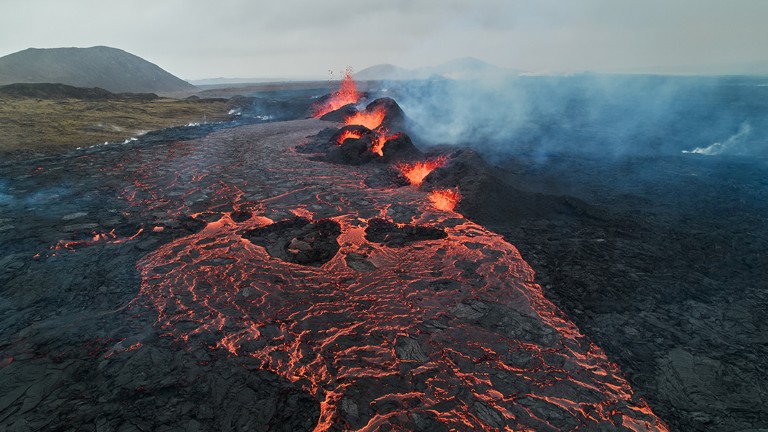
Infrared (IR) instruments measure heat reflected or emitted from the Earth and its atmosphere. Scientists can use IR satellites to measure heat waves, map out vegetation cover, and determine atmospheric conditions. They can also spot and map forest fires and volcanoes. The summer of 2000 was one of the worst to hit the American West in decades, and NASA's Landsat 7 captured a thermal snapshot of a 800-square-kilometre Montana blaze. Through the cloud (blue), active fire (red) can be seen surrounding burn scars (dull red) and heading into unburned vegetation (green).

Credit: J. Schmaltz, MODIS Rapid Response Team, NASA/GSFC

Visible

Range: 700 nm to 400 nm

Visible-light satellite imaging comes in two varieties: true-colour, which is what humans see, and false-colour, which translates values of brightness into a coloured image. Colour can easily highlight things such as phytoplankton blooms: here the bright turquoise of a bloom in the Barents Sea is from sunlight flashing off phytoplankton coated in white calcium carbonate. Google Earth uses the true-colour kind, relying on commercial satellites like Skybird that can snap images down to a half metre in resolution. That is good enough to distinguish a Cooper Mini from a Great Dane. Agencies like the CIA have access to 10-centimetre resolution images. So next time you're reading a newspaper on a park bench, look up instead of over your shoulder.

Credit: TOMS, NASA/GSFC

Ultraviolet

Range: 400 nm to 1 nm

The atmosphere's ozone layer deflects most of the Sun's ultraviolet (UV) rays, keeping them from reaching the surface. The first satellite images of a hole in the ozone layer above Antarctica went unnoticed for years because the data was thrown out by a computer programme that assumed it was an error. When researchers at the British Antarctic Survey detected the hole with land-based techniques in 1985, scientists went back to the satellite images and discovered the hole had been around for nearly a decade.