C. PICKENSIn a small, drab laboratory in Ann Arbor, Michigan, Vishva Dixit was getting bored. It was 1994 and although the University of Michigan associate professor had a grant to continue his studies on thrombospondin, a protein in the extracellular matrix, the work had become tedious. "I seemed to be dotting the 'i's and crossing the 't's," he recalls. "I felt that I needed to be doing something more important."
But what? Dixit had no idea. Biology's 'hot' topic at the time was the cell cycle — specifically, how cells grow and divide — but that didn't appeal to him. Then when reading the latest issue of Scientific American at home, he came across an article about cancer immunotherapy that briefly mentioned the role that tumour necrosis factors play in cell death. That instantly caught his attention. "I was always greatly intrigued by death," he says, but quickly recognizing how morbid that sounds, he adds, "Remember, I was trained as a pathologist."
Although he may overstate the role a magazine article played in his decision to change fields, it was a risk nonetheless. No one else at Michigan studied cell death at the time, and his own grant was intended to fund other work. "If it didn't work out, I was done," he says — he wouldn't be able to renew the grant after having nothing to show for it. But that pressure, he says, galvanized him into action, and for the first time in years, he was excited. "I needed to be addressing a question that was important, where I could make some headway, where I felt I was having some impact," he recalls. "This was it."
Big mysteries
“The scientific question one addresses is as important as the answer one gets.”
Vishva Dixit
Dixit's gambit paid off: his lab became famous for elucidating, in a series of landmark papers, what happens during cell death. Although he has now left academia — he is currently vice-president of research at Genentech, a biotechnology company based in San Francisco, California, and also oversees its postdoctoral programme — Dixit is still drawn to the big mysteries, especially when the rest of the field is preoccupied with other things. "The scientific question one addresses is as important as the answer one gets," Dixit says, choosing his words carefully, much as he chooses his projects.
Dixit has turned his attention to innate immunity, winning recognition for his role in elucidating the function of the 'inflammasome', a complex of proteins inside immune cells that initiates attacks against many pathogens. He suspects that the inflammasome plays an important role in a number of different diseases, including type II diabetes. He is also helping to develop cancer therapeutics based on his research on cell-death signalling, several of which are now in early phase II clinical trials.
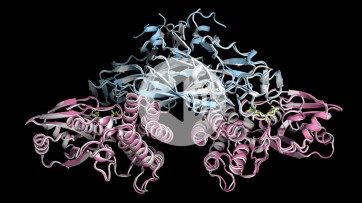
Forming an inflammasone scaffold. Click on the image to see an enlarged version."He has had many different interests," says Andrew Chan, senior vice-president of immunology and antibody engineering at Genentech. "He tackles the big questions, goes after them with phenomenal rigour, and he perseveres." Dixit owns 53 patents and has published 124 journal articles, some garnering more than 2,000 citations.
Dixit's ambition, disregard for convention and love for science have their roots in his childhood. He grew up in Kenya, where both his North Indian parents were practising physicians at a time when, he says, only US$1 was allocated per person per year for health care. His mother told him stories about how drastically African medicine changed when the first antibiotic became available — before then, she and her husband told their dying patients that their best treatment was mountain air. "Then one day you have streptomycin. For people like her, it must have been such a miraculous day," Dixit says. "It made me think about wanting to do something in science that would influence the lives of people."
His interest in death also started in childhood, thanks to the forensic-pathology books that his parents kept at home. "For whatever bizarre reason, those books fascinated me," Dixit recalls. "They had all these totally revolting pictures of gun-shot wounds, of decapitations that would be revolting to most kids, but that sort of captured me." He decided to become a pathologist both because of his preoccupation with death and for practical reasons: it provided him with the most options. "Pathology traversed all medical disciplines," he says.
Dixit wasn't convinced, however, that as a physician he would be able to make a real difference. It would be better, he thought, "to in some way contribute to the progress of medicine" or, in other words, to go into research. After completing his MD, Dixit left Kenya to go to Washington University School of Medicine in St Louis to pursue his residency along with a laboratory fellowship. After that, he was off to Michigan.
A great big onion
“It was, in a way, a bit like peeling an onion. Every layer revealed something interesting.”
Jack Dixon
When Dixit started studying programmed cell death, all that anyone knew about the process, he says, was that cells committed suicide after trigger molecules bound to death receptors on the cell surface. In a series of clever experiments, Dixit's lab identified each component of the cell-death pathway — he named one of the death proteins 'Yama' after the Hindu god of death, although it is now known as caspase-3 — and determined how they were all connected1. "It was, in a way, a bit like peeling an onion," says Jack Dixon, a pharmacologist at the University of California, San Diego, who was also at Michigan at the time. "Every layer that they took off revealed something interesting."
One of the things that Dixit uncovered was an entirely new form of cellular signalling. Until then, scientists predicted that receptors signalled either by serving as ion channels or by adding and removing phosphate groups to and from proteins in a continuous game of tag. A big question in the field was how, exactly, the death pathway started, and Dixit's work revealed that death receptors use adaptor molecules to activate a cascade, initiated by protease enzymes called caspases, that ultimately dismantle the cell. In the "spectacular dance of death" that follows, Dixit says, swatches of the cell membrane 'bleb', bulging and blistering as they break away from the cytoskeleton; cavities form inside the cell; and the cell's nucleus condenses drastically.
The signalling pathway was also far simpler than expected: Dixit predicted that multiple steps separated the adaptor protein from the activation of the death proteases, but his lab discovered that the adaptor directly interacts with the protease via a 'death effector domain'2. "We realized the solution was embarrassingly simple and was staring us in the face," he recalls.
Dixit's work soon attracted interest from Genentech, the company that had given him, free of charge, his first batch of tumour necrosis factor. "They sent me a veritable tonne of the stuff," he says. He moved to the company in 1997 because he was impressed by its dedication to basic research; he was also attracted by the possibility of translating his work into drug development.
Genentech has developed death-receptor activating factors such as Apo2L/TRAIL, which are being tested in combination with drugs against non-Hodgkin's lymphoma. But Dixit largely has turned away from death. The key questions have been answered, he says. He hasn't strayed far, though. When cells commit suicide, they build a protein scaffold that brings a caspase into contact with the death receptor. There are other types of immune-related caspases present inside the cell, too; Dixit wanted to elucidate their function, because he assumed they are also important.
Dixit and others, including Jürg Tschopp, a biochemist at the University of Lausanne in Switzerland, showed that just as the death caspases are recruited into an activating scaffold, other immune caspases — in particular, caspase-1 — integrate into an activating scaffold named the inflammasome3 in 2002. This caspase activates immune factors called cytokines, which initiate an immune attack. In 2004, Dixit's lab provided unequivocal genetic evidence for the identity of specific scaffold components known as adaptors that are responsible for caspase-1 activation, and they showed that inflammasomes have the ability to distinguish between pathogenic attacks — for instance, between different types of bacteria — through the use of different adaptors4.
Amazing instincts
The inflammasome may have important implications for medicine, particularly in treating inflammatory diseases, and maybe even in type II diabetes (see 'A warming trend for the inflammasome'). In the meantime, Dixit continues to follow his instincts, which, colleagues say, are amazing. "He has a really gifted sense of where to go with his science," says Jim Wells, a cellular and molecular pharmacologist at the University of California, San Francisco.
ADVERTISEMENT
Genentech in San Francisco, California, is developing new anticancer drugs.C. PICKENSFor example, while studying how immune pathways turn themselves off, Dixit's group uncovered a surprising twist on a common cellular regulatory process called ubiquitination. Many proteins can be tagged by the addition of chains of protein labels called ubiquitins that are, as the name suggests, found all over most cells. Most of the time ubiquitination marks proteins as rubbish to be degraded and recycled, but in 2004, while studying a protein called A20, Dixit's lab noticed what it called 'ubiquitin editing', a more complex form of ubiquitin signalling5. Responsible for turning off the pro-inflammatory NF-κB pathway, A20 can both ubiquitinate and deubiquitinate the same proteins, a duality that at first seemed like "the ultimate futile cycle", Dixit recalls.
But ubiquitins can signal different things depending on how they are added to a protein. When A20 interacts with an immune mediator called RIP, it first removes an activating ubiquitin chain that is attached by one amino-acid residue (lysine) and then marks it for destruction by building a ubiquitin chain using a different lysine linker. "These seemingly contradictory activities actually act in concert to attenuate cytokine signalling," he says.
The man who started his career in a tiny run-down lab at the University of Michigan may now have a roomy, windowed office with all the resources he needs at his fingertips, but colleagues say that he's still the same guy he's always been — brilliant, discerning, even a little bit calculating — although he is a much snappier dresser now. Dixit insists that his new environment has not changed his perspective on science: he still refuses to tackle anything but the biggest questions he can find, prepared to choose new paths whenever necessary. In fact, he doesn't even feel as if he has stepped out of academia completely — Genentech, he maintains, is as strongly rooted in basic science as anywhere else, and he has at least as much freedom now as he did at Michigan. "People say, 'What's it like having gone to industry?' I say, 'To be honest, I really don't know, because I work at Genentech'." One gets the feeling, however, that Dixit would feel at home anywhere, as long as he had the tools to address life's next big mystery.
Melinda Wenner is a freelance writer in New York City.
-
References
- Tewari, M. et al. Cell 81, 801–809 (1995).
- Muzio, M. et al. Cell 85, 817–827 (1996).
- Martinon, F., Burns, K. & Tschopp, J. Mol. Cell 10, 417–426 (2002).
- Mariathasan, S. et al. Nature 430, 213–217 (2004).
- Wertz, I. et al. Nature 430, 694–699 (2004).
- Hoffman, H. N. et al. Nature Genet. 29, 301–305 (2001)
- Martinon, F. et al. Nature 440, 237–241 (2006).
- Dostert, C. et al. Science 320, 674–677 (2008).
- Malozowski, S. et al. N. Engl. J. Med. 357, 302–303 (2007).

It is a very inspiring story as well as it tells that one can pursue his interests in basic science research very well in an so called "non-academic" set-up as well which has become more or less very sluggish where you spend most of your time in writing your grants and publishing papers without realizing that most of them would end up getting into oblivion after few years.