Table of contents

ARTICLE NAVIGATION - ISSUE
September 2009, Volume 12 No 9 pp1075-1204
About the coverEditorial
Troublesome variability in mouse studies - p1075
doi:10.1038/nn0909-1075
We urge greater awareness of the potential genetic and environmental confounds involved in designing and interpreting studies with mice, and encourage the accurate reporting of the study's design.
Full Text - Troublesome variability in mouse studies | PDF (120 KB) - Troublesome variability in mouse studies
News and Views
Be careful what you train for - pp1077 - 1079
Wolfram Tetzlaff, Karim Fouad & Brian Kwon
doi:10.1038/nn0909-1077
No effective therapeutic interventions exist for severe spinal cord injury. A report in this issue shows that rats can recover substantial 'hand' function after complete lesion of the cervical dorsal corticospinal tract, if treated with a combination of specific reaching rehabilitation exercises and chondroitinase injections to enhance axonal sprouting.
Full Text - Be careful what you train for | PDF (320 KB) - Be careful what you train for
See also: Article by García-Alías et al.
Wnts blow on NeuroD1 to promote adult neuron production and diversity - pp1079 - 1081
Pierre Vanderhaeghen
doi:10.1038/nn0909-1079
NeuroD1 is well known for its role in development. In this issue, two papers collectively show that the Wnt pathway directly activates the transcription factor NeuroD1 to regulate adult neurogenesis and, potentially, neuron diversity.
Full Text - Wnts blow on NeuroD1 to promote adult neuron production and diversity | PDF (585 KB) - Wnts blow on NeuroD1 to promote adult neuron production and diversity
See also: Brief Communication by Gao et al. | Article by Kuwabara et al.
Get stoned in GABAergic synapses - pp1081 - 1083
Ken Mackie & István Katona
doi:10.1038/nn0909-1081
The study by Ozaita and colleagues in this issue identifies a function of CB1 cannabinoid receptors—THC-induced amnesia—and reveals the surprising role of GABAergic synapses in mediating this phenomenon.
Full Text - Get stoned in GABAergic synapses | PDF (234 KB) - Get stoned in GABAergic synapses
See also: Article by Puighermanal et al.
Recognizing Grandmother - pp1083 - 1085
Bharathi Jagadeesh
doi:10.1038/nn0909-1083
Using fMRI to probe face cells in the monkey temporal lobe, a study shows that these face-responsive cells appear to be feature detectors, but only work this way in the holistic construct of a face.
Full Text - Recognizing Grandmother | PDF (523 KB) - Recognizing Grandmother
See also: Article by Freiwald et al.
Reconnecting injured nerves - p1085
Min Cho
doi:10.1038/nn0909-1085
Full Text - Reconnecting injured nerves | PDF (138 KB) - Reconnecting injured nerves
See also: Article by Alto et al.
Brief Communications
Midline crossing and Slit responsiveness of commissural axons require USP33 - pp1087 - 1089
Junichi Yuasa-Kawada, Mariko Kinoshita-Kawada, Guan Wu, Yi Rao & Jane Y Wu
doi:10.1038/nn.2382
This study implicates the proteosome degradation machinery in controlling axon guidance by showing that the deubiquiting enzyme USP33 is essential for controlling Slit/Robo-mediated commissural axonal guidance.
Abstract - Midline crossing and Slit responsiveness of commissural axons require USP33 | Full Text - Midline crossing and Slit responsiveness of commissural axons require USP33 | PDF (282 KB) - Midline crossing and Slit responsiveness of commissural axons require USP33 | Supplementary information
Neurod1 is essential for the survival and maturation of adult-born neurons - pp1090 - 1092
Zhengliang Gao, Kerstin Ure, Jessica L Ables, Diane C Lagace, Klaus-Armin Nave, Sandra Goebbels, Amelia J Eisch & Jenny Hsieh
doi:10.1038/nn.2385
This study uses inducible ablation of NeuroD1 from adult neuronal stem cells/progenitors to show that this transcription factor is crucial for the survival and maturation of adult-born neurons in the hippocampus and olfactory bulb.
Abstract - Neurod1: is essential for the survival and maturation of adult-born neurons | Full Text - Neurod1 is essential for the survival and maturation of adult-born neurons | PDF (425 KB) - Neurod1 is essential for the survival and maturation of adult-born neurons | Supplementary information
See also: News and Views by Vanderhaeghen | Article by Kuwabara et al.
L-type voltage-dependent Ca2+ channels mediate expression of presynaptic LTP in amygdala - pp1093 - 1095
Elodie Fourcaudot, Frederic Gambino, Guillaume Casassus, Bernard Poulain, Yann Humeau & Andreas Lüthi
doi:10.1038/nn.2378
Here, the authors describe the presynaptic mechanism for the induction of cortico-amygdala LTP that involves presynaptic L-type voltage-dependent Ca2+ channels in the lateral amygdala.
Abstract - L-type voltage-dependent Ca: 2+: channels mediate expression of presynaptic LTP in amygdala | Full Text - L-type voltage-dependent Ca2+ channels mediate expression of presynaptic LTP in amygdala | PDF (243 KB) - L-type voltage-dependent Ca2+ channels mediate expression of presynaptic LTP in amygdala | Supplementary information
Articles
Wnt-mediated activation of NeuroD1 and retro-elements during adult neurogenesis - pp1097 - 1105
Tomoko Kuwabara, Jenny Hsieh, Alysson Muotri, Gene Yeo, Masaki Warashina, Dieter Chichung Lie, Lynne Moore, Kinichi Nakashima, Makoto Asashima & Fred H Gage
doi:10.1038/nn.2360
This study shows that adult neurogenesis requires canonical Wnt signaling to trigger transcription of pro-neural NeuroD1. Wnt signaling activates
-catenin, which in complex with TCF/LEF displaces the repressor Sox2 from a previously unknown combined Sox/LEF element in the Neurod1 promoter. Similar Sox/LEF elements activated by Wnt signaling were found in LINE-1 retrotransposons.
Abstract - Wnt-mediated activation of NeuroD1 and retro-elements during adult neurogenesis | Full Text - Wnt-mediated activation of NeuroD1 and retro-elements during adult neurogenesis | PDF (1,250 KB) - Wnt-mediated activation of NeuroD1 and retro-elements during adult neurogenesis | Supplementary information
See also: News and Views by Vanderhaeghen | Brief Communication by Gao et al.
Chemotropic guidance facilitates axonal regeneration and synapse formation after spinal cord injury - pp1106 - 1113
Laura Taylor Alto, Leif A Havton, James M Conner, Edmund R Hollis II, Armin Blesch & Mark H Tuszynski
doi:10.1038/nn.2365
The authors report a successfully targeted reinnervation of hindlimb sensory fibers projection into the CNS following spinal cord injury in rats. Cervical level 1 lesions followed by expression of the neurotrophin NT-3 in the appropriate brainstem target led to proper targeting of regenerating axons.
Abstract - Chemotropic guidance facilitates axonal regeneration and synapse formation after spinal cord injury | Full Text - Chemotropic guidance facilitates axonal regeneration and synapse formation after spinal cord injury | PDF (808 KB) - Chemotropic guidance facilitates axonal regeneration and synapse formation after spinal cord injury | Supplementary information
See also: News and Views by Cho
Kinetic basis of partial agonism at NMDA receptors - pp1114 - 1120
Cassandra L Kussius & Gabriela K Popescu
doi:10.1038/nn.2361
The authors propose a mechanism of partial agonism, showing that partial agonists of both GluN1 and GluN2 NMDA receptor subunits have similar effects on the NMDA receptor activation reaction and they increase the height of all energy barriers during NMDA receptor activation. This contrasts with the localized effects observed for pentameric ligand-gated channels.
Abstract - Kinetic basis of partial agonism at NMDA receptors | Full Text - Kinetic basis of partial agonism at NMDA receptors | PDF (674 KB) - Kinetic basis of partial agonism at NMDA receptors | Supplementary information
Cholinergic modulation of multivesicular release regulates striatal synaptic potency and integration - pp1121 - 1128
Michael J Higley, Gilberto J Soler-Llavina & Bernardo L Sabatini
doi:10.1038/nn.2368
In the striatum, acetylcholine modulates glutamate release via muscarinic receptors. The authors examine individual synapses in rat striatum and find that glutamatergic afferents show multivesicular release and low postsynpatic receptor saturation. Acetylcholine decreases both the probability of release and the amount of glutamate in the cleft, thereby suppressing the activation of nonlinearities in dendrites.
Abstract - Cholinergic modulation of multivesicular release regulates striatal synaptic potency and integration | Full Text - Cholinergic modulation of multivesicular release regulates striatal synaptic potency and integration | PDF (965 KB) - Cholinergic modulation of multivesicular release regulates striatal synaptic potency and integration
Rapamycin activation of 4E-BP prevents parkinsonian dopaminergic neuron loss - pp1129 - 1135
Luke S Tain, Heather Mortiboys, Ran N Tao, Elena Ziviani, Oliver Bandmann & Alexander J Whitworth
doi:10.1038/nn.2372
Here, Tain et al. describe the genetic interaction between 4E-BP, an inhibitor of translation, with Parkinson's disease–associated park and Pink1 in Drosophila, where the manipulation of 4E-BP reduced the pathologic phenotypes, including degeneration of dopaminergic neurons, in park and Pink1 mutant flies.
Abstract - Rapamycin activation of 4E-BP prevents parkinsonian dopaminergic neuron loss | Full Text - Rapamycin activation of 4E-BP prevents parkinsonian dopaminergic neuron loss | PDF (634 KB) - Rapamycin activation of 4E-BP prevents parkinsonian dopaminergic neuron loss | Supplementary information
Origins of correlated activity in an olfactory circuit - pp1136 - 1144
Hokto Kazama & Rachel I Wilson
doi:10.1038/nn.2376
In the Drosophila antennal lobe, there are several projection neurons (PNs) that are postsynaptic to each glomerulus. Here, the authors report that activity in these 'sister' PNs is correlated at a fine temporal scale. The predominant source of correlated activity is shared input from olfactory receptor neurons, with a smaller contribution from reciprocal PN-PN connections.
Abstract - Origins of correlated activity in an olfactory circuit | Full Text - Origins of correlated activity in an olfactory circuit | PDF (2,001 KB) - Origins of correlated activity in an olfactory circuit | Supplementary information
Chondroitinase ABC treatment opens a window of opportunity for task-specific rehabilitation - pp1145 - 1151
Guillermo García-Alías, Stanley Barkhuysen, Miranda Buckle & James W Fawcett
doi:10.1038/nn.2377
Degradation of chondroitin sulphate proteoglycans by chondroitinase ABC (ChABC) in the adult or injured rodent nervous system is known to promote local structural plasticity; however, this alone does not enable much functional recovery after a spinal cord injury. In this study, the authors coupled ChABC treatment with specific motor exercises, which resulted in substantial recovery of injured rats' grasping abilities.
Abstract - Chondroitinase ABC treatment opens a window of opportunity for task-specific rehabilitation | Full Text - Chondroitinase ABC treatment opens a window of opportunity for task-specific rehabilitation | PDF (526 KB) - Chondroitinase ABC treatment opens a window of opportunity for task-specific rehabilitation | Supplementary information
See also: News and Views by Tetzlaff et al.
Cannabinoid modulation of hippocampal long-term memory is mediated by mTOR signaling - pp1152 - 1158
Emma Puighermanal, Giovanni Marsicano, Arnau Busquets-Garcia, Beat Lutz, Rafael Maldonado & Andrés Ozaita
doi:10.1038/nn.2369
Cannabis can impair memory function. This study shows that, in mice, the active component of cannabis, via CB1 receptors on GABA interneurons and a mechanism involving NMDA receptors, activates the mTOR pathway and protein synthesis. This transient activation impairs mice's performance in a memory test.
Abstract - Cannabinoid modulation of hippocampal long-term memory is mediated by mTOR signaling | Full Text - Cannabinoid modulation of hippocampal long-term memory is mediated by mTOR signaling | PDF (459 KB) - Cannabinoid modulation of hippocampal long-term memory is mediated by mTOR signaling | Supplementary information
See also: News and Views by Mackie & Katona
High-sensitivity rod photoreceptor input to the blue-yellow color opponent pathway in macaque retina - pp1159 - 1164
Greg D Field, Martin Greschner, Jeffrey L Gauthier, Carolina Rangel, Jonathon Shlens, Alexander Sher, David W Marshak, Alan M Litke & E J Chichilnisky
doi:10.1038/nn.2353
It has been thought that blue-yellow color opponent cells in the primate retina receive little input from rods. Here, the authors report that rod and cone signals are multiplexed in blue-yellow cells and that this may be the source of the blue hue bias in night vision.
Abstract - High-sensitivity rod photoreceptor input to the blue-yellow color opponent pathway in macaque retina | Full Text - High-sensitivity rod photoreceptor input to the blue-yellow color opponent pathway in macaque retina | PDF (529 KB) - High-sensitivity rod photoreceptor input to the blue-yellow color opponent pathway in macaque retina | Supplementary information
Change detection by thalamic reticular neurons - pp1165 - 1170
Xiong-Jie Yu, Xin-Xiu Xu, Shigang He & Jufang He
doi:10.1038/nn.2373
This paper shows that neurons in the thalamic reticular nucleus (TRN) respond strongly to unexpected sounds and convey this information to the auditory thalamus, modulating the responses of medial geniculate body (MGB) neurons in complex ways. Unexpectedly, visual stimuli via the TRN also modulated the 'auditory' MGB, suggesting a new site of cross-modal sensory integration.
Abstract - Change detection by thalamic reticular neurons | Full Text - Change detection by thalamic reticular neurons | PDF (565 KB) - Change detection by thalamic reticular neurons | Supplementary information
Elimination of climbing fiber instructive signals during motor learning - pp1171 - 1179
Michael C Ke, Cong C Guo & Jennifer L Raymond
doi:10.1038/nn.2366
Climbing fiber input to the cerebellum is thought to control the induction of motor learning. Here, the authors use a new behavioral training procedure in which climbing fiber signals are eliminated, but learning still occurs. This suggests that other neural signals, possibly Purkinje cell simple spike activity, are sufficient to induce motor learning.
Abstract - Elimination of climbing fiber instructive signals during motor learning | Full Text - Elimination of climbing fiber instructive signals during motor learning | PDF (741 KB) - Elimination of climbing fiber instructive signals during motor learning | Supplementary information
Stress, genotype and norepinephrine in the prediction of mouse behavior using reinforcement learning - pp1180 - 1186
Gediminas Luksys, Wulfram Gerstner & Carmen Sandi
doi:10.1038/nn.2374
Individual performance during learning is known to be affected by stress and motivation, as well as by genetic predispositions that influence sensitivity to these factors. Here, the authors find that a reinforcement-learning model can provide an integrative framework for predicting the influence of these factors on mouse learning behavior.
Abstract - Stress, genotype and norepinephrine in the prediction of mouse behavior using reinforcement learning | Full Text - Stress, genotype and norepinephrine in the prediction of mouse behavior using reinforcement learning | PDF (598 KB) - Stress, genotype and norepinephrine in the prediction of mouse behavior using reinforcement learning | Supplementary information
A face feature space in the macaque temporal lobe - pp1187 - 1196
Winrich A Freiwald, Doris Y Tsao & Margaret S Livingstone
doi:10.1038/nn.2363
Cells in a primate face area are sensitive to both specific face parts and the presence of the whole, upright face reports an electrophysiology study in monkeys. Cells in the middle face patch detected distinct constellations of face parts, but their tuning amplitude was modulated by the presence of a whole, upright face.
Abstract - A face feature space in the macaque temporal lobe | Full Text - A face feature space in the macaque temporal lobe | PDF (1,020 KB) - A face feature space in the macaque temporal lobe | Supplementary information
See also: News and Views by Jagadeesh
Resource
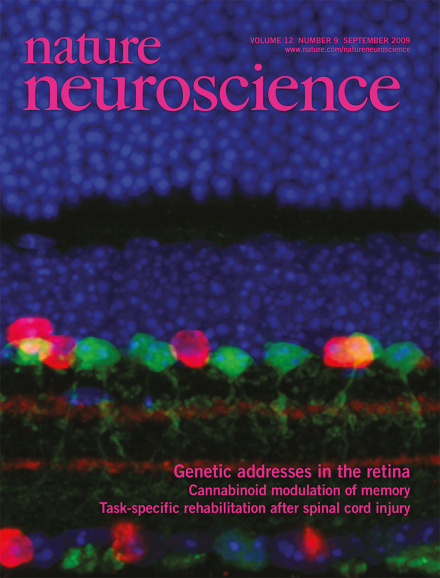
Genetic address book for retinal cell types - pp1197 - 1204
Sandra Siegert, Brigitte Gross Scherf, Karina Del Punta, Nick Didkovsky, Nathaniel Heintz & Botond Roska
doi:10.1038/nn.2370
Selective targeting of specific neuronal populations, for genetic or other manipulations, is crucial to much of neuroscience. The authors screened 536 BAC transgenic mouse lines from the GENSAT collection for specific reporter expression in the retina. Here, they describe several mouse lines selectively targeting different retinal cell types. The full dataset is accessible at http://www.gensat.org/retina.jsp.
Abstract - Genetic address book for retinal cell types | Full Text - Genetic address book for retinal cell types | PDF (1,322 KB) - Genetic address book for retinal cell types | Supplementary information