Table of contents


Top

Focus

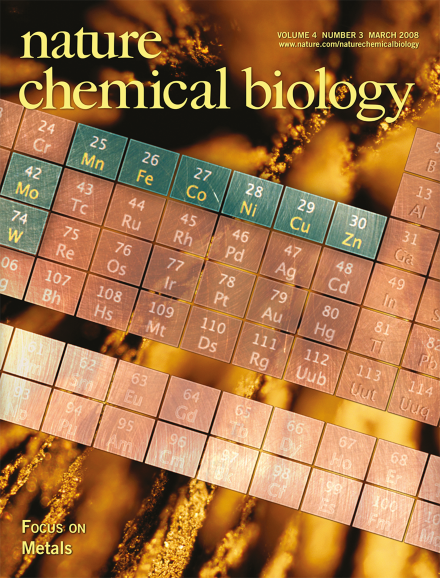
Focus on Metals

In this issue, we highlight important recent advances in understanding both the chemistry and biology of metals in biological systems. We also feature new tools and approaches that can be used to gain a better understanding of the roles that metal ions play in cells and in whole organisms. We hope this collection of articles highlights the excitement of the 'chemical biology' of metals.

Top

In This Issue

Focus on metals

In this issue pv

doi:10.1038/nchembio0308-v


Top

Editorial

Focus on metals

Metals in chemical biology p143

doi:10.1038/nchembio0308-143

As scientists move towards a more comprehensive understanding of the role of metals in biology, bioinorganic chemistry will be an increasingly important component of chemical biology.


Top

Commentaries

Focus on metals

Assembling the pieces pp145 - 147

Dennis J Thiele & Jonathan D Gitlin

doi:10.1038/nchembio0308-145


Focus on metals

Expanding chemical biology of 2-oxoglutarate oxygenases pp152 - 156

Christoph Loenarz & Christopher J Schofield

doi:10.1038/nchembio0308-152


Top

Elements

Focus on metals

Ivano Bertini p157

Joanne Kotz

doi:10.1038/nchembio0308-157

Building on his contributions to NMR methodologies for studying metalloproteins, Bertini has been instrumental in bringing together inorganic chemists and biologists interested in metals in biology.


Top

News and Views

Delivery of tailor-made cobalamin to methylmalonyl-CoA mutase pp158 - 159

Vahe Bandarian

doi:10.1038/nchembio0308-158

Methylmalonyl coenzyme A mutase (MCM) catalyzes the adenosylcobalamin-dependent isomerization of methylmalonyl-CoA to succinyl-CoA. Adenosyltransferase, an enzyme that carries out the final step in biosynthesis of adenosylcobalamin, is shown to be involved in delivery of the cofactor to MCM.

See also: Brief Communication by Padovani et al.


Aggregator compounds confound amyloid fibrillization assay pp159 - 160

Gilbert M Rishton

doi:10.1038/nchembio0308-159

The highly sensitive and artificial biochemical assays that enable high-throughput screening are vulnerable to artifact-generating compounds that occur in drug screening collections. An investigation of known aggregator compounds and amyloid fibrillization inhibitors suggests that such inhibitors operate via a nonspecific mechanism in a well-used assay of amyloid fibrillization.

See also: Brief Communication by Feng et al.


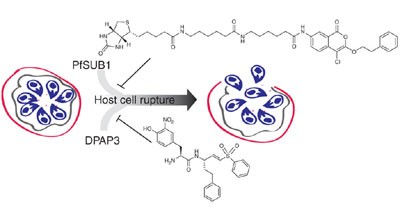
Arresting malaria parasite egress from infected red blood cells pp161 - 162

Marcus C S Lee & David A Fidock

doi:10.1038/nchembio0308-161

The escape of mature malaria parasites from the confines of their host red blood cells is an essential yet poorly understood process. Recent studies now highlight a key role for parasite proteases that trigger the degradation of parasite and host membranes, leading to the egress of infectious parasite forms.

See also: Article by Arastu-Kapur et al.


It's a mod mod tRNA world pp162 - 164

Richard J Maraia, Nathan H Blewett & Mark A Bayfield

doi:10.1038/nchembio0308-162

Postsynthetic modifications are widespread in genetic regulation. Trm9-mediated modification of the anticodon wobble base of specific tRNAs modulates expression of DNA damage response mRNAs in which cognate codons are unusually overrepresented. Thus, modification-dependent tRNA decoding activity is keyed to codon use in a genetic program.


Looking at membrane lipids from the inside of the cell pp164 - 165

J Antoinette Killian

doi:10.1038/nchembio0308-164

A novel biosensor developed to visualize phosphatidylserine in intact cells suggests a new role for the anionic lipid in specifying intracellular membranes involved in signaling events.


Research highlights p167

doi:10.1038/nchembio0308-167


Top

Reviews

Focus on metals

Synthetic fluorescent sensors for studying the cell biology of metals pp168 - 175

Dylan W Domaille, Emily L Que & Christopher J Chang

doi:10.1038/nchembio.69


Focus on metals

Mechanisms for copper acquisition, distribution and regulation pp176 - 185

Byung-Eun Kim, Tracy Nevitt & Dennis J Thiele

doi:10.1038/nchembio.72


Top

Brief Communications

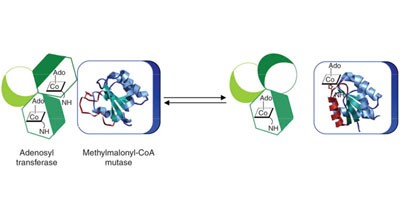
Adenosyltransferase tailors and delivers coenzyme B12 pp194 - 196

Dominique Padovani, Tetyana Labunska, Bruce A Palfey, David P Ballou & Ruma Banerjee

doi:10.1038/nchembio.67

no alt info

See also: News and Views by Bandarian


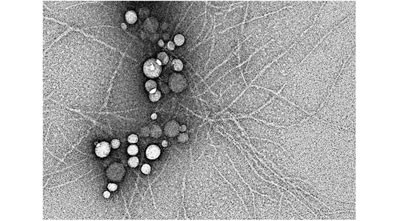
Small-molecule aggregates inhibit amyloid polymerization pp197 - 199

Brian Y Feng, Brandon H Toyama, Holger Wille, David W Colby, Sean R Collins, Barnaby C H May, Stanley B Prusiner, Jonathan Weissman & Brian K Shoichet

doi:10.1038/nchembio.65

no alt info

See also: News and Views by Rishton


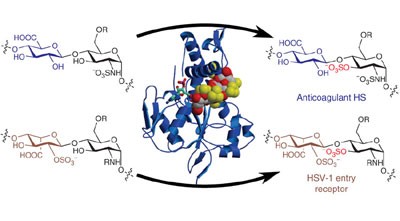
Engineering sulfotransferases to modify heparan sulfate pp200 - 202

Ding Xu, Andrea F Moon, Danyin Song, Lars C Pedersen & Jian Liu

doi:10.1038/nchembio.66

no alt info

Top

Article

Identification of proteases that regulate erythrocyte rupture by the malaria parasite Plasmodium falciparum pp203 - 213

Shirin Arastu-Kapur, Elizabeth L Ponder, Urs carona Pec caronar Fonovic acute, Sharon Yeoh, Fang Yuan, Marko Fonovic acute, Munira Grainger, Carolyn I Phillips, James C Powers & Matthew Bogyo

doi:10.1038/nchembio.70

no alt info

See also: News and Views by Lee & Fidock


Top

Extra navigation

Subscribe to Nature Chemical Biology

Subscribe

naturejobs

natureproducts