Table of contents


Top

Focus

Focus on Natural Products

Investigations into natural products have recently regained prominence with the increasing understanding of their biological significance and increasing recognition of the origin and function of their structural diversity. This issue highlights some of the major questions and advances in natural products research, from recent synthetic approaches to access complicated natural products to a new educational program which utilizes natural products as a basis for discovery-based research.

Top

In This Issue

Focus on natural products

In this issue pv

doi:10.1038/nchembio0707-v


Top

Editorial

Focus on natural products

All natural p351

doi:10.1038/nchembio0707-351

Natural products research focuses on the chemical properties, biosynthesis and biological functions of secondary metabolites. As our scientific understanding of all things 'natural' is rapidly expanding, we should also make time to communicate the subtleties of chemical distinctions to the public.


Top

Correspondence

Rethinking relationships between natural products p352

Stuart L Schreiber

doi:10.1038/nchembio0707-352


Top

Commentaries

Focus on natural products

One pathway, many products pp353 - 355

Michael A Fischbach & Jon Clardy

doi:10.1038/nchembio0707-353

Biosynthetic pathways for secondary metabolites usually make many products, not just one. In this Commentary, we consider why molecular promiscuity might be an evolutionarily advantageous feature of these pathways.


Focus on natural products

Plant endophytes as a platform for discovery-based undergraduate science education pp356 - 359

Scott A Strobel & Gary A Strobel

doi:10.1038/nchembio0707-356

Project ownership is an essential but sometimes overlooked ingredient for a successful undergraduate research experience. We have embarked on an experiment in undergraduate education that targets isolation of microbes from rainforest plants and characterization of natural products as objectives for discovery-based undergraduate research.


Focus on natural products

Revisiting the ancient concept of botanical therapeutics pp360 - 366

Barbara M Schmidt, David M Ribnicky, Peter E Lipsky & Ilya Raskin

doi:10.1038/nchembio0707-360

Mixtures of interacting compounds produced by plants may provide important combination therapies that simultaneously affect multiple pharmacological targets and provide clinical efficacy beyond the reach of single compound–based drugs. Developing innovative scientific methods for discovery, validation, characterization and standardization of these multicomponent botanical therapeutics is essential to their acceptance into mainstream medicine.


Top

Elements

Focus on natural products

Natural products at the Hans Knöll Institute p367

Catherine Goodman

doi:10.1038/nchembio0707-367

Understanding the creation, induction and function of natural products that are important for microbial communication are central aims for scientists at the Leibniz Institute for Natural Product Research and Infection Biology – Hans Knöll Institute.


Top

News and Views

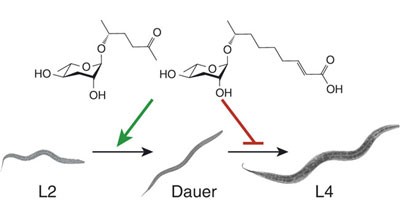
From eye of newt to chemical structure pp368 - 369

Piali Sengupta & James H Thomas

doi:10.1038/nchembio0707-368

Formation of the dauer diapause stage in the nematode Caenorhabditis elegans has been the subject of intensive study over the past few decades. Recent work has established the chemical structure of three components of the secreted dauer pheromone mixture, thereby ushering in a new era in which the functions of the pheromones can be studied in detail.


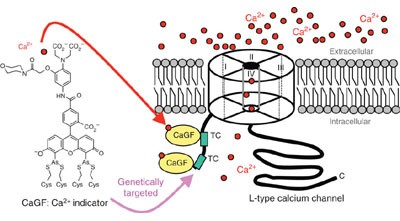
Calcium channels light up pp369 - 370

Eric Green & Ricardo E Dolmetsch

doi:10.1038/nchembio0707-369

The development of a technique for measuring calcium concentrations in nanodomains next to calcium channels provides new insights into calcium signaling.


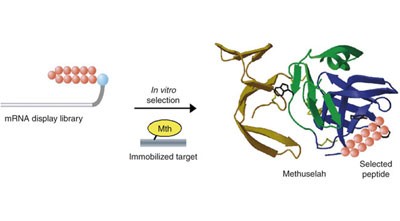
Methuselah antagonist extends life span pp371 - 372

Deirdre McGarrigle & Xin-Yun Huang

doi:10.1038/nchembio0707-371

Newly identified peptide antagonists of the GPCR Methuselah confirm the role of this receptor in aging and should prove useful as tools for investigating the physiological functions of this class of receptor.


A LOVely view of blue light photosensing pp372 - 374

Wen-Huang Ko, Abigail I Nash & Kevin H Gardner

doi:10.1038/nchembio0707-372

A combination of structural and functional data provides insight into the mechanism used by the blue light photosensory protein Vivid to convert the light-driven formation of a protein-flavin bond into a conformational change in the surrounding protein.


Cofactor-independent oxygenases go it alone pp374 - 375

Susanne Fetzner

doi:10.1038/nchembio0707-374

Oxygenases have long been thought to require a cofactor for catalysis. The structure of a vancomycin biosynthetic enzyme in complex with a substrate analog, and with molecular oxygen bound in its active site, supports the idea that cofactor-independent oxygenases act by mediating direct single-electron transfer from a substrate anion to dioxygen.


Research Highlights p377

doi:10.1038/nchembio0707-377


Top

Perspectives

Focus on natural products

Mining and engineering natural-product biosynthetic pathways pp379 - 386

Barrie Wilkinson & Jason Micklefield

doi:10.1038/nchembio.2007.7


Top

Reviews

Focus on natural products

Modern synthetic efforts toward biologically active terpenes pp396 - 407

Thomas J Maimone & Phil S Baran

doi:10.1038/nchembio.2007.1


Focus on natural products

The function of terpene natural products in the natural world pp408 - 414

Jonathan Gershenzon & Natalia Dudareva

doi:10.1038/nchembio.2007.5


Top

Letters

Extension of Drosophila melanogaster life span with a GPCR peptide inhibitor pp415 - 419

William W Ja, Anthony P West, Jr, Silvia L Delker, Pamela J Bjorkman, Seymour Benzer & Richard W Roberts

doi:10.1038/nchembio.2007.2

no alt info


Top

Article

Calcium Green FlAsH as a genetically targeted small-molecule calcium indicator pp423 - 431

Oded Tour, Stephen R Adams, Rex A Kerr, Rene M Meijer, Terrence J Sejnowski, Richard W Tsien & Roger Y Tsien

doi:10.1038/nchembio.2007.4

no alt info

Top

Corrigendum

Corrigendum: Histone deacetylase inhibitors reverse gene silencing in Friedreich's ataxia p432

David Herman, Kai Jenssen, Ryan Burnett, Elisabetta Soragni, Susan L Perlman & Joel M Gottesfeld

doi:10.1038/nchembio0707-432


Top

Extra navigation

Subscribe to Nature Chemical Biology

Subscribe

Open Innovation Challenges

naturejobs