Table of contents


Top

Editorial

A strike against preemption p397

doi:10.1038/nbt0509-397

Industry has been warned: US Food and Drug Administration (FDA) approval is no shield against failure-to-warn or product-liability suits.


Top

News

Wyeth preemption case ruling sparks labeling confusion pp399 - 400

Malorye Allison

doi:10.1038/nbt0509-399


Health under DeParle and Sebelius p400

Emily Waltz

doi:10.1038/nbt0509-400a


Google spawns venture fund p400

Victor Bethencourt

doi:10.1038/nbt0509-400b


Cash infusion for HIV microbicides pp401 - 402

Nayanah Siva

doi:10.1038/nbt0509-401


Corporate venture funds chase early-stage deals pp403 - 404

Peter Mitchell

doi:10.1038/nbt0509-403


Mexico OKs GM corn p404

Veronica Guerrero

doi:10.1038/nbt0509-404


Biotech fat cats p404

doi:10.1038/nbt0509-404b


FDA on warpath for Google links p405

Randy Osborne

doi:10.1038/nbt0509-405


Healthcare reform looms, firms seek scraps from US stimulus pp406 - 408

Jeffrey L Fox

doi:10.1038/nbt0509-406


Chugai reports Actemra deaths p407

Asher Mullard

doi:10.1038/nbt0509-407


Irish biotech buoyant p408

Cormac Sheridan

doi:10.1038/nbt0509-408a


Hospital to genotype all tumors p408

James Netterwald

doi:10.1038/nbt0509-408b


Profile

Richard Gold p409

Hannah Hoag

doi:10.1038/nbt0509-409

Lawyer Richard Gold argues that superfluous patents stifle innovation. Industry should adopt new models, he says, in which knowledge is viewed as a club good.


Data Page

Biotech braves the winter in 1Q09 p410

Walter Yang

doi:10.1038/nbt0509-410


News Feature

Academia and the company coin pp411 - 414

Jim Kling

doi:10.1038/nbt0509-411

As the economic downturn chokes spin-outs from academia, a spate of newly minted university-industry partnerships are springing up. Failing to address the financial conflicts in such partnerships could spell trouble for both faculty and drug companies. Jim Kling investigates.


Top

Bioentrepreneur

Building a business

Prepare to meet your partner pp415 - 418

Cori Gorman, Cammie Edwards & Robert Meister

doi:10.1038/bioe.2009.3


Top

Opinion and Comment

Correspondence

Regulating laboratory-developed tests p419

Hal Barron

doi:10.1038/nbt0509-419a


Regulating laboratory-developed tests pp419 - 420

Kathy Hudson & Gail Javitt

doi:10.1038/nbt0509-419b


Regulating laboratory-developed tests pp420 - 421

Alan Mertz

doi:10.1038/nbt0509-420


Regulating laboratory-developed tests p421

Drew Fromkin

doi:10.1038/nbt0509-421


In need of a reality check p422

Steven Murphy

doi:10.1038/nbt0509-422


Commentary

Gilead's deal of a lifetime p423

Brady Huggett & Christopher Scott

doi:10.1038/nbt0509-423

Gilead Sciences' ascent to the upper echelon of biotech centered around one very savvy acquisition that launched an HIV franchise.


Proceeding in a receding economy pp424 - 425

George A Scangos

doi:10.1038/nbt0509-424

The biotech sector must not only maintain an emphasis on ground-breaking products and focus on retaining key staff but also mobilize to ensure that US health policy continues to reward its innovations.


Book Review

Be reasonable p426

doi:10.1038/nbt0509-426


Top

Features

Small but tenacious: South Africa's health biotech sector pp427 - 445

Sara Al-Bader, Sarah E Frew, Insiya Essajee, Victor Y Liu, Abdallah S Daar & Peter A Singer

doi:10.1038/nbt0509-427

Despite a challenging business environment, entrepreneurial health biotech companies in South Africa are finding ways to succeed.


Patents

Combine and conquer: handling biotech combination inventions in the wake of KSR pp446 - 448

Ha Kung Wong & Dana Lau

doi:10.1038/nbt0509-446

To what extent will KSR limit combination inventions in biotech?


Recent patent applications in biological imaging p449

doi:10.1038/nbt0509-449


Top

News and Views

Overpowering the component problem pp450 - 451

Matthew R Bennett & Jeff Hasty

doi:10.1038/nbt0509-450

Synthetic gene networks can be readily redesigned using new libraries of quantitatively characterized promoters coupled with predictive mathematical modeling.

See also: Research by Ellis et al.


Expanded CAG repeats in the crosshairs pp451 - 452

Neil Aronin

doi:10.1038/nbt0509-451

Antisense oligomers targeted to CAG repeats allow allele-specific knockdown of the gene that causes Huntington's disease.

See also: Research by Hu et al.


Targeted instant immunity pp452 - 453

Claude F Meares

doi:10.1038/nbt0509-452

Antibodies can be programmed to bind cancer cells using covalently binding antigens and adapters.


Top

Research Highlights

Research highlights p454

doi:10.1038/nbt0509-454


Top

Computational Biology

Primer

How to map billions of short reads onto genomes pp455 - 457

Cole Trapnell & Steven L Salzberg

doi:10.1038/nbt0509-455

Mapping the vast quantities of short sequence fragments produced by next-generation sequencing platforms is a challenge. What programs are available and how do they work?


Top

Research

Brief Communications

Embryonic stem cell–specific microRNAs promote induced pluripotency pp459 - 461

Robert L Judson, Joshua E Babiarz, Monica Venere & Robert Blelloch

doi:10.1038/nbt.1535

Judson et al. show that microRNAs specific to mouse embryonic stem cells can substitute for the reprogramming factor cMyc in the generation of induced pluripotent stem cells. The development of reprogramming methods that do not rely on transgenes may facilitate clinical translation of this technology.


Antibacterial discovery in actinomycetes strains with mutations in RNA polymerase or ribosomal protein S12 pp462 - 464

Takeshi Hosaka, Mayumi Ohnishi-Kameyama, Hideyuki Muramatsu, Kana Murakami, Yasuhisa Tsurumi, Shinya Kodani, Mitsuru Yoshida, Akihiko Fujie & Kozo Ochi

doi:10.1038/nbt.1538

Hosaka et al. show that selection of bacteria for antibiotic resistance can be used to discover new antibacterials. Some of the mutant strains they generated, which bear mutations in RNA polymerase and in a ribosomal protein, produce a previously unknown class of antibacterial called piperidamycin.


Article

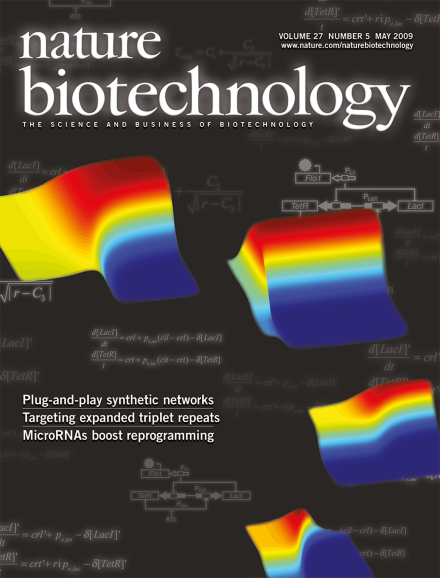
Diversity-based, model-guided construction of synthetic gene networks with predicted functions pp465 - 471

Tom Ellis, Xiao Wang & James J Collins

doi:10.1038/nbt.1536

Ellis et al. describe a strategy for rationally assembling gene networks with predictable behaviors. Using mathematical models, they predict the responses of complex synthetic gene networks built from quantitatively characterized promoter libraries, and harness these networks to regulate an industrially relevant yeast phenotype.

See also: News and Views by Bennett & Hasty


Letters

Allelic imbalance sequencing reveals that single-nucleotide polymorphisms frequently alter microRNA-directed repression pp472 - 477

Jinkuk Kim & David P Bartel

doi:10.1038/nbt.1540

Single-nucleotide polymorphisms in microRNA target sites can disrupt the effects of the microRNA. Kim and Bartel use sequencing to investigate this phenomenon on a large scale and find that such polymorphisms generate gene-regulatory diversity in mice.


Allele-specific silencing of mutant huntingtin and ataxin-3 genes by targeting expanded CAG repeats in mRNAs pp478 - 484

Jiaxin Hu, Masayuki Matsui, Keith T Gagnon, Jacob C Schwartz, Sylvie Gabillet, Khalil Arar, Jun Wu, Ilya Bezprozvanny & David R Corey

doi:10.1038/nbt.1539

Strategies for allele-specific knockdown of the mutant genes in triplet-repeat disorders have relied on point or deletion mutations that differ among affected individuals. Hu et al. show that antisense oligomers can selectively recognize expanded CAG repeats in mRNAs, allowing silencing of mutant but not wild-type alleles.

See also: News and Views by Aronin


Corrigenda

Corrigendum: Highly efficient neural conversion of human ES and iPS cells by dual inhibition of SMAD signaling p485

Stuart M Chambers, Christopher A Fasano, Eirini P Papapetrou, Mark Tomishima, Michel Sadelain & Lorenz Studer

doi:10.1038/nbt0509-485a


Corrigendum: Targeted and genome-scale strategies reveal gene-body methylation signatures in human cells p485

Madeleine P Ball, Jin Billy Li, Yuan Gao, Je-Hyuk Lee, Emily M LeProust, In-Hyun Park, Bin Xie, George Q Daley & George M Church

doi:10.1038/nbt0509-485b


Errata

Erratum: Biotech patents—business as usual? p485

Stacy Lawrence

doi:10.1038/nbt0509-485c


Erratum: Proprietary science, open science and the role of patent disclosure: the case of zinc-finger proteins p485

Subhashini Chandrasekharan, Sapna Kumar, Cory M Valley & Arti Rai

doi:10.1038/nbt0509-485d


Erratum: Biotech scientists bank on big pharma's biologics push p485

Grace Wong

doi:10.1038/nbt0509-485e


Erratum: Identification of selective inhibitors of uncharacterized enzymes by high-throughput screening with fluorescent activity-based probes p485

Daniel A Bachovchin, Steven J Brown, Hugh Rosen & Benjamin F Cravatt

doi:10.1038/nbt0509-485f


Top

Careers and Recruitment

People

People p486

doi:10.1038/nbt0509-486


Top

Extra navigation

Open Innovation Challenges

  • Methods to Analyze Consumer Emotions

    • Deadline: Jan 17 2010
    • Reward: $10,000 USD

    The Seeker is looking for methods to analyze consumer emotions. This Challenge requires only a writ...

  • Single-cell Analysis Platform

    • Deadline: Dec 02 2009
    • Reward: $5,000 USD

    This Challenge is looking for novel approaches to analyzing changes at a single-cell level. This is...

naturejobs

ADVERTISEMENT