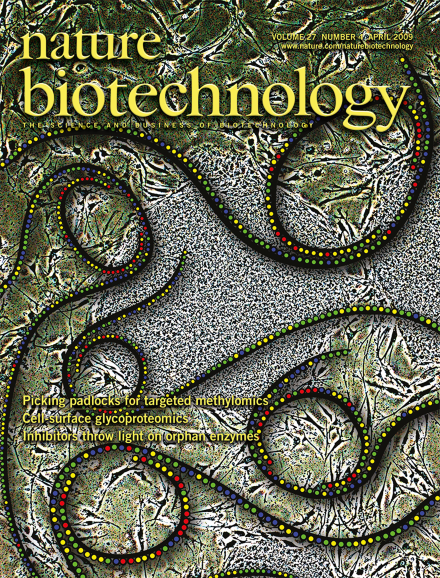
Table of contents


Top

Editorial

Making a difference p297

doi:10.1038/nbt0409-297

If there is one thing that the new team at the US Food and Drug Administration should immediately implement, it is a comprehensive, open database of drug-related adverse events.


Top

News

Pharma swept up in biogenerics gold rush pp299 - 301

Mark Ratner

doi:10.1038/nbt0409-299


One-off therapy for HIV p300

Joe Alper

doi:10.1038/nbt0409-300


First US approval for a transgenic animal drug pp302 - 304

Jim Kling

doi:10.1038/nbt0409-302


RIP Raptiva? p303

Laura DeFrancesco

doi:10.1038/nbt0409-303


EU impasse over GM deepens p304

Anna Meldolesi

doi:10.1038/nbt0409-304a


Cellulosic ethanol stimulus p304

Emily Waltz

doi:10.1038/nbt0409-304b


Competition intensifies around hepatitis C pp305 - 306

Emma Dorey

doi:10.1038/nbt0409-305a


Indian biotechs partner with government p305

K S Jayaraman

doi:10.1038/nbt0409-305b


Malaysia seeks biotech partners p305

Susan Aldridge

doi:10.1038/nbt0409-305c


Genentech's Cabilly victory p307

Emily Waltz

doi:10.1038/nbt0409-307


Profile

Corey Goodman p308

Jim Kling

doi:10.1038/nbt0409-308

Meet the man behind Pfizer's recent decision to bet its entire R&D effort on the biotech model.


News Feature

New relief for gout pp309 - 311

Jill U Adams

doi:10.1038/nbt0409-309

A gout drug has been approved by the FDA, the first in 40 years, with three more in the wings. What accounts for this sudden slew of gout therapies? Jill U. Adams investigates.


Top

Bioentrepreneur

Building a business

Lab relocation roulette: it's your move pp313 - 315

Richard Sayre

doi:10.1038/bioe.2009.2


Top

Opinion and Comment

Correspondence

Incentives for Brazilian health biotech pp317 - 318

Luiz A B Castro & Allan Kardec Barros

doi:10.1038/nbt0409-317


German GM research—a personal account pp318 - 319

Stefan Rauschen

doi:10.1038/nbt0409-318


A kernel for the Tropical Disease Initiative pp320 - 321

Leticia Ortí, Rodrigo J Carbajo, Ursula Pieper, Narayanan Eswar, Stephen M Maurer, Arti K Rai, Ginger Taylor, Matthew H Todd, Antonio Pineda-Lucena, Andrej Sali & Marc A Marti-Renom

doi:10.1038/nbt0409-320


Of Newtons and heretics pp321 - 322

Agomoni Ganguli-Mitra, Markus Schmidt, Helge Torgersen, Anna Deplazes & Nikola Biller-Andorno

doi:10.1038/nbt0409-321


Commentary

Leveraging biotech's drug discovery expertise for neglected diseases pp323 - 329

Joanna E Lowell & Christopher D Earl

doi:10.1038/nbt0409-323

More needs to be done to tap the potential of drug discovery programs in mid-tier biotech companies for innovative treatments against neglected diseases.


Top

Book Review

Drowning in good ideas p330

Bruce Berman reviews The Gridlock Economy: How Too Much Ownership Wrecks Markets, Stops Innovation and Costs Lives by Michael Heller

doi:10.1038/nbt0409-330


Top

Features

Development trends for therapeutic antibody fragments pp331 - 337

Aaron L Nelson & Janice M Reichert

doi:10.1038/nbt0409-331

Although fewer antibody fragments have entered the clinic than full-length monoclonal antibodies, proof-of-concept studies for these therapeutics remain the main hurdle.


Patents

New guidance on the patentability of embryonic stem cell patents in Europe pp338 - 339

Robert Fitt

doi:10.1038/nbt0409-338

The European Patent Office rules in the latest installment of the prosecution of the WARF patents.


Top

News and Views

Locking in on the human methylome pp341 - 342

Benjamin P Berman, Daniel J Weisenberger & Peter W Laird

doi:10.1038/nbt0409-341

Two groups have combined padlock probes and massively parallel sequencing to characterize cytosine methylation in targeted regions of the human genome.

See also: Research by Deng et al. | Research by Ball et al.


A whale of a library pp342 - 344

Deming Xu & Terry Roemer

doi:10.1038/nbt0409-342

The MoBY-ORF collection of barcoded yeast genes provides mechanistic insights into antiproliferative compounds.

See also: Research by Ho et al.


Getting to the core of the gut microbiome pp344 - 346

Matthias H Tschöp, Philip Hugenholtz & Christopher L Karp

doi:10.1038/nbt0409-344

Metagenomic analysis of gastrointestinal bacteria sheds light on obesity.


Missing lincs in the transcriptome pp346 - 347

Thomas Gingeras

doi:10.1038/nbt0409-346

Are long, intervening noncoding (linc) RNAs a new class of functional transcripts?


Top

Research Highlights

Research highlights p348

doi:10.1038/nbt0409-348


Top

Computational Biology

Primer

SNP imputation in association studies pp349 - 351

Eran Halperin & Dietrich A Stephan

doi:10.1038/nbt0409-349

Only a subset of single-nucleotide polymorphisms (SNPs) can be genotyped in genome-wide association studies. Imputation methods can infer the alleles of 'hidden' variants and use those inferences to test the hidden variants for association.


Top

Research

Articles

Targeted bisulfite sequencing reveals changes in DNA methylation associated with nuclear reprogramming pp353 - 360

Jie Deng, Robert Shoemaker, Bin Xie, Athurva Gore, Emily M LeProust, Jessica Antosiewicz-Bourget, Dieter Egli, Nimet Maherali, In-Hyun Park, Junying Yu, George Q Daley, Kevin Eggan, Konrad Hochedlinger, James Thomson, Wei Wang, Yuan Gao & Kun Zhang

doi:10.1038/nbt.1530

Although technically feasible, whole-genome analysis of cytosine methylation using bisulfite sequencing remains prohibitively expensive for large eukaryotic genomes. Deng et al. use 30,000 nondegenerate padlock probes to capture approx66,000 bisulfite-converted sites in human CpG islands and compare their methylation in fibroblasts, embryonic stem cells and induced pluripotent stem cells.

See also: News and Views by Berman et al.


Targeted and genome-scale strategies reveal gene-body methylation signatures in human cells pp361 - 368

Madeleine P Ball, Jin Billy Li, Yuan Gao, Je-Hyuk Lee, Emily M LeProust, In-Hyun Park, Bin Xie, George Q Daley & George M Church

doi:10.1038/nbt.1533

Ball et al. exploit next-generation sequencing to detect methylation across the human genome. A targeted approach uses padlock probes and bisulfite-treated DNA, whereas an untargeted method relies on the methylation-sensitive restriction enzyme HpaII.

See also: News and Views by Berman et al.


A molecular barcoded yeast ORF library enables mode-of-action analysis of bioactive compounds pp369 - 377

Cheuk Hei Ho, Leslie Magtanong, Sarah L Barker, David Gresham, Shinichi Nishimura, Paramasivam Natarajan, Judice L Y Koh, Justin Porter, Christopher A Gray, Raymond J Andersen, Guri Giaever, Corey Nislow, Brenda Andrews, David Botstein, Todd R Graham, Minoru Yoshida & Charles Boone

doi:10.1038/nbt.1534

Knowing a drug's mode of action is invaluable for informing drug discovery efforts. Ho et al. construct an optimized yeast genomic library that enables rapid mutant cloning by complementation to guide mode-of-action studies.

See also: News and Views by Xu & Roemer


Mass-spectrometric identification and relative quantification of N-linked cell surface glycoproteins pp378 - 386

Bernd Wollscheid, Damaris Bausch-Fluck, Christine Henderson, Robert O'Brien, Miriam Bibel, Ralph Schiess, Ruedi Aebersold & Julian D Watts

doi:10.1038/nbt.1532

Wollscheid et al. describe a multiplexed, mass spectrometry–based approach to catalog glycoproteins on the surfaces of live cells without the need for antibodies. They use it to monitor changes in the cell-surface glycoproteome during T-cell activation and the differentiation of embryonic stem cells to neural progenitors.


Identification of selective inhibitors of uncharacterized enzymes by high-throughput screening with fluorescent activity-based probes pp387 - 394

Daniel A Bachovchin, Steven J Brown, Hugh Rosen & Benjamin F Cravatt

doi:10.1038/nbt.1531

Many enzymes in eukaryotic and prokaryotic proteomes have no known substrate. Bachovchin et al. use the fluorescence polarization signal of broad-spectrum, activity-based probes to find inhibitors of such enzymes in high-throughput screens.


Top

Naturejobs

Careers and Recruitment

Biotech hirings and firings p395

Michael Francisco

doi:10.1038/nbt0409-395


People

People p396

doi:10.1038/nbt0409-396


Top

Extra navigation

Open Innovation Challenges

naturejobs

ADVERTISEMENT