Table of contents
Volume 462 Number 7271 pp251-380
(this content only available online) indicates content that is available online only
Editorials
The entangled bank unravels p251
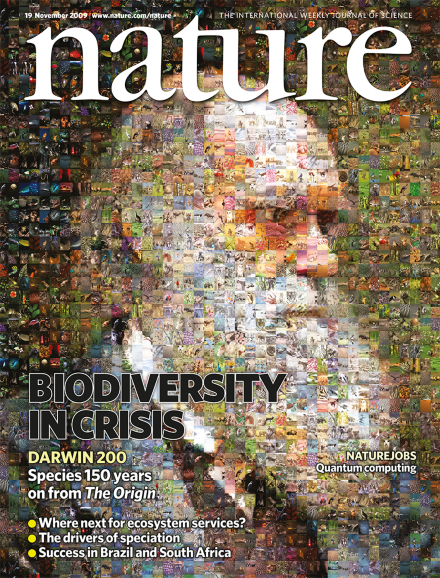
This third special issue in Nature's year-long celebration of Charles Darwin focuses on the dire challenges to Earth's biodiversity — and finds some reason for hope.
doi:10.1038/462251a
See also: Editor's summary
Access denied? p252
Information-sharing resources are essential to biologists and deserve international support.
doi:10.1038/462252a
Research Highlights
Biodiversity: Weird worms p254
doi:10.1038/462254a
Geology: Impact ironed out p254
doi:10.1038/462254b
Cancer biology: Gene highs and lows p254
doi:10.1038/462254c
Microscopy: Cell close-up p254
doi:10.1038/462254d
Agriculture: Mixed manure message p254
doi:10.1038/462254e
Palaeontology: Hot-blooded dinosaurs p254
doi:10.1038/462254f
Nanobiotechnology: Magnetic tumour cells p255
doi:10.1038/462255a
Marine ecology: Speedy sponge p255
doi:10.1038/462255b
Planetary science: Cracking Martian ice p255
doi:10.1038/462255c
Regenerative biology: Brainy stem cells p255
doi:10.1038/462255d
News
News briefing: 19 November 2009 p256
The week in science
doi:10.1038/462256a
Japanese science faces deep cuts p258
The government's election promises vowed more support for science, but so far budgets look set to shrink.
David Cyranoski
doi:10.1038/462258a
Plant genetics database at risk as funds run dry p258
National Science Foundation to cut support for Arabidopsis resource.
Alison Abbott
doi:10.1038/462258b
Muon collider gains momentum p260
Fermilab pins hopes on untested technology in race to stay at the cutting edge of physics.
Eric Hand
doi:10.1038/462260a
Efforts to sustain biodiversity fall short p263
But the issue is gaining attention as nations prepare for next year's summit.
Natasha Gilbert
doi:10.1038/462263a
Growth in R&D investment holding up p264
But analysts expect effects of financial crisis to be more marked next year.
Andrea Chipman
doi:10.1038/462264a
Fresh hope for German stem-cell patent case p265
Referral to European Court may help to harmonize laws on intellectual property.
Alison Abbott
doi:10.1038/462265a
News Features
Biodiversity: Biodiversity's bright spot p266
While species losses mount worldwide, conservationists in Brazil have made great strides towards saving the golden lion tamarin and its forest habitat from destruction. Gene Russo reports.
doi:10.1038/462266a
Biodiversity: Putting a price on nature p270
Gretchen Daily knows the value of ecosystems — but can ascribing financial worth to them help to maintain biodiversity? Emma Marris meets an ecosystem-services evangelist.
doi:10.1038/462270a
Biodiversity: On the origin of bar codes p272
Genetic sequences in a cell's mitochondria can be used to accurately determine species. Could this be because they are responsible for creating what they identify? Nick Lane investigates.
doi:10.1038/462272a
Column
Experts and democracy p275
Specialist advice can be invaluable in shaping policy, but, argues Colin Macilwain, democracies need to keep a careful eye on the powers acquired by an unelected elite.
Colin Macilwain
doi:10.1038/462275a
Correspondence
Boreal forests' carbon stores need better management p276
Stuart Pimm, Nigel Roulet & Andrew Weaver
doi:10.1038/462276a
Legal and practical pitfalls in making use of patents p276
David Piehler
doi:10.1038/462276b
Water should take centre stage at climate talks p276
Yulia Timoshkina
doi:10.1038/462276c
Sensible measures to guard India's groundwater supply p276
Saumitra Mukherjee
doi:10.1038/462276d
Opinion
Costing the Earth p277
The value of biodiversity must be accounted for, says Pavan Sukhdev. It is time for governments to invest to secure the flow of nature's 'public goods'.
Pavan Sukhdev
doi:10.1038/462277a
See also: Editor's summary
A force to fight global warming p278
Natural ecosystems and biodiversity must be made a bulwark against climate change, not a casualty of it, argue Will R. Turner, Michael Oppenheimer and David S. Wilcove.
Will R. Turner, Michael Oppenheimer & David S. Wilcove
doi:10.1038/462278a
See also: Editor's summary
Let the locals lead p280
To save biodiversity, on-the-ground agencies need to set the conservation research agenda, not distant academics and non-governmental organizations, argue Robert J. Smith and colleagues.
Robert J. Smith, Diogo Veríssimo, Nigel Leader-Williams, Richard M. Cowling & Andrew T. Knight
doi:10.1038/462280a
Full Text | PDF (837K) | Supplementary information
See also: Editor's summary
A call to the custodians of deep time p282
Palaeontologists must model the causes of biodiversity rather than simply cataloguing fossils, says Douglas Erwin, as they curate the only record of ecosystems undamaged by humans.
Douglas Erwin
doi:10.1038/462282a
See also: Editor's summary
Global Darwin: Multicultural mergers p284
Latin Americans first saw evolution as a reason to 'whiten' their societies, then as a reason to take pride in their mixed lineage, says Jürgen Buchenau in the last of four pieces on Darwin's global influence.
Jürgen Buchenau
doi:10.1038/462284a
Books and Arts
Bonds forged on the high seas p286
Shared experiences on global voyages linked Darwin and his fellow naturalists, explains Alistair Sponsel.
Alistair Sponsel reviews Darwin's Armada: Four Voyages and the Battle for the Theory of Evolution by Iain McCalman
doi:10.1038/462286a
Log of life beneath the waves p287
Mark Schrope reviews World Ocean Census: A Global Survey of Marine Life by Darlene Trew Crist, Gail Scowcroft & James M. Harding Jr
doi:10.1038/462287a
Q&A: Bird behaviour, Darwin and dance p288
Nicky Clayton, a biologist and psychologist who studies the behaviour of birds, and who is also a salsa and tango dancer, collaborated with Rambert Dance Company to create a work commemorating Charles Darwin. As The Comedy of Change tours the United Kingdom, she explains how communicating via motion is common to both dance and the natural world.
Patrick Goymer
doi:10.1038/462288a
In Retrospect: The earliest picture of evolution? p289
Ideas about the mutability of species may have been part of Enlightenment imagery before Lamarck.
Fausto Barbagli reviews De anima brutorum commentaria (Commentary on the Soul of Animals) by Francesco Maria Soldini
doi:10.1038/462289a
Corrections p289
doi:10.1038/462289b
News and Views
Astrophysics: Burst of support for relativity p291
Light from a distant
-ray burst backs up a key prediction of Albert Einstein's theory of relativity — that photon speed is the same regardless of energy. But it might set the stage for evolution of the theory.
Giovanni Amelino-Camelia
doi:10.1038/462291a
See also: Editor's summary
Structural biology: New beginnings for transcription p292
A structure for the enzyme RNA polymerase II in combination with the transcription factor TFIIB changes our view of how the polymerase and its helper proteins initiate transcription.
Steven Hahn
doi:10.1038/462292a
See also: Editor's summary
Evolutionary biology: Why reproduction often takes two p294
On the face of it, self-fertilization is the efficient way to breed: compared with outcrossing, there's usually much less fuss, for a start. So why isn't reproduction by selfing far more prevalent than it is?
Aneil F. Agrawal
doi:10.1038/462294a
See also: Editor's summary
50 & 100 years ago p295
doi:10.1038/462295b
Palaeoclimate: Kink in the thermometer p295
Temperature estimates derived from isotopes in polar ice cores reveal much about Earth's past climate. According to the latest analysis, interglacial periods were rather warmer than previously thought.
David Noone
doi:10.1038/462295a
See also: Editor's summary
Epigenomics: Methylation matters p296
Genome-wide maps of methylated cytosine bases at single-base-pair resolution in human cells reveal distinct differences between cell types. These maps provide a starting point to decode the function of this enigmatic mark.
Dirk Schübeler
doi:10.1038/462296a
See also: Editor's summary
Chemical physics: Guiding light p297
Andrew Mitchinson
doi:10.1038/462297a
News and Views Q&A
Malaria: Evolution in vector control p298
Each week some 20,000 people die from malaria. There will be no magic ways of reducing this dreadful toll, not least because the mosquito vector and the parasite itself have formidable abilities to resist control measures. Angles of attack that rest on evolutionary principles are being explored.
Yannis Michalakis & François Renaud
doi:10.1038/462298a
Reviews
Light and shadow from distant worlds p301
Drake Deming & Sara Seager
doi:10.1038/nature08556
First paragraph | Full Text | PDF (413K)
See also: Editor's summary
Human genetics illuminates the paths to metabolic disease p307
Stephen O'Rahilly
doi:10.1038/nature08532
First paragraph | Full Text | PDF (342K)
See also: Editor's summary
Articles
Human DNA methylomes at base resolution show widespread epigenomic differences p315
DNA cytosine methylation has essential roles in a number of cellular processes. Here, the first genome-wide, single-base-resolution maps of methylated cytosines in a mammalian genome — from both human embryonic stem cells and fetal fibroblasts — are presented, along with analyses of the transcriptome, histone modifications, and sites of DNA–protein interaction for several regulatory factors. The results reveal key differences in methylation patterns between the two genomes.
Ryan Lister, Mattia Pelizzola, Robert H. Dowen, R. David Hawkins, Gary Hon, Julian Tonti-Filippini, Joseph R. Nery, Leonard Lee, Zhen Ye, Que-Minh Ngo, Lee Edsall, Jessica Antosiewicz-Bourget, Ron Stewart, Victor Ruotti, A. Harvey Millar, James A. Thomson, Bing Ren & Joseph R. Ecker
doi:10.1038/nature08514
Abstract | Full Text | PDF (1,456K) | Supplementary information
See also: Editor's summary | News and Views by Schübeler
RNA polymerase II–TFIIB structure and mechanism of transcription initiation p323
Transcription of eukaryotic protein-coding genes is initiated by RNA polymerase II (Pol II) in a complex with transcription factors including the transcription factor IIB (B). The crystal structure of the complete Pol II–B complex is now presented with complementary functional data. The results shed light on the mechanism of transcription initiation, including the transition to RNA elongation.
Dirk Kostrewa, Mirijam E. Zeller, Karim-Jean Armache, Martin Seizl, Kristin Leike, Michael Thomm & Patrick Cramer
doi:10.1038/nature08548
PDB code
3D view
Abstract | Full Text | PDF (2,390K) | Supplementary information
See also: Editor's summary | News and Views by Hahn
Letters
A limit on the variation of the speed of light arising from quantum gravity effects p331
Lorentz invariance — the postulate that all observers measure exactly the same speed of light in vacuum, independent of photon energy — is a cornerstone of Einstein's special relativity, but it has been suggested that it might break near the Planck scale. A possible variation of photon speed with energy is a key test for this proposed violation; here, by studying sharp features in
-ray burst light-curves to look for even tiny variations in photon speed, no evidence for the violation of Lorentz invariance is found.
A. A. Abdo, M. Ackermann, M. Ajello, K. Asano, W. B. Atwood, M. Axelsson, L. Baldini, J. Ballet, G. Barbiellini, M. G. Baring, D. Bastieri, K. Bechtol, R. Bellazzini, B. Berenji, P. N. Bhat, E. Bissaldi, E. D. Bloom, E. Bonamente, J. Bonnell, A. W. Borgland, A. Bouvier, J. Bregeon, A. Brez, M. S. Briggs, M. Brigida, P. Bruel, J. M. Burgess, T. H. Burnett, G. A. Caliandro, R. A. Cameron, P. A. Caraveo, J. M. Casandjian, C. Cecchi, Ö. Çelik, V. Chaplin, E. Charles, C. C. Cheung, J. Chiang, S. Ciprini, R. Claus, J. Cohen-Tanugi, L. R. Cominsky, V. Connaughton, J. Conrad, S. Cutini, C. D. Dermer, A. de Angelis, F. de Palma, S. W. Digel, B. L. Dingus, E. do Couto e Silva, P. S. Drell, R. Dubois, D. Dumora, C. Farnier, C. Favuzzi, S. J. Fegan, J. Finke, G. Fishman, W. B. Focke, L. Foschini, Y. Fukazawa, S. Funk, P. Fusco, F. Gargano, D. Gasparrini, N. Gehrels, S. Germani, L. Gibby, B. Giebels, N. Giglietto, F. Giordano, T. Glanzman, G. Godfrey, J. Granot, J. Greiner, I. A. Grenier, M.-H. Grondin, J. E. Grove, D. Grupe, L. Guillemot, S. Guiriec, Y. Hanabata, A. K. Harding, M. Hayashida, E. Hays, E. A. Hoversten, R. E. Hughes, G. Jóhannesson, A. S. Johnson, R. P. Johnson, W. N. Johnson, T. Kamae, H. Katagiri, J. Kataoka, N. Kawai, M. Kerr, R. M. Kippen, J. Knödlseder, D. Kocevski, C. Kouveliotou, F. Kuehn, M. Kuss, J. Lande, L. Latronico, M. Lemoine-Goumard, F. Longo, F. Loparco, B. Lott, M. N. Lovellette, P. Lubrano, G. M. Madejski, A. Makeev, M. N. Mazziotta, S. McBreen, J. E. McEnery, S. McGlynn, P. Mészáros, C. Meurer, P. F. Michelson, W. Mitthumsiri, T. Mizuno, A. A. Moiseev, C. Monte, M. E. Monzani, E. Moretti, A. Morselli, I. V. Moskalenko, S. Murgia, T. Nakamori, P. L. Nolan, J. P. Norris, E. Nuss, M. Ohno, T. Ohsugi, N. Omodei, E. Orlando, J. F. Ormes, M. Ozaki, W. S. Paciesas, D. Paneque, J. H. Panetta, D. Parent, V. Pelassa, M. Pepe, M. Pesce-Rollins, V. Petrosian, F. Piron, T. A. Porter, R. Preece, S. Rainò, E. Ramirez-Ruiz, R. Rando, M. Razzano, S. Razzaque, A. Reimer, O. Reimer, T. Reposeur, S. Ritz, L. S. Rochester, A. Y. Rodriguez, M. Roth, F. Ryde, H. F.-W. Sadrozinski, D. Sanchez, A. Sander, P. M. Saz Parkinson, J. D. Scargle, T. L. Schalk, C. Sgrò, E. J. Siskind, D. A. Smith, P. D. Smith, G. Spandre, P. Spinelli, M. Stamatikos, F. W. Stecker, M. S. Strickman, D. J. Suson, H. Tajima, H. Takahashi, T. Takahashi, T. Tanaka, J. B. Thayer, J. G. Thayer, D. J. Thompson, L. Tibaldo, K. Toma, D. F. Torres, G. Tosti, E. Troja, Y. Uchiyama, T. Uehara, T. L. Usher, A. J. van der Horst, V. Vasileiou, N. Vilchez, V. Vitale, A. von Kienlin, A. P. Waite, P. Wang, C. Wilson-Hodge, B. L. Winer, K. S. Wood, X. F. Wu, R. Yamazaki, T. Ylinen & M. Ziegler
doi:10.1038/nature08574
First paragraph | Full Text | PDF (234K) | Supplementary information
See also: Editor's summary | News and Views by Amelino-Camelia
Coexistence of Fermi arcs and Fermi pockets in a high-Tc copper oxide superconductor p335
Fermi arcs, which are open-ended gapless sections in the large Fermi surface, have been observed in the pseudogap state of high-transition-temperature (high-Tc) copper oxide superconductors rather than the closed loop expected of an ordinary metal. This is all the more puzzling because Fermi pockets have been suggested by recent quantum oscillation measurements. Fermi pockets are now measured in a high-Tc copper oxide superconductor and, surprisingly, they appear to coexist with the Fermi arcs.
Jianqiao Meng, Guodong Liu, Wentao Zhang, Lin Zhao, Haiyun Liu, Xiaowen Jia, Daixiang Mu, Shanyu Liu, Xiaoli Dong, Jun Zhang, Wei Lu, Guiling Wang, Yong Zhou, Yong Zhu, Xiaoyang Wang, Zuyan Xu, Chuangtian Chen & X. J. Zhou
doi:10.1038/nature08521
First paragraph | Full Text | PDF (906K) | Supplementary information
See also: Editor's summary
Ultraflat graphene p339
Graphene, an atom-thin carbon sheet is interesting for its fundamental properties as well as for its possible applications in electronics, is not strictly two-dimensional. Microscopic corrugations, or ripples, have been observed in all graphene sheets so far. Direct experimental study of the physics of such ripples has been hindered by the lack of flat graphene layers. Ultraflat graphene is now achieved through its deposition on the atomically flat terraces of cleaved mica surfaces.
Chun Hung Lui, Li Liu, Kin Fai Mak, George W. Flynn & Tony F. Heinz
doi:10.1038/nature08569
First paragraph | Full Text | PDF (469K) | Supplementary information
See also: Editor's summary
Evidence for warmer interglacials in East Antarctic ice cores p342
Reconstructions of temperature variations from Antarctic ice cores rely on the assumption that the relationship between hydrogen and oxygen isotope ratios and temperature are stable in space and time. Three East Antarctic ice core records are now analysed alongside input from general circulation models to reveal that during warmer interglacial periods the isotope ratios are less sensitive to temperature than during colder interglacials; consequently, previous estimates of interglacial temperatures are probably too cold.
L. C. Sime, E. W. Wolff, K. I. C. Oliver & J. C. Tindall
doi:10.1038/nature08564
First paragraph | Full Text | PDF (1,517K) | Supplementary information
See also: Editor's summary | News and Views by Noone
Reconstruction of the history of anthropogenic CO2 concentrations in the ocean p346
The ocean takes up 20 to 35 per cent of anthropogenic CO2 emissions, but uncertainties remain as to the distribution of this CO2 in the ocean, its rate of uptake over the industrial era, and the relative roles of the ocean and terrestrial biosphere in anthropogenic CO2 sequestration. An observationally based reconstruction of the spatially resolved, time-dependent history of anthropogenic carbon in the ocean over the industrial era now allows these questions to be addressed.
S. Khatiwala, F. Primeau & T. Hall
doi:10.1038/nature08526
First paragraph | Full Text | PDF (586K) | Supplementary information
See also: Editor's summary
Mutation load and rapid adaptation favour outcrossing over self-fertilization p350
The tendency of organisms to reproduce by cross-fertilization, despite the advantages of self-fertilization and particularly the cost of males, is one of the oldest puzzles of evolutionary biology. Two advantages of outcrossing that could outweigh this cost have been suggested: the avoidance of inbreeding and an enhanced ability to adapt to environmental change. Here, the study of outcrossing in populations of Caenorhabditis elegans suggests that both of these explanations are correct.
Levi T. Morran, Michelle D. Parmenter & Patrick C. Phillips
doi:10.1038/nature08496
First paragraph | Full Text | PDF (177K) | Supplementary information
See also: Editor's summary | News and Views by Agrawal
Frequency of gamma oscillations routes flow of information in the hippocampus p353
Gamma oscillations in the brain are thought to 'bind' spatially distributed cells, a function that is probably important in perception, attentional selection and memory. However, it is unclear why the frequency of gamma oscillations varies substantially across space and time. Here, the study of the frequency of gamma oscillations in the CA1 area of the hippocampus suggests that variations in gamma frequency may be important for routeing information in the brain.
Laura Lee Colgin, Tobias Denninger, Marianne Fyhn, Torkel Hafting, Tora Bonnevie, Ole Jensen, May-Britt Moser & Edvard I. Moser
doi:10.1038/nature08573
First paragraph | Full Text | PDF (563K) | Supplementary information
See also: Editor's summary
Systems-level dynamic analyses of fate change in murine embryonic stem cells p358
The interaction between the different molecular mechanisms that regulate changes in embryonic stem cell (ESC) fate is not fully understood. A dynamic systems-level study of cell fate change in murine ESCs following a well-defined perturbation is now presented; the data demonstrate how a single genetic perturbation leads to widespread changes in several molecular regulatory layers, and provide a dynamic view of information flow in the epigenome, transcriptome and proteome.
Rong Lu, Florian Markowetz, Richard D. Unwin, Jeffrey T. Leek, Edoardo M. Airoldi, Ben D. MacArthur, Alexander Lachmann, Roye Rozov, Avi Ma'ayan, Laurie A. Boyer, Olga G. Troyanskaya, Anthony D. Whetton & Ihor R. Lemischka
doi:10.1038/nature08575
First paragraph | Full Text | PDF (1,443K) | Supplementary information
See also: Editor's summary
Signal peptides are allosteric activators of the protein translocase p363
Most secreted proteins are synthesized as 'preproteins' with amino-terminal, cleavable signal peptides which mediate targeting and translocation across membranes by translocases. The main bacterial translocase comprises the SecYEG protein-conducting channel and the peripheral ATPase motor SecA. Signal peptides, thought to be involved in preprotein targeting to SecA, are now shown to have a new role beyond targeting as allosteric activators of the translocase.
Giorgos Gouridis, Spyridoula Karamanou, Ioannis Gelis, Charalampos G. Kalodimos & Anastassios Economou
doi:10.1038/nature08559
First paragraph | Full Text | PDF (832K) | Supplementary information
See also: Editor's summary
Dynamic activation of an allosteric regulatory protein p368
Allosteric regulation is used to control protein activity across a broad range of biological processes. Effectors are thought to function by selectively stabilizing a specific conformational state with distinct binding or enzymatic activity, thereby regulating protein activity. Here, the characterization of the binding of cyclic AMP to the catabolite activator protein demonstrates that allosteric proteins can be regulated predominantly by changes in their structural dynamics.
Shiou-Ru Tzeng & Charalampos G. Kalodimos
doi:10.1038/nature08560
First paragraph | Full Text | PDF (2,036K) | Supplementary information
See also: Editor's summary
Naturejobs
NewsEmerging shortages p375
Some of the world's fastest-growing economies are facing science and engineering workforce shortfalls.
Gene Russo
doi:10.1038/nj7271-375a
Postdoc journal
Climate-change depression p375
Writing about issues that matter helps ease my worries about the world's problems.
Joanne Isaac
doi:10.1038/nj7271-375b
In Brief
Postdocs on a pittance p375
Rewards are few for postdocs in Canada, says survey.
doi:10.1038/nj7271-375c
Tenure or family? p375
Lack of family-friendly policies responsible for leaky pipeline for women in the US.
doi:10.1038/nj7271-375d
Huge cuts by drug firms p375
The R&D closure is the latest in a series of hits to drug companies.
doi:10.1038/nj7271-375e
Careers and Recruitment
Quantum potential p376
The emerging field of quantum information science is harnessing nature's strangest habits — and providing an academic haven for young physicists. Eric Hand reports.
Eric Hand
doi:10.1038/nj7271-376a
Futures
A letter from the past p380
On the dubious position of Aelfus in the evolutionary tree of mankind.
Ruy José Válka Alves
doi:10.1038/462380a