Table of contents
Volume 462 Number 7270 pp137-242
In this issue (12 November 2009)
Also this week
(this content only available online) indicates content that is available online only
Editorials
Containing risk p137
The ad-hoc proliferation of high-security biological labs must be controlled, and should be tied in more closely to broader research and public-health goals.
doi:10.1038/462137a
No turning back p137
Spain should not use the recession as an excuse to stall plans to boost its scientific enterprise.
doi:10.1038/462137b
A healthy get together p138
The recently launched World Health Summit offers a rare chance for dialogue.
doi:10.1038/462138a
Research Highlights
Gene therapy: Nerve repair p140
doi:10.1038/462140a
Climate science: Volcano chills p140
doi:10.1038/462140b
Longevity: Sweet food, short life p140
doi:10.1038/462140c
Climate change: Kilimanjaro's loss p140
doi:10.1038/462140d
Neuroscience: Early stress marks genes p140
doi:10.1038/462140e
Astronomy: Galaxies far, far away p140
doi:10.1038/462140f
Biophysics: DNA stop and go p141
doi:10.1038/462141a
Atmospheric science: Industrial UV shield p141
doi:10.1038/462141b
Nanoscience: Release the goods p141
doi:10.1038/462141c
Genomics: Sequencing costs drop p141
doi:10.1038/462141d
News
News briefing: 12 November 2009 p142
The week in science
doi:10.1038/462142a
End of the road for Copenhagen? p144
Expectations are dropping as December's UN climate talks get closer.
Jeff Tollefson
doi:10.1038/462144a
Wellcome Trust makes it personal in funding revamp p145
People not projects are the focus of longer-term grants.
Natasha Gilbert
doi:10.1038/462145a
European biosafety labs set to grow p146
Bioterrorism and emerging diseases spur building boom, although some question the need for more facilities.
Declan Butler
doi:10.1038/462146a
Call to boost isotope supplies p147
Two dedicated plants are needed to meet demand, committee says.
Eric Hand
doi:10.1038/462147a
China moves to help high-tech firms p149
But initiatives meet with mixed response.
David Cyranoski
doi:10.1038/462149a
Snapshot: Glider eavesdrops on whales p151
Probe tunes in to cetacean song.
Rex Dalton
doi:10.1038/462151a
Britain sets up defence advisory group p151
Government seeks academic input on security issues.
Geoff Brumfiel
doi:10.1038/462151b
Report row ousts top Indian scientist p152
Ruckus over call for reform at national science agency raises questions about attracting expatriate talent.
K. S. Jayaraman
doi:10.1038/462152a
Correction p152
doi:10.1038/462152b
News Feature
Swine flu: One killer virus, three key questions p154
Nature visits the labs of researchers working to solve some of the most perplexing puzzles of swine-flu behaviour.
doi:10.1038/462154a
Correspondence
Weapons: the need to replace ageing and deteriorating stock p158
Jay Davis
doi:10.1038/462158a
Weapons: existing stockpile can be safely maintained p158
Gerald E. Marsh
doi:10.1038/462158b
Many types of action are required to tackle climate change p158
Mike Hulme
doi:10.1038/462158c
Decarbonization figures for India and China unconvincing p158
Roger A. Pielke, Jr.
doi:10.1038/462158d
No special cases in efforts to stop immigration fraud p159
Iain Scott
doi:10.1038/462159a
Emissions affected by trade among developing countries p159
Dabo Guan & David M. Reiner
doi:10.1038/462159b
Phosphorus decline could be good for water supplies p159
Michael J. Castellano
doi:10.1038/462159c
Opinion
Universities need a new social contract p160
To reconcile solution-driven research and blue-skies thinking, academic institutions urgently need innovative collaborations and new funding models, says Indira V. Samarasekera.
Indira V. Samarasekera
doi:10.1038/462160a
Global Darwin: Revolutionary road p162
In China, under the threat of Western imperialism, interpretations of Darwin's ideas paved the way for Marx, Lenin and Mao, argues James Pusey in the third in our series on reactions to evolutionary theory.
James Pusey
doi:10.1038/462162a
Books and Arts
Fun with nuclear reactors p164
Two books reveal the spirit of adventure behind the history of nuclear technology, finds William J. Nuttall.
William J. Nuttall reviews Uranium Wars: The Scientific Rivalry that Created the Nuclear Age by Amir Aczel and Atomic Awakening: A New Look at the History and Future of Nuclear Power by James Mahaffey
doi:10.1038/462164a
Valuing the digital economy p165
John Gilbey reviews Wired for Innovation: How Information Technology is Reshaping the Economy by Erik Brynjolfsson & Adam Saunders
doi:10.1038/462165a
Tips from the top of the career ladder p165
Asha Gopinathan reviews Beyond the Boys' Club: Strategies for Achieving Career Success as a Woman Working in a Male-dominated Field by Suzanne Doyle-Morris
doi:10.1038/462165b
Q&A: The algorist p166
Having moved from engineering to art, Jean-Pierre Hébert applies mathematical rules to generate artworks that explore themes of chaos and determinism. As resident artist at the Kavli Institute for Theoretical Physics, and with an exhibition on in Los Angeles, Hébert explains his interest in algorithms.
Daniel Cressey reviews Jean-Pierre Hébert: Drawings as Thoughts
doi:10.1038/462166a
News and Views
Drug discovery: Predicting promiscuity p167
Computational methods that reliably predict the biological activities of compounds have long been sought. The validation of one such method suggests that in silico predictions for drug discovery have come of age.
Andrew L. Hopkins
doi:10.1038/462167a
See also: Editor's summary
Astrophysics: A fossil record for exoplanets p168
Stars that host planets experience more mixing of their internal elements than do stars that lack such companions. This correlation may serve as a useful diagnostic in the search for planets around stars other than the Sun.
Marc Pinsonneault
doi:10.1038/462168a
See also: Editor's summary
Language evolution: The importance of being human p169
The FOXP2 gene is implicated in the development of human speech and language. A comparison of the human and chimpanzee FOXP2 proteins highlights the differences in function in the two species.
Martin H. Dominguez & Pasko Rakic
doi:10.1038/462169a
See also: Editor's summary
Condensed-matter physics: Dirac electrons broken to pieces p170
Graphene continues to surprise physicists with its remarkable electronic properties. Experiments now show that electrons in the material can team up to behave as if they are only fragments of themselves.
Alberto F. Morpurgo
doi:10.1038/462170a
See also: Editor's summary
Chemical biology: A Notch above other inhibitors p171
A tenet of drug discovery states that molecules greater than a certain size don't enter cells. But not only do certain synthetic peptides refute this idea, they also inhibit 'undruggable' biological targets.
Paramjit S. Arora & Aseem Z. Ansari
doi:10.1038/462171a
See also: Editor's summary
Articles
Predicting new molecular targets for known drugs p175
Drugs that are chemically quite similar often bind to biologically diverse protein targets, and it is unclear how selective many of these compounds are. Because many drug–target combinations exist, it would be useful to explore possible interactions computationally. Here, 3,665 drugs are tested against hundreds of targets; chemical similarities between drugs and ligand sets are found to predict thousands of unanticipated associations.
Michael J. Keiser, Vincent Setola, John J. Irwin, Christian Laggner, Atheir I. Abbas, Sandra J. Hufeisen, Niels H. Jensen, Michael B. Kuijer, Roberto C. Matos, Thuy B. Tran, Ryan Whaley, Richard A. Glennon, Jérôme Hert, Kelan L. H. Thomas, Douglas D. Edwards, Brian K. Shoichet & Bryan L. Roth
doi:10.1038/nature08506
Abstract | Full Text | PDF (1,478K) | Supplementary information
See also: Editor's summary | News and Views by Hopkins
Direct inhibition of the NOTCH transcription factor complex p182
It is notoriously difficult to target transcription factors with aberrant activity in cancer. Inappropriate activation of the NOTCH complex of transcription factors is directly implicated in the pathogenesis of several disease states, including T-cell acute lymphoblastic leukaemia. The design of synthetic, cell-permeable, stabilized
-helical peptides that disrupt protein–protein interactions in NOTCH is now described.
Raymond E. Moellering, Melanie Cornejo, Tina N. Davis, Cristina Del Bianco, Jon C. Aster, Stephen C. Blacklow, Andrew L. Kung, D. Gary Gilliland, Gregory L. Verdine & James E. Bradner
doi:10.1038/nature08543
PDB code
3D view
Abstract | Full Text | PDF (1,294K) | Supplementary information
See also: Editor's summary | News and Views by Arora & Ansari
Letters
Enhanced lithium depletion in Sun-like stars with orbiting planets p189
Although a large range of lithium (Li) abundances is observed in solar-type stars, this range has proved theoretically difficult to understand. An earlier suggestion that Li is more depleted in stars with planets was weakened by the lack of a proper comparison sample of stars without detected planets. Here, Li abundances are reported for an unbiased sample of solar-analogue stars with and without detected planets. It is found that about 50% of the solar analogues without detected planets have on average ten times more Li that those with planets.
Garik Israelian, Elisa Delgado Mena, Nuno C. Santos, Sergio G. Sousa, Michel Mayor, Stephane Udry, Carolina Domínguez Cerdeña, Rafael Rebolo & Sofia Randich
doi:10.1038/nature08483
First paragraph | Full Text | PDF (198K)
See also: Editor's summary | News and Views by Pinsonneault
Fractional quantum Hall effect and insulating phase of Dirac electrons in graphene p192
The fractional quantum Hall effect (FQHE) is the quintessential collective quantum behaviour of charge carriers confined to two dimensions but it has not yet been observed in graphene, a material distinguished by the charge carriers' two-dimensional and relativistic character. Here, and in an accompanying paper, the FQHE is observed in graphene through the use of devices containing suspended graphene sheets; the results of these two papers open a door to the further elucidation of the complex physical properties of graphene.
Xu Du, Ivan Skachko, Fabian Duerr, Adina Luican & Eva Y. Andrei
doi:10.1038/nature08522
First paragraph | Full Text | PDF (503K) | Supplementary information
See also: Editor's summary | News and Views by Morpurgo
Observation of the fractional quantum Hall effect in graphene p196
The fractional quantum Hall effect (FQHE) is the quintessential collective quantum behaviour of charge carriers confined to two dimensions but it has not yet been observed in graphene, a material distinguished by the charge carriers' two-dimensional and relativistic character. Here, and in an accompanying paper, the FQHE is observed in graphene through the use of devices containing suspended graphene sheets; the results of these two papers open a door to the further elucidation of the complex physical properties of graphene.
Kirill I. Bolotin, Fereshte Ghahari, Michael D. Shulman, Horst L. Stormer & Philip Kim
doi:10.1038/nature08582
First paragraph | Full Text | PDF (434K) | Supplementary information
See also: Editor's summary | News and Views by Morpurgo
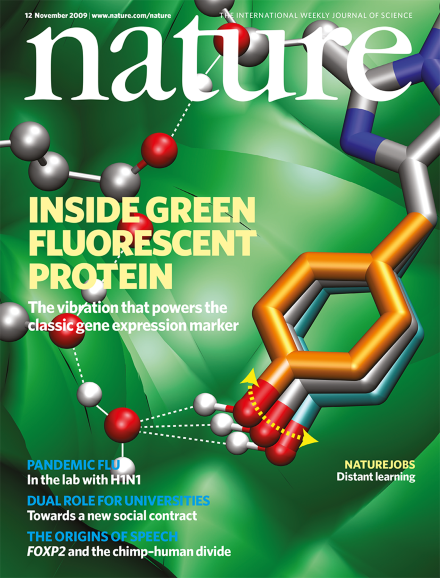
Mapping GFP structure evolution during proton transfer with femtosecond Raman spectroscopy p200
Tracing the transient atomic motions that lie at the heart of chemical reactions requires high-resolution structural information on the timescale of molecular vibrations. Femtosecond stimulated Raman spectroscopy is now shown to provide sufficiently detailed and time-resolved vibrational spectra of the electronically excited chromophore of green fluorescent protein to reveal skeletal motions involved in the proton transfer that produces the fluorescent form of the protein.
Chong Fang, Renee R. Frontiera, Rosalie Tran & Richard A. Mathies
doi:10.1038/nature08527
First paragraph | Full Text | PDF (1,243K) | Supplementary information
See also: Editor's summary
Oxygen and hydrogen isotope evidence for a temperate climate 3.42 billion years ago p205
The study of stable oxygen isotope ratios (
18O) of Precambrian cherts suggests that ocean temperatures during the Archaean era (about 3.5 billion years ago) were between 55 °C and 85 °C, but uncertainty about the
18O of the primitive ocean has led to considerable debate regarding this conclusion. Here, a combined analysis of oxygen and hydrogen istopes sampled from 3.42-billion-year-old Buck Reef Chert rocks in South Africa indicates that the ancient ocean was much cooler than previously thought.
M. T. Hren, M. M. Tice & C. P. Chamberlain
doi:10.1038/nature08518
First paragraph | Full Text | PDF (341K) | Supplementary information
See also: Editor's summary
Permeability of asthenospheric mantle and melt extraction rates at mid-ocean ridges p209
The timescale for segregation and transport of basaltic melts, which are ultimately responsible for formation of the Earth's crust, is critically dependent on the permeability of the partly molten asthenospheric mantle, yet this permeability is known mainly from semi-empirical and analogue models. A high-pressure, high-temperature centrifuge is now used to measure the rate of basalt melt flow in olivine aggregates; the resulting permeabilities are one to two orders of magnitude larger than predicted by current parameterizations.
James A. D. Connolly, Max W. Schmidt, Giulio Solferino & Nikolai Bagdassarov
doi:10.1038/nature08517
First paragraph | Full Text | PDF (400K) | Supplementary information
See also: Editor's summary
Human-specific transcriptional regulation of CNS development genes by FOXP2 p213
The transcription factor FOXP2 is the only gene implicated in human speech, and yet it differs very little from the chimpanzee orthologue. Here, the two amino acids specific to humans are shown to alter FOXP2 function in vitro by conferring differential transcriptional regulation, and these observations are extended in vivo to human and chimpanzee brain. Together, these data identify transcriptional targets that may serve critical functions in language development.
Genevieve Konopka, Jamee M. Bomar, Kellen Winden, Giovanni Coppola, Zophonias O. Jonsson, Fuying Gao, Sophia Peng, Todd M. Preuss, James A. Wohlschlegel & Daniel H. Geschwind
doi:10.1038/nature08549
First paragraph | Full Text | PDF (733K) | Supplementary information
See also: Editor's summary | News and Views by Dominguez & Rakic
Bidirectional plasticity in fast-spiking GABA circuits by visual experience p218
The contribution of individual circuit elements to experience-dependent synaptic plasticity in the brain remains unknown. An intracellular analysis of the changes that occur when an eye is deprived of vision in early life now reveals a counterintuitive initial shift towards the occluded eye followed by a late preference for the open eye. These results, combined with intracellular pharmacology, suggest that inhibitory neurons have a major role in shaping experience-dependent plasticity in the developing visual cortex.
Yoko Yazaki-Sugiyama, Siu Kang, Hideyuki Câteau, Tomoki Fukai & Takao K. Hensch
doi:10.1038/nature08485
First paragraph | Full Text | PDF (1,589K) | Supplementary information
See also: Editor's summary
Human DAZL, DAZ and BOULE genes modulate primordial germ-cell and haploid gamete formation p222
Defects in human germ-cell (oocyte and sperm) development are the leading cause of infertility in men and women. A germ-cell reporter is now used to quantify and isolate primordial germ cells derived from both male and female human embryonic stem cells. Human DAZL is observed to function in primordial germ-cell formation, whereas the closely related genes DAZ and BOULE promote later stages of meiosis and development of gametes.
Kehkooi Kee, Vanessa T. Angeles, Martha Flores, Ha Nam Nguyen & Renee A. Reijo Pera
doi:10.1038/nature08562
First paragraph | Full Text | PDF (984K) | Supplementary information
See also: Editor's summary
Uptake through glycoprotein 2 of FimH+ bacteria by M cells initiates mucosal immune response p226
To evoke the mucosal immune system, which forms the largest part of the entire immune system, antigens on the mucosal surface must be transported across the epithelial barrier. The molecular mechanisms promoting this antigen uptake, called antigen transcytosis and mediated by specialized epithelial M cells, remain largely unknown. Here, glycoprotein 2, specifically expressed by M cells, is reported to serve as a transcytotic receptor for mucosal antigens.
Koji Hase, Kazuya Kawano, Tomonori Nochi, Gemilson Soares Pontes, Shinji Fukuda, Masashi Ebisawa, Kazunori Kadokura, Toru Tobe, Yumiko Fujimura, Sayaka Kawano, Atsuko Yabashi, Satoshi Waguri, Gaku Nakato, Shunsuke Kimura, Takaya Murakami, Mitsutoshi Iimura, Kimiyo Hamura, Shin-Ichi Fukuoka, Anson W. Lowe, Kikuji Itoh, Hiroshi Kiyono & Hiroshi Ohno
doi:10.1038/nature08529
First paragraph | Full Text | PDF (751K) | Supplementary information
See also: Editor's summary
Cohesin acetylation speeds the replication fork p231
Cohesin inhibits the transcriptional machinery's interaction with and movement along chromatin, but does not prevent replication forks from duplicating the genome in S phase. Using single-molecule analysis, a replication complex is now found to affect acetylation of a subunit of cohesin, and this acetylation appears to be a central determinant of fork processivity. Loss of this regulatory mechanism leads to the spontaneous accrual of DNA damage.
Marie-Emilie Terret, Rebecca Sherwood, Sadia Rahman, Jun Qin & Prasad V. Jallepalli
doi:10.1038/nature08550
First paragraph | Full Text | PDF (681K) | Supplementary information
See also: Editor's summary
Naturejobs
Careers Q&ASheila Widnall p237
Based at the Massachusetts Institute of Technology (MIT), Cambridge, Widnall is the winner of the Arthur M. Bueche Award for expanding opportunities for women and minorities in engineering.
Virginia Gewin
doi:10.1038/nj7270-237a
Postdoc journal
Nice to be appreciated p237
Postdoc appreciation day has come and gone worldwide. Did anyone notice?
Julia Boughner
doi:10.1038/nj7270-237b
In Brief
UK engineering up p237
UK undergraduate admissions rise in physics and engineering programmes.
doi:10.1038/nj7270-237c
Eagle eye on resources p237
A new online research resources network for scientists is launched.
doi:10.1038/nj7270-237d
Chinese science online p237
Chinese government launches a website aimed at sharing science and technology resources.
doi:10.1038/nj7270-237e
Careers and Recruitment
A bridge to somewhere p238
Graduate students who head abroad to study face any number of challenges if they hope to prosper. Virginia Gewin provides a study guide.
Virginia Gewin
doi:10.1038/nj7270-238a
Addendum
Clarification p239
doi:10.1038/nj7270-239a
Futures
An open letter p242
To any impressionable young school leavers who are considering joining the space corps.
Martin Hayes
doi:10.1038/462242a