Table of contents

indicates content that is available online only

Top

Editorials

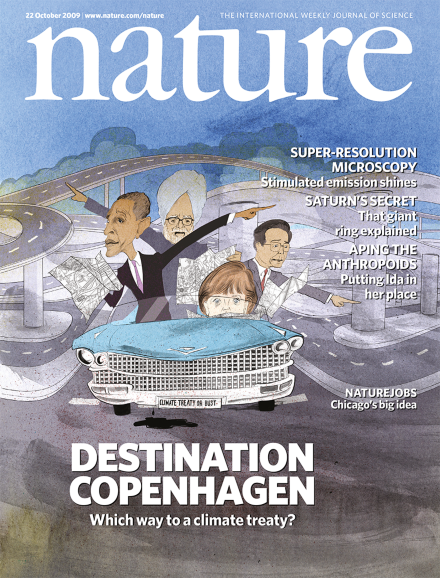
Climate of compromise p1027

The chances of a strong treaty emerging from the United Nations climate talks in Copenhagen seem small, but recent progress offers hope.

doi:10.1038/4611027a


Russia's grand plan p1028

The creation of a second pillar of excellence will give the country a chance to regain its scientific stature.

doi:10.1038/4611028a


Top

Research Highlights

Behaviour: Dislikeable likeness p1030

doi:10.1038/4611030a


Bionanosensing: Picky chips p1030

doi:10.1038/4611030b


Atmospheric science: Fire down under p1030

doi:10.1038/4611030c


Biochemistry: Hungry circadian clock p1030

doi:10.1038/4611030d


Physics: Stars in a pellet p1030

doi:10.1038/4611030e


Cell biology: Golgi stretch p1030

doi:10.1038/4611030f


Cancer biology: Metastatic mayhem p1031

doi:10.1038/4611031a


Immunology: Gut response p1031

doi:10.1038/4611031b


Ecology: Digging diversity p1031

doi:10.1038/4611031c


Palaeontology: Transition fossil p1031

doi:10.1038/4611031d


Top

Journal Club

Journal club p1031

Corinne Le Quéré

doi:10.1038/4611031e


Top

News

News briefing: 22 October 2009 p1032

The week in science.

doi:10.1038/4611032a


Time running out for climate talks p1034

Rift between developed and developing nations might be too great.

Jeff Tollefson

doi:10.1038/4611034a


Hwang verdict imminent p1035

Disgraced stem-cell researcher may face time in jail.

David Cyranoski

doi:10.1038/4611035a


High hopes for Russia's nanotech firms p1036

But an ambitious government initiative has been slow to incubate a domestic high-tech industry.

Quirin Schiermeier

doi:10.1038/4611036a


Hazy goals hold up conservation p1037

Lack of targets hampers efforts to save species.

Linda Nordling

doi:10.1038/4611037a


Europe's Galileo project gains ground p1039

Long-troubled satellite-navigation system receives formal backing from European Commission president.

Katharine Sanderson

doi:10.1038/4611039a


Fossil primate challenges Ida's place p1040

Controversial German specimen is related to lemurs, not humans, analysis of an Egyptian find suggests.

Rex Dalton

doi:10.1038/4611040a


Announcement p1040

doi:10.1038/4611040b


Transgenic aubergine put on ice p1041

Indian minister delays approval of GM crop.

K. S. Jayaraman

doi:10.1038/4611041a


Correction p1041

doi:10.1038/4611041b


Top

News Features

Climate: When the ice melts p1042

Deep in the Himalayas, the disappearance of glaciers is threatening the kingdom of Bhutan. Anjali Nayar trekked through the mountains to see how the country is adapting to a warming world.

doi:10.1038/4611042a


Climate: Counting carbon in the Amazon p1048

If the next climate treaty tackles deforestation, tropical nations will need to monitor the biomass of their forests. One ecologist has worked out a way to do that from the sky, finds Jeff Tollefson.

doi:10.1038/4611048a


Top

Correspondence

Sharing: project will make climate data freely available to all p1053

Don Gunasekera

doi:10.1038/4611053a


Sharing: public databases combat mistrust and secrecy p1053

Andrew A. Farke, Michael P. Taylor & Mathew J. Wedel

doi:10.1038/4611053b


Sharing: guidelines go one step forwards, two steps back p1053

Jelte Wicherts & Marjan Bakker

doi:10.1038/4611053c


UK red tape as sticky as the US version for would-be students p1053

Colin Stoneking

doi:10.1038/4611053d


Top

Opinion

India pushes for common responsibility p1054

Rajendra K. Pachauri says that India wants to be a constructive partner in Copenhagen negotiations on climate change. The country is taking domestic action even though it cannot accept mandatory emissions limits.

Rajendra K. Pachauri

doi:10.1038/4611054a


China expects leadership from rich nations p1055

Greater emissions cuts by developed nations are the starting point for a successful climate deal at Copenhagen in December says Jiahua Pan.

Jiahua Pan

doi:10.1038/4611055a


Copenhagen needs a strong lead negotiator p1056

Reaching an international climate agreement requires someone with exceptional skill, knowledge and diplomacy, says Kyoto chair Raúl Estrada-Oyuela.

Raúl Estrada-Oyuela.

doi:10.1038/4611056a


Top

Books and Arts

Conveying the campaign message p1058

The arts and advertising can galvanise public and political will in tackling global warming. But shared concern for human health is a better motivator than polar bears, finds Sanjay Khanna.

Sanjay Khanna

doi:10.1038/4611058a


Q&A: The science of persuasion p1059

Psychologist Robert Gifford is co-author of a recent American Psychological Association report that examined the interface between psychology and climate change. He explains what makes people receptive and how to get messages about climate science across effectively.

Sanjay Khanna

doi:10.1038/4611059a


Climate books with clout p1060

David Reay examines the evolution of books about global warming and highlights those that have had most influence on public perceptions.

David Reay

doi:10.1038/4611060a


Q&A: Architect of a sustainable future p1061

German architect Albert Speer Jr is a pioneer of sustainable building and city planning whose firm has designed ecological communities from Cologne in Germany to Shanghai in China. With the publication of a new book setting out his philosophy, he explains why we should take a more holistic approach to urban development.

John Whitfield

doi:10.1038/4611061a


Top

News and Views

Chemical physics: Molecular conformations fielded p1063

Studies of molecular dynamics can be foiled by the presence of stereoisomers — molecules that have the same bond sequence arranged in different geometries. This problem has now been deflected.

Albert Stolow

doi:10.1038/4611063a


Solar System: Saturn's colossal ring p1064

A hitherto undetected disk of debris around Saturn is the largest ever found to be orbiting a planet. This ring may hold the key to one of the most enigmatic landscapes in the Solar System.

Matthew S. Tiscareno & Matthew M. Hedman

doi:10.1038/4611064a

See also: Editor's summary


Climate change: Early survival of Antarctic ice p1065

Analyses of boron isotopes in ancient marine carbonate sediments provide an enlightening perspective on the links between carbon dioxide and ice-cap cover at a climatically momentous time in Earth's history.

Damien Lemarchand

doi:10.1038/4611065a

See also: Editor's summary


Ecology: Kelp in postglacial time p1066

Tim Lincoln

doi:10.1038/4611066a


Molecular biology: Slip sliding on DNA p1067

Dedicated binding proteins stabilize single-stranded DNA, protecting it from breakage and distortion. Once thought to form inert complexes with DNA, such proteins are now shown to be remarkably mobile.

Nicholas P. George & James L. Keck

doi:10.1038/4611067a

See also: Editor's summary


50 & 100 years ago p1068

doi:10.1038/4611068b


Biochemistry: Enzyme's black box cracked open p1068

Polyketide synthase enzymes make compounds from molecules that synthetic chemists can't easily control. The basis of the enzymes' ability to use such unstable precursors has been laid bare.

David H. Sherman

doi:10.1038/4611068a

See also: Editor's summary


Microscopy: Light from the dark p1069

Fluorescence microscopy is the most popular way to image biomolecules, but it leaves many of them in the dark. Non-fluorescent, light-absorbing molecules can now be viewed by a method that turns them into mini-lasers.

Stefan W. Hell & Eva Rittweger

doi:10.1038/4611069a

See also: Editor's summary


Top

Brief Communications Arising

Silk production from tarantula feet questioned pE9

Fernando Pérez-Miles, Alejandra Panzera, David Ortiz-Villatoro & Cintya Perdomo

doi:10.1038/nature08404


Gorb et al. reply pE9

Stanislav N. Gorb, Senta Niederegger, Cheryl Y. Hayashi, Adam P. Summers, Walter Vötsch & Paul Walther

doi:10.1038/nature08405


Top

Review

The DNA-damage response in human biology and disease p1071

Stephen P. Jackson & Jiri Bartek

doi:10.1038/nature08467

See also: Editor's summary


Top

Articles

A role for a neo-sex chromosome in stickleback speciation p1079

Closely related species often have different sex-chromosome systems, but it is not known whether sex-chromosome turnover contributes to the evolution of reproductive isolation between species. Here, a neo-sex chromosome is identified in only one member of a sympatric species pair of stickleback fish in Japan. The newly evolved sex chromosome is found to contain genes that contribute to speciation, suggesting that sex-chromosome turnover might have a greater role in speciation than was previously appreciated.

Jun Kitano, Joseph A. Ross, Seiichi Mori, Manabu Kume, Felicity C. Jones, Yingguang F. Chan, Devin M. Absher, Jane Grimwood, Jeremy Schmutz, Richard M. Myers, David M. Kingsley & Catherine L. Peichel

doi:10.1038/nature08441

See also: Editor's summary


Pten in stromal fibroblasts suppresses mammary epithelial tumours p1084

The tumour microenvironment has an important role in tumorigenesis. Here, the genetic inactivation of Pten in stromal fibroblasts of mouse mammary glands is shown to accelerate the initiation, progression and malignant transformation of mammary epithelial tumours. The data presented suggest that the Pten–Ets2 axis — Ets2 being a transcription factor activated by the loss of Pten — is a critical stroma-specific signalling pathway that suppresses mammary epithelial tumours.

Anthony J. Trimboli, Carmen Z. Cantemir-Stone, Fu Li, Julie A. Wallace, Anand Merchant, Nicholas Creasap, John C. Thompson, Enrico Caserta, Hui Wang, Jean-Leon Chong, Shan Naidu, Guo Wei, Sudarshana M. Sharma, Julie A. Stephens, Soledad A. Fernandez, Metin N. Gurcan, Michael B. Weinstein, Sanford H. Barsky, Lisa Yee, Thomas J. Rosol, Paul C. Stromberg, Michael L. Robinson, Francois Pepin, Michael Hallett, Morag Park, Michael C. Ostrowski & Gustavo Leone

doi:10.1038/nature08486

See also: Editor's summary


SSB protein diffusion on single-stranded DNA stimulates RecA filament formation p1092

During DNA metabolism, single-stranded DNA intermediates are often generated that are protected from degradation by binding of ssDNA-binding (SSB) proteins. Bacterial SSB protein forms a tetramer that wraps ssDNA using its four subunits. Here it is shown that tetrameric SSB protein can spontaneously migrate along ssDNA; this diffusional movement introducing a new model for the redistribution of the SSB protein, while remaining bound to ssDNA during recombination and repair processes.

Rahul Roy, Alexander G. Kozlov, Timothy M. Lohman & Taekjip Ha

doi:10.1038/nature08442

See also: Editor's summary | News and Views by George & Keck


Top

Letters

Saturn's largest ring p1098

In the Solar System, planetary rings tend to lie within a few radii of their host body, because at these distances gravitational accelerations inhibit satellite formation. One of the best known exceptions to this rule is Saturn's E ring, a broad sheet of dust continuously supplied by source satellites that fades from view at five to ten planetary radii. An enormous ring associated with Saturn's outer moon Phoebe is now reported; it extends from at least 128 to 207 Saturn radii.

Anne J. Verbiscer, Michael F. Skrutskie & Douglas P. Hamilton

doi:10.1038/nature08515

See also: Editor's summary | News and Views by Tiscareno & Hedman


Information causality as a physical principle p1101

A broad class of theories exist which share the distinguishing characteristics of quantum mechanics but allow even stronger correlations. Here, the principle of 'information causality' is introduced and shown to be respected by both classical and quantum physics; however, it is violated by other models that resemble quantum mechanics but with stronger correlations. It is suggested that information causality may help to distinguish physical theories from non-physical ones.

Marcin Pawl strokeowski, Tomasz Paterek, Dagomir Kaszlikowski, Valerio Scarani, Andreas Winter & Marek Z dotukowski

doi:10.1038/nature08400

See also: Editor's summary


Imaging chromophores with undetectable fluorescence by stimulated emission microscopy p1105

Imaging beyond the diffraction limit — to resolve tiny features in cells, for example — has had to rely on tagging the imaged substance with fluorescent chromophores or other techniques that are much less sensitive, like absorption. The use of stimulated emission (a property, unlike fluorescence, which all molecules can have) is now reported; sensitivity is orders of magnitude higher than for spontaneous emission or absorption contrast, and fluorescence is not used.

Wei Min, Sijia Lu, Shasha Chong, Rahul Roy, Gary R. Holtom & X. Sunney Xie

doi:10.1038/nature08438

See also: Editor's summary | News and Views by Hell & Rittweger


Atmospheric carbon dioxide through the Eocene–Oligocene climate transition p1110

It is generally accepted that declining carbon dioxide (CO2) levels were an important factor in the Eocene–Oligocene transition about 34 million years ago, when the world shifted from a greenhouse to an icehouse climate. Here, using the boron isotope pH proxy on carbonate microfossils from a recently discovered geological section in Tanzania, atmospheric CO2 levels before, during and after the climate transition are estimated.

Paul N. Pearson, Gavin L. Foster & Bridget S. Wade

doi:10.1038/nature08447

See also: Editor's summary | News and Views by Lemarchand


Trench-parallel anisotropy produced by serpentine deformation in the hydrated mantle wedge p1114

Although seismic anisotropy in the upper mantle is generally attributed to the crystal-preferred orientation of olivine, the strong trench-parallel anisotropy observed in several subduction systems is difficult to explain in terms of olivine anisotropy. Using high-pressure deformation experiments, it is now shown that the crystal-preferred orientation of serpentine, the main hydrous mineral in the upper mantle, can produce the strong trench-parallel seismic anisotropy observed in such subduction systems.

Ikuo Katayama, Ken-ichi Hirauchi, Katsuyoshi Michibayashi & Jun-ichi Ando

doi:10.1038/nature08513

See also: Editor's summary


Convergent evolution of anthropoid-like adaptations in Eocene adapiform primates p1118

The recent description of the primitive Eocene primate Darwinius has been widely publicized as an important 'link' in the early evolution of Anthropoidea. The extinct group to which Darwinius belongs, the 'adapoid' primates, was not generally thought to be close to the anthropoids. Here, the jaw and teeth of a large-bodied adapiform from the earliest late Eocene of Egypt is described; detailed phylogenetic analysis shows that adapiforms were only very distant relatives of anthropoids but that they do have some features that suggest convergent evolution.

Erik R. Seiffert, Jonathan M. G. Perry, Elwyn L. Simons & Doug M. Boyer

doi:10.1038/nature08429

See also: Editor's summary


Sleep deprivation impairs cAMP signalling in the hippocampus p1122

Sleep deprivation can have adverse cognitive effects, with one of the major consequences on the brain being memory deficits in learning models that are dependent on the hippocampus. A molecular mechanism by which brief sleep deprivation alters hippocampal function is now identified in mice; it involves the impairment of cyclic-AMP- and protein-kinase-A-dependent forms of synaptic plasticity.

Christopher G. Vecsey, George S. Baillie, Devan Jaganath, Robbert Havekes, Andrew Daniels, Mathieu Wimmer, Ted Huang, Kim M. Brown, Xiang-Yao Li, Giannina Descalzi, Susan S. Kim, Tao Chen, Yu-Ze Shang, Min Zhuo, Miles D. Houslay & Ted Abel

doi:10.1038/nature08488

See also: Editor's summary


The postsynaptic function of type II cochlear afferents p1126

The mammalian cochlea is innervated predominantly by type I sensory neurons, but also present are the far less numerous type II neurons, the function of which has been the subject of much speculation. Studies of type II fibres now show that they receive excitatory glutamatergic synaptic input and that they are depolarized by exogenous ATP. These results prove that type II neurons function as cochlear afferents, and can be modulated by ATP.

Catherine Weisz, Elisabeth Glowatzki & Paul Fuchs

doi:10.1038/nature08487

See also: Editor's summary


Unexpected consequences of a sudden and massive transposon amplification on rice gene expression p1130

Most eukaryotic genomes harbour numerous transposable elements which contribute to gene and genome evolution; however, how genomic integrity is maintained in the face of high transposition is not completely understood. High-throughput sequencing of individual rice plants is now used to assess the impact of insertion on gene expression. The vast majority of transposable element insertions are found either to upregulate or to have no detectable effect on gene transcription.

Ken Naito, Feng Zhang, Takuji Tsukiyama, Hiroki Saito, C. Nathan Hancock, Aaron O. Richardson, Yutaka Okumoto, Takatoshi Tanisaka & Susan R. Wessler

doi:10.1038/nature08479

See also: Editor's summary


A transposon-induced epigenetic change leads to sex determination in melon p1135

During the development of flowering plants, sex determination leads to the physical separation of male and female flowers from an originally bisexual floral meristem. Here, in melon, the transition from male to female flowers is shown to result from epigenetic changes in the promoter of a transcription factor, CmWIP1. The data presented are used to propose a model for the control and development of male, female and hermaphrodite flowers in melon.

Antoine Martin, Christelle Troadec, Adnane Boualem, Mazen Rajab, Ronan Fernandez, Halima Morin, Michel Pitrat, Catherine Dogimont & Abdelhafid Bendahmane

doi:10.1038/nature08498

See also: Editor's summary


Structural basis for biosynthetic programming of fungal aromatic polyketide cyclization p1139

Regiospecific cyclizations of reactive poly-beta-keto intermediates are known to lead to the structural variability of aromatic products of fungal nonreducing, multidomain iterative polyketide synthases (NR-PKS group of IPKSs), but questions about the process remain. The crystal structure and mutational studies of a dissected product template monodomain from PksA, the NR-PKS that initiates the biosynethesis of the hepatocarcinogen aflatoxin B1, are now presented.

Jason M. Crawford, Tyler P. Korman, Jason W. Labonte, Anna L. Vagstad, Eric A. Hill, Oliver Kamari-Bidkorpeh, Shiou-Chuan Tsai & Craig A. Townsend

doi:10.1038/nature08475

See also: Editor's summary | News and Views by Sherman


Structural basis for translational fidelity ensured by transfer RNA lysidine synthetase p1144

tRNAs are transcribed as precursor molecules that are then shortened, have a short sequence added, and may then undergo modifications of certain nucleotides to generate a different amino acid specificity. Here, tRNAIle2 lysidine synthetase (TilS) — a bacterial enzyme that carries out a nucleotide modification — is shown to specifically recognize and modify tRNAIle2 in its precursor form, thereby avoiding potential translation errors.

Kotaro Nakanishi, Luc Bonnefond, Satoshi Kimura, Tsutomu Suzuki, Ryuichiro Ishitani & Osamu Nureki

doi:10.1038/nature08474

See also: Editor's summary


Top

Technology Features

Neural circuits: Putting neurons on the map p1149

After a long lull, powerful new technologies are putting the charting of brain circuitry back on neuroscientists' agenda. Michael Eisenstein explores the challenge of mapping the mammalian mind.

Michael Eisenstein

doi:10.1038/4611149a


Neural circuits: Whose map is it anyway? p1150

doi:10.1038/4611150a


Neural circuits: Table of suppliers p1153

doi:10.1038/4611153a


Top

Naturejobs

Prospects

Going mobile p1157

Survey results suggest that mobile technology offers scientists both increased productivity and unwelcome intrusion. Rich Pennock speculates on the consequences.

Rich Pennock

doi:10.1038/nj7267-1157a


Careers Q&A

Stefan Söldner-Rembold p1157

A particle physicist at the University of Manchester, UK, Söldner-Rembold is the latest spokesperson elected to co-coordinate the D0 experiment, an exploration of the subatomic universe that started in 1992 at the Fermi National Accelerator Laboratory in Batavia, Illinois.

Virginia Gewin

doi:10.1038/nj7267-1157b


Region

Seeds of collaboration p1158

Academic and government labs in the Chicago area are combining forces to reel in a host of large collaborative research projects — and tens of millions of dollars in funding. Paul Smaglik sums up.

Paul Smaglik

doi:10.1038/nj7267-1158a


Top

Futures

Tropicbird p1162

The winds of change.

K V

doi:10.1038/4611162a


Extra navigation

.
  • Japanese table of contents

Open Innovation Challenges

naturejobs

ADVERTISEMENT