Table of contents
Volume 460 Number 7252 pp151-298
(this content only available online) indicates content that is available online only
Editorials
Japan's tipping point p151
With changing demographics, a tight economy and increasing competition, Japan could slide from the top ranks of research nations. Drastic action is needed.
doi:10.1038/460151a
How to stop blogging p152
Organizers have only two options for their meetings: open or closed.
doi:10.1038/460152a
Adieu to nuclear recycling p152
President Barack Obama should be applauded for his decision to scrap commercial reprocessing.
doi:10.1038/460152b
Research Highlights
Perception: Picture imperfect? p154
doi:10.1038/460154a
Ecology: A dusting of snow p154
doi:10.1038/460154b
Evolution: Mary had a littler lamb p154
doi:10.1038/460154c
Cancer biology: At rest in the bones p154
doi:10.1038/460154d
Astronomy: A star is born p154
doi:10.1038/460154e
Genomics: Closing in on cholesterol p154
doi:10.1038/460154f
Microbiology: Supershedding mice p155
doi:10.1038/460155a
Geology: Earth-shattering research p155
doi:10.1038/460155b
Computational biology: Unstuck by design p155
doi:10.1038/460155c
Neurology: Feeling out autism p155
doi:10.1038/460155d
News
US stem-cell research expands p156
Biomedical agency announces new funding policy for cell lines.
Meredith Wadman
doi:10.1038/460156a
Flu jabs urged for developing countries p156
Move should spur demand for vaccines and keep production facilities running.
Alison Abbott
doi:10.1038/460156b
Czech researchers angry over government changes p157
Reform reshuffles budgets for science and industry.
Quirin Schiermeier
doi:10.1038/460157a
Developing nations tackle climate p158
Emissions targets, clean-energy projects and calls for justice are multiplying, reports Jeff Tollefson.
Jeff Tollefson
doi:10.1038/460158a
Iran presidential candidate speaks out p160
2005 contender Mostafa Moin talks about how the international science community can help Iran.
Declan Butler
doi:10.1038/460160a
When Earth greened over p161
Explosion of animal life could have been triggered by blanket of vegetation.
Eric Hand
doi:10.1038/460161a
US AIDS chief lays out priorities p162
Focus to shift from US priorities to those of countries receiving aid.
Erika Check Hayden
doi:10.1038/460162a
Evolution wins out in Hong Kong curriculum dispute p163
doi:10.1038/460163a
Japanese diplomat chosen to lead nuclear watchdog p163
doi:10.1038/460163b
Governments fail to reduce global biodiversity decline p163
doi:10.1038/460163c
US scientist jailed for sharing sensitive data p163
doi:10.1038/460163d
US Air Force will continue to share meteor data p163
doi:10.1038/460163e
Lunar Reconnaissance Orbiter snaps test pictures p163
doi:10.1038/460163f
News Features
Human genetics: One gene, twenty years p164
When the cystic fibrosis gene was found in 1989, therapy seemed around the corner. Two decades on, biologists still have a long way to go, finds Helen Pearson.
doi:10.1038/460164a
Science education: Reading, writing and nanofabrication p171
With its electron microscope, genetic sequencing machines and observatory, the Yokohama Science Frontier High School is equipped like no other. Will future scientists be inspired there, asks David Cyranoski.
doi:10.1038/460171a
Correspondence
Interrogation: has abuse been reduced by psychologists? p173
Frank Summers
doi:10.1038/460173a
Birds and people both depend on China's wetlands p173
Lei Cao & Anthony D. Fox
doi:10.1038/460173b
Route for political interests to weaken conservation p173
Petri Ahlroth & Janne S. Kotiaho
doi:10.1038/460173c
Commentary
Too small to overlook p174
Voluntary reporting of nanomaterials by industry has failed. Mandatory measures are a step in the right direction, but the field needs more data sharing and oversight, say Andrew Maynard and David Rejeski.
doi:10.1038/460174a
Essay
Darwin's last laugh p175
We must look for mental commonalities between humans and other animals to understand the minds of either, says Frans B. M. de Waal, rebutting a recent claim to the contrary.
Frans B. M. de Waal
doi:10.1038/460175a
Books and Arts
Orderly anarchists p176
The profit motive has led pirates to come up with surprisingly democratic and egalitarian social structures. It is a lesson in bottom-up economics, explains Michael Shermer.
Michael Shermer
doi:10.1038/460176a
Solo journey to a fifth dimension p177
Stefan Michalowski & Georgia Smith review Hypermusic Prologue: A Projective Opera in Seven Planes by Hèctor Parra & Lisa Randall
doi:10.1038/460177a
Where they lived p178
Andrew Robinson reviews Lived in London: Blue Plaques and the Stories Behind Them Edited by Emily Cole
doi:10.1038/460178a
Fresh formulae for portraiture p179
New portraits of physicists David Brewster and Peter Higgs show that naturalistic images can find distinct ways to reflect scientists and their work, Martin Kemp explains.
Martin Kemp
doi:10.1038/460179a
News and Views
Evolutionary biology: Microbes exploit groundhog day p181
Can microorganisms learn from history? When a sequence of environmental changes is repeated, natural selection might select for responses that enable the microbes to prepare for later challenges in the sequence.
Tim F. Cooper
doi:10.1038/460181a
See also: Editor's summary
Vision: New light on allergy receptor p182
A receptor usually found on immune cells implicated in allergy turns out to be a diagnostic marker and promising treatment target for a degenerative eye disease. Curiously, its role in the eye seems to be unrelated to inflammation.
Maria Grant
doi:10.1038/460182a
See also: Editor's summary
Organic chemistry: Forgotten hydrocarbons prepared p183
Dendralene hydrocarbons have a reputation for being difficult — it seemed that these molecules couldn't easily be made. A practical synthesis of dendralenes opens them up for study, and reveals some surprises.
Henning Hopf
doi:10.1038/460183a
Immunology: B cells break the rules p184
A study of lymphocytes that lack a DNA-repair enzyme challenges long-standing dogma about the spatial separation of processes that rearrange antibody genes, and provides clues about the origins of B-cell cancers.
Marilyn Diaz & Janssen Daly
doi:10.1038/460184a
See also: Editor's summary
Materials science: Nanotubes sorted using DNA p186
A vast number of DNA sequences are possible, and so finding the few that bind to a particular non-DNA entity is a daunting task. A systematic search algorithm has found sequences that target specific carbon nanotubes.
Mark C. Hersam
doi:10.1038/460186a
See also: Editor's summary
Quantum information: Circuits that process with magic p187
Practical quantum computation will require a scalable, robust system to generate and process information with precise control. This is now possible using a superconducting circuit and a little quantum magic.
Raymond W. Simmonds & Frederick W. Strauch
doi:10.1038/460187a
See also: Editor's summary
Obituary: Herbert Frank York (1921–2009) p189
A voice of calm in the era of nuclear weapons.
Michael M. May
doi:10.1038/460189a
Horizons
The possibility of impossible cultures p190
Insights from evolutionary developmental biology and the mind sciences could change our understanding of the human capacity to think and the ways in which the human mind constrains cultural expressions.
Marc D. Hauser
doi:10.1038/460190a
Synthesis at the molecular frontier p197
Driven by remarkable advances in the understanding of structure and reaction mechanisms, organic synthesis will be increasingly directed to producing bioinspired and newly designed molecules.
Paul A. Wender & Benjamin L. Miller
doi:10.1038/460197a
Biomarkers in psychiatry p202
The use of biomarkers to predict human behaviour and psychiatric disorders raises social and ethical issues, which must be resolved by collaborative efforts.
Ilina Singh & Nikolas Rose
doi:10.1038/460202a
Toxicology for the twenty-first century p208
The testing of substances for adverse effects on humans and the environment needs a radical overhaul if we are to meet the challenges of ensuring health and safety.
Thomas Hartung
doi:10.1038/460208a
Review
The role of black holes in galaxy formation and evolution p213
Virtually all massive galaxies host central black holes, the growth of which releases vast amounts of energy that powers quasars and other weaker active galactic nuclei. However, a tiny fraction of this energy could halt star formation by heating and ejecting ambient gas; a central question in galaxy evolution is the degree to which this process has caused the decline of star formation in large elliptical galaxies.
A. Cattaneo, S. M. Faber, J. Binney, A. Dekel, J. Kormendy, R. Mushotzky, A. Babul, P. N. Best, M. Brüggen, A. C. Fabian, C. S. Frenk, A. Khalatyan, H. Netzer, A. Mahdavi, J. Silk, M. Steinmetz & L. Wisotzki
doi:10.1038/nature08135
First paragraph | Full Text | PDF (763K)
See also: Editor's summary
Articles
Adaptive prediction of environmental changes by microorganisms p220
Habitats where environmental change occurs in a reliable order offer microorganisms the opportunity to prepare in advance. Here, in both the bacterium Escherichia coli and the yeast Saccharomyces cerevisiae, stimuli that typically appear early in the ecology of the organism are shown to induce genes that are useful for coping with conditions that normally occur later, a process that is also shown to improve fitness.
Amir Mitchell, Gal H. Romano, Bella Groisman, Avihu Yona, Erez Dekel, Martin Kupiec, Orna Dahan & Yitzhak Pilpel
doi:10.1038/nature08112
Abstract | Full Text | PDF (306K) | Supplementary information
See also: Editor's summary | News and Views by Cooper
CCR3 is a target for age-related macular degeneration diagnosis and therapy p225
Age-related macular degeneration (AMD) is a major cause of blindness. Now, the eosinophil/mast cell chemokine receptor CCR3 is shown to be specifically expressed in choroidal neovascular endothelial cells in humans with AMD, and targeting CCR3 or its ligands in mice inhibits the choroidal neovascularization that underlies AMD. In the mouse model, CCR3 blockade was more effective and less toxic than VEGF-A neutralization, which is currently in clinical use.
Atsunobu Takeda, Judit Z. Baffi, Mark E. Kleinman, Won Gil Cho, Miho Nozaki, Kiyoshi Yamada, Hiroki Kaneko, Romulo J. C. Albuquerque, Sami Dridi, Kuniharu Saito, Brian J. Raisler, Steven J. Budd, Pete Geisen, Ariel Munitz, Balamurali K. Ambati, Martha G. Green, Tatsuro Ishibashi, John D. Wright, Alison A. Humbles, Craig J. Gerard, Yuichiro Ogura, Yuzhen Pan, Justine R. Smith, Salvatore Grisanti, M. Elizabeth Hartnett, Marc E. Rothenberg & Jayakrishna Ambati
doi:10.1038/nature08151
Abstract | Full Text | PDF (1,089K) | Supplementary information
See also: Editor's summary | News and Views by Grant
Mechanisms promoting translocations in editing and switching peripheral B cells p231
Editing and class switch recombination, two processes in the development of B cells, are thought to be separated in the bone marrow and spleen, respectively. Errors in either of these processes can initiate chromosomal translocations, including those of B cell lymphomas, but collaboration between them may also initiate translocations. Here it is shown that both editing and class switch recombination can occur in peripheral B cells, offering insights into the origin of the translocations observed in certain B cell lymphomas.
Jing H. Wang, Monica Gostissa, Catherine T. Yan, Peter Goff, Thomas Hickernell, Erica Hansen, Simone Difilippantonio, Duane R. Wesemann, Ali A. Zarrin, Klaus Rajewsky, Andre Nussenzweig & Frederick W. Alt
doi:10.1038/nature08159
Abstract | Full Text | PDF (546K) | Supplementary information
See also: Editor's summary | News and Views by Diaz & Daly
Letters
Type IIn supernovae at redshift z
2 from archival data p237
Type IIn supernovae are luminous core-collapse explosions of massive stars that, unlike other types, are very bright in the ultraviolet and have strong, long-lived emission lines that should enable detection at redshift z
2. Here, three spectroscopically confirmed type IIn supernovae are reported at redshifts z = 0.808, 2.013 and 2.357, detected in archival data.
Jeff Cooke, Mark Sullivan, Elizabeth J. Barton, James S. Bullock, Ray G. Carlberg, Avishay Gal-Yam & Erik Tollerud
doi:10.1038/nature08082
First paragraph | Full Text | PDF (283K) | Supplementary information
See also: Editor's summary
Demonstration of two-qubit algorithms with a superconducting quantum processor p240
Quantum computers, which harness the superposition and entanglement of physical states, hold great promise for the future. Here, the demonstration of a two-qubit superconducting processor and the implementation of quantum algorithms, represents an important step in quantum computing.
L. DiCarlo, J. M. Chow, J. M. Gambetta, Lev S. Bishop, B. R. Johnson, D. I. Schuster, J. Majer, A. Blais, L. Frunzio, S. M. Girvin & R. J. Schoelkopf
doi:10.1038/nature08121
First paragraph | Full Text | PDF (602K) | Supplementary information
See also: Editor's summary | News and Views by Simmonds & Strauch
Direct observation of correlations between individual photon emission events of a microcavity laser p245
Lasers are recognized for coherent light emission, the onset of which is reflected in a change in photon statistics; but, until now, attempts to directly measure correlations in the individual photon emission events of semiconductor lasers have been unsuccessful. By using a streak camera technique with sufficient time resolution, the dynamical evolution of correlations between individual photon emission events is now demonstrated.
J. Wiersig,
C. Gies,
F. Jahnke,
M. A
mann,
T. Berstermann,
M. Bayer,
C. Kistner,
S. Reitzenstein,
C. Schneider,
S. Höfling,
A. Forchel,
C. Kruse,
J. Kalden
&
D. Hommel
doi:10.1038/nature08126
First paragraph | Full Text | PDF (513K) | Supplementary information
See also: Editor's summary
DNA sequence motifs for structure-specific recognition and separation of carbon nanotubes p250
Methods for production of single-walled carbon nanotubes (SWNTs) generate mixtures of metallic and semiconducting tubes with different diameters and chiralities. However, many fundamental studies and technical applications of SWNTs require a population of tubes with identical chirality. A new method that is capable of purifying each species in a nanotube mixture is now demonstrated.
Xiaomin Tu, Suresh Manohar, Anand Jagota & Ming Zheng
doi:10.1038/nature08116
First paragraph | Full Text | PDF (507K) | Supplementary information
See also: Editor's summary | News and Views by Hersam
Late Cretaceous seasonal ocean variability from the Arctic p254
Although the modern Arctic Ocean is regarded as a barometer of global change and an amplifier of global warming, little is known about its state in the greenhouse period of the Late Cretaceous epoch (65–99 million years ago). Here, a seasonally resolved Cretaceous sedimentary record from the Alpha ridge of the Arctic Ocean is presented; evidence suggests seasonal diatom productivity in a stratified ocean with possible winter sea ice cover.
Andrew Davies, Alan E. S. Kemp & Jennifer Pike
doi:10.1038/nature08141
First paragraph | Full Text | PDF (1,949K) | Supplementary information
See also: Editor's summary
Bone-marrow adipocytes as negative regulators of the haematopoietic microenvironment p259
Adult bone marrow contains numerous adipocytes, the numbers of which correlate inversely with the haematopoietic activity of the marrow. It had been unclear whether adipocytes participate in haematopoietic regulation or simply expand to fill marrow space; here it is shown that murine haematopoiesis is reduced in adipocyte-rich marrow during homeostasis, and that adipocytes antagonize haematopoietic recovery after bone-marrow irradiation.
Olaia Naveiras, Valentina Nardi, Pamela L. Wenzel, Peter V. Hauschka, Frederic Fahey & George Q. Daley
doi:10.1038/nature08099
First paragraph | Full Text | PDF (708K) | Supplementary information
See also: Editor's summary
CD14 regulates the dendritic cell life cycle after LPS exposure through NFAT activation p264
Here, CD14 is shown to regulate mouse dendritic cell apoptosis after lipopolysaccharide stimulation via a pathway involving activation of the transcription factor NFAT; an event that is essential for maintaining self-tolerance and preventing autoimmunity. Given the involvement of CD14 in diseases such as sepsis and heart failure, the discovery of signal transduction pathways activated exclusively by CD14 is an important step towards the development of potential new treatments.
Ivan Zanoni, Renato Ostuni, Giusy Capuano, Maddalena Collini, Michele Caccia, Antonella Ellena Ronchi, Marcella Rocchetti, Francesca Mingozzi, Maria Foti, Giuseppe Chirico, Barbara Costa, Antonio Zaza, Paola Ricciardi-Castagnoli & Francesca Granucci
doi:10.1038/nature08118
First paragraph | Full Text | PDF (500K) | Supplementary information
See also: Editor's summary
T cells dampen innate immune responses through inhibition of NLRP1 and NLRP3 inflammasomes p269
The mechanisms controlling excessive inflammatory responses, which can result in damage to tissues and diseases such as arthritis and type-2 diabetes, are poorly understood. Mouse effector and memory CD4+ T cells are now shown to inhibit inflammasome activity, revealing a mechanism by which effector and memory T cells can suppress potentially damaging inflammation while leaving the primary inflammatory response intact.
Greta Guarda, Catherine Dostert, Francesco Staehli, Katrin Cabalzar, Rosa Castillo, Aubry Tardivel, Pascal Schneider & Jürg Tschopp
doi:10.1038/nature08100
First paragraph | Full Text | PDF (490K) | Supplementary information
See also: Editor's summary
Unlimited multistability in multisite phosphorylation systems p274
Although naked DNA has a relatively static and easy to grasp information capacity, reversible phosphorylation at several sites in even a single protein encodes a potentially large amount of information, and the calculation of this information capacity is complex. Here, this complexity is reduced to solving two algebraic equations, allowing the estimation of the information capacity of a signalling protein as a function of the varying amounts of kinases and phosphatases.
Matthew Thomson & Jeremy Gunawardena
doi:10.1038/nature08102
First paragraph | Full Text | PDF (397K) | Supplementary information
See also: Editor's summary
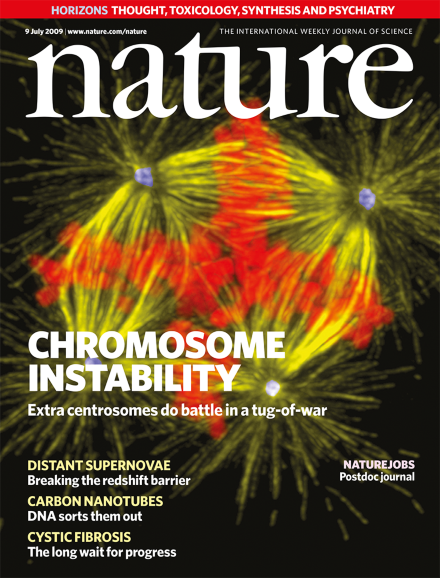
A mechanism linking extra centrosomes to chromosomal instability p278
Chromosomal instability (CIN) is a hallmark of many tumours and correlates with the presence of extra centrosomes, but a direct mechanistic link between CIN and extra centrosomes has not been established. Live-cell imaging is now used to demonstrate that extra centrosomes can promote chromosome missegregation as a consequence of cells passing through a transient 'multipolar spindle intermediate'.
Neil J. Ganem, Susana A. Godinho & David Pellman
doi:10.1038/nature08136
First paragraph | Full Text | PDF (944K) | Supplementary information
See also: Editor's summary
Uniparental expression of PolIV-dependent siRNAs in developing endosperm of Arabidopsis p283
Small interfering RNAs (siRNAs) that are associated with gene silencing have been discovered in most eukaryotes. In Arabidopsis thaliana, siRNAs are now shown to be uniparentally expressed from the maternal genome, having maximal expression in the young developing seed. This unusual pattern of expression provides evidence for a link between genomic imprinting and RNA silencing in plants.
Rebecca A. Mosher, Charles W. Melnyk, Krystyna A. Kelly, Ruth M. Dunn, David J. Studholme & David C. Baulcombe
doi:10.1038/nature08084
First paragraph | Full Text | PDF (855K) | Supplementary information
See also: Editor's summary
A histone H3 lysine 36 trimethyltransferase links Nkx2-5 to Wolf–Hirschhorn syndrome p287
Histone H3 trimethylation at lysine 36 (H3K36me3) is associated with actively transcribed regions and may provide landmarks for continuing transcription. Here it is shown that the H3K36me3-specific histone methyltransferase Wolf-Hirschhorn syndrome candidate 1 (WHSC1) functions in transcription regulation together with developmental transcription factors whose defects overlap with the human disease Wolf-Hirschorn syndrome (WHS). Furthermore, Whsc1-deficient mice display defects similar to those seen in WHS patients.
Keisuke Nimura, Kiyoe Ura, Hidetaka Shiratori, Masato Ikawa, Masaru Okabe, Robert J. Schwartz & Yasufumi Kaneda
doi:10.1038/nature08086
First paragraph | Full Text | PDF (843K) | Supplementary information
See also: Editor's summary
Addendum
Ionic high-pressure form of elemental boron p292
Artem R. Oganov, Jiuhua Chen, Carlo Gatti, Yanzhang Ma, Yanming Ma, Colin W. Glass, Zhenxian Liu, Tony Yu, Oleksandr O. Kurakevych & Vladimir L. Solozhenko
doi:10.1038/nature08164
Erratum
Slow earthquakes triggered by typhoons p292
ChiChing Liu, Alan T. Linde & I. Selwyn Sacks
doi:10.1038/nature08202
Naturejobs
ProspectsDebating the literature p295
A new approach can revitalize literature updates, building skills and teamwork at the same time. B. Harihara Venkatraman, Dipankar Basak and Dhandapani Venkataraman report.
B. Harihara Venkatraman, Dipankar Basak & Dhandapani Venkataraman
doi:10.1038/nj7252-295a
Postdoc journal
Expect the unexpected p295
Lab life requires vigilance.
Bryan Venters
doi:10.1038/nj7252-295b
In Brief
Boon for biotech p295
Bulletin identifies the best in biotech.
doi:10.1038/nj7252-295c
Student enrolment up p295
US graduate numbers rise in science and engineering.
doi:10.1038/nj7252-295d
Plain English p295
Free service helps scientists get published.
doi:10.1038/nj7252-295e