Europe's largest particle accelerator might not produce data until 2009.
Geoff Brumfiel
doi:10.1038/455436a
(this content only available online) indicates content that is available online only
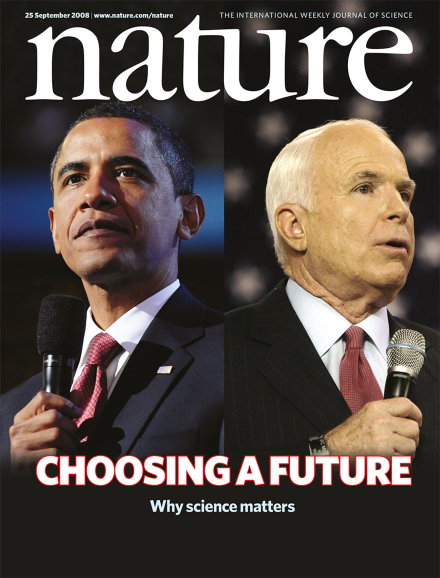
The next US president will lead the country back onto the world stage in many arenas, including science.
doi:10.1038/455431a
See also: Editor's summary
Better to confront superstition with science than to disregard the superstitious.
doi:10.1038/455431b
Self-regulation is a good first step — but synthetic-biology companies still need independent oversight.
doi:10.1038/455432a
doi:10.1038/455434a
doi:10.1038/455434b
doi:10.1038/455434c
doi:10.1038/455434d
doi:10.1038/455434e
doi:10.1038/455434f
doi:10.1038/455435a
doi:10.1038/455435b
doi:10.1038/455435c
doi:10.1038/455435d
Europe's largest particle accelerator might not produce data until 2009.
Geoff Brumfiel
doi:10.1038/455436a
Loan programme aims to support firms in getting products to the clinic.
Erika Check Hayden
doi:10.1038/455436b
Oil-rich nations concern proliferation experts with atomic projects.
Geoff Brumfiel
doi:10.1038/455438a
President appoints committee to exploit reservoirs found on coast.
Jeff Tollefson
doi:10.1038/455438b
doi:10.1038/455440a
doi:10.1038/455441a
doi:10.1038/455441b
doi:10.1038/455441c
doi:10.1038/455441d
doi:10.1038/455441e
doi:10.1038/455441f
The leading US presidential candidates are not trying to woo voters with science issues. But the senator who wins will help shape the world's most influential research agenda. Alexandra Witze looks at how John McCain and Barack Obama have developed their thoughts on science and technology, and where each of them might take the country if elected.
Alexandra Witze
doi:10.1038/455442a
Barack Obama accepted Nature's invitation to answer 18 science-related questions in writing; John McCain's campaign declined. Obama's answers to many of the questions are printed here; answers to additional questions (on topics including biosecurity, the nuclear weapons laboratories and US participation in international projects) can be found at http://www.nature.com/uselection. Wherever possible, Nature has noted what McCain has said at other times on these topics.
Alexandra Witze
doi:10.1038/455446a
A new president could bring radical shifts to America's major research entities. Nature profiles some of the agencies in need of a makeover.
Jeff Tollefson
doi:10.1038/455451a
Concerns about the next president's science adviser miss the real issues, says David Goldston.
David Goldston
doi:10.1038/455453a
What is it like to be labelled a genius? Kendall Powell follows the paths of four MacArthur Fellows - and finds they lead to rutting elephant bulls, climate-change champions, hybrid sunflowers and robotic hands.
Kendall Powell
doi:10.1038/455455a
Marco Prunotto
doi:10.1038/455460a
Keith Suckling
doi:10.1038/455460b
Susan Green
doi:10.1038/455460c
Robin Lovelace
doi:10.1038/455461a
Donald E. Hirsch
doi:10.1038/455461b
Tin-Lap Lee
doi:10.1038/455461c
Samuel Donovan
doi:10.1038/455461d
The OECD is developing a strategy for nations to measure and ultimately promote innovation. It requires knowledge of a complex system, say Fred Gault and Susanne Huttner.
doi:10.1038/455462a
See also: Editor's summary
Expansion of the railways across the western United States changed the face of vertebrate palaeontology, and perhaps the country itself, explains Ross MacPhee.
Ross MacPhee reviews The Legacy of the Mastodon: The Golden Age of Fossils in America by Keith Thomson
doi:10.1038/455464a
Steven Shapin, Jerry Coyne, Rita Colwell, Martin Nowak, Jerry Ravetz & Kevin Padian
doi:10.1038/455464b
See also: Editor's summary
Erika Check Hayden reviews The California Academy of Sciences
doi:10.1038/455466a
John B. Clark reviews Unmaking the Public University: The Forty-Year Assault on the Middle Class by Christopher Newfield
doi:10.1038/455467a
The annual UK Big Draw festival, a month of nationwide workshops and talks launched this weekend in London, teaches people how to 'see' through drawing. Terry Rosenberg, head of design at Goldsmiths, University of London, explains how gaining skills in life drawing can help scientists perceive the world and communicate their results.
Louise Whiteley
doi:10.1038/455468a
Agriculture in developing countries was transformed when scientists met aid officials and convinced them to invest in research. Lowell S. Hardin was there, and believes today's food crisis demands a similar vision.
Lowell S. Hardin
doi:10.1038/455470a
See also: Editor's summary
Animals sense light and chemical signals through proteins called G-protein-coupled receptors. The crystal structure of one such receptor in complex with a G-protein fragment shows how these receptors are activated.
Thue W. Schwartz & Wayne L. Hubbell
doi:10.1038/455473a
See also: Editor's summary
Physicists have come up with an innovative way of manipulating the direction of magnetization in a solid. The approach might be used to make low-power-consumption computer memory devices.
Eiji Saitoh
doi:10.1038/455474a
See also: Editor's summary
Existing therapies for hearing defects are generally ineffective in severe forms of deafness. A technical feat that generates sound-sensing hair cells in the inner ear of mice might have long-term potential.
Mats Ulfendahl
doi:10.1038/455475a
See also: Editor's summary
Serendipitous observations have revealed fast optical flaring after the onset of X-ray-burst activity from a source in our Milky Way galaxy. It could be the first time this has been observed in a rare kind of neutron star.
Chryssa Kouveliotou
doi:10.1038/455477a
See also: Editor's summary
When the myelin layer that covers neuronal processes is lost through disease, neural stem cells recapitulate the developmental program of 'myelination'. The underlying molecular mechanisms often fail in the ageing brain.
Klaus-Armin Nave
doi:10.1038/455478a
A medley of molecules, and the interactions between them, mediate cancer. The latest news is that the enzyme CDK8 orchestrates cross-talk between two signalling pathways that are frequently deregulated in human cancers.
René Bernards
doi:10.1038/455479a
See also: Editor's summary
Ten years after the term metagenomics was coined, the approach continues to gather momentum. This culture-independent, molecular way of analysing environmental samples of cohabiting microbial populations has opened up fresh perspectives on microbiology.
Philip Hugenholtz & Gene W. Tyson
doi:10.1038/455481a
See also: Editor's summary
Long Cai, Chiraj K. Dalal & Michael B. Elowitz
doi:10.1038/nature07292
Abstract | Full Text | PDF (560K) | Supplementary information
See also: Editor's summary
Sylvia E. J. Fischer, Maurice D. Butler, Qi Pan & Gary Ruvkun
doi:10.1038/nature07274
Abstract | Full Text | PDF (442K) | Supplementary information
See also: Editor's summary
Patrick Scheerer,
Jung Hee Park,
Peter W. Hildebrand,
Yong Ju Kim,
Norbert Krau
,
Hui-Woog Choe,
Klaus Peter Hofmann
&
Oliver P. Ernst
doi:10.1038/nature07330
Abstract | Full Text | PDF (1,088K) | Supplementary information
See also: Editor's summary | News and Views by Schwartz & Hubbell
A. Stefanescu,
G. Kanbach,
A. S
owikowska,
J. Greiner,
S. McBreen
&
G. Sala
doi:10.1038/nature07308
First paragraph | Full Text | PDF (289K)
See also: Editor's summary | News and Views by Kouveliotou
A. J. Castro-Tirado, A. de Ugarte Postigo, J. Gorosabel, M. Jelínek, T. A. Fatkhullin, V. V. Sokolov, P. Ferrero, D. A. Kann, S. Klose, D. Sluse, M. Bremer, J. M. Winters, D. Nuernberger, D. Pérez-Ramírez, M. A. Guerrero, J. French, G. Melady, L. Hanlon, B. McBreen, K. Leventis, S. B. Markoff, S. Leon, A. Kraus, F. J. Aceituno, R. Cunniffe, P. Kubánek, S. Vítek, S. Schulze, A. C. Wilson, R. Hudec, M. Durant, J. M. González-Pérez, T. Shahbaz, S. Guziy, S. B. Pandey, L. Pavlenko, E. Sonbas, S. A. Trushkin, N. N. Bursov, N. A. Nizhelskij, C. Sánchez-Fernández & L. Sabau-Graziati
doi:10.1038/nature07328
First paragraph | Full Text | PDF (544K) | Supplementary information
See also: Editor's summary | News and Views by Kouveliotou
Samuel Deléglise, Igor Dotsenko, Clément Sayrin, Julien Bernu, Michel Brune, Jean-Michel Raimond & Serge Haroche
doi:10.1038/nature07288
First paragraph | Full Text | PDF (1,557K) | Supplementary information
See also: Editor's summary
D. Chiba, M. Sawicki, Y. Nishitani, Y. Nakatani, F. Matsukura & H. Ohno
doi:10.1038/nature07318
First paragraph | Full Text | PDF (444K) | Supplementary information
See also: Editor's summary | News and Views by Saitoh
Steffen M. Olsen, Bogi Hansen, Detlef Quadfasel & Svein Østerhus
doi:10.1038/nature07302
First paragraph | Full Text | PDF (633K) | Supplementary information
See also: Editor's summary
Christophe Cassou
doi:10.1038/nature07286
First paragraph | Full Text | PDF (766K) | Supplementary information
See also: Editor's summary
Richard P. Evershed,
Sebastian Payne,
Andrew G. Sherratt,
Mark S. Copley,
Jennifer Coolidge,
Duska Urem-Kotsu,
Kostas Kotsakis,
Mehmet Özdo
an,
Aslý E. Özdo
an,
Olivier Nieuwenhuyse,
Peter M. M. G. Akkermans,
Douglass Bailey,
Radian-Romus Andeescu,
Stuart Campbell,
Shahina Farid,
Ian Hodder,
Nurcan Yalman,
Mihriban Özba
aran,
Erhan B
çakc
,
Yossef Garfinkel,
Thomas Levy
&
Margie M. Burton
doi:10.1038/nature07180
First paragraph | Full Text | PDF (385K)
See also: Editor's summary
Xiaocong Yu, Tshidi Tsibane, Patricia A. McGraw, Frances S. House, Christopher J. Keefer, Mark D. Hicar, Terrence M. Tumpey, Claudia Pappas, Lucy A. Perrone, Osvaldo Martinez, James Stevens, Ian A. Wilson, Patricia V. Aguilar, Eric L. Altschuler, Christopher F. Basler & James E. Crowe Jr
doi:10.1038/nature07231
First paragraph | Full Text | PDF (227K) | Supplementary information
See also: Editor's summary
Samuel P. Gubbels, David W. Woessner, John C. Mitchell, Anthony J. Ricci & John V. Brigande
doi:10.1038/nature07265
First paragraph | Full Text | PDF (1,202K) | Supplementary information
See also: Editor's summary | News and Views by Ulfendahl
Wanzhong He, Mark S. Ladinsky, Kathryn E. Huey-Tubman, Grant J. Jensen, J. Richard McIntosh & Pamela J. Björkman
doi:10.1038/nature07255
First paragraph | Full Text | PDF (1,870K) | Supplementary information
See also: Editor's summary
-catenin activity p547Ron Firestein, Adam J. Bass, So Young Kim, Ian F. Dunn, Serena J. Silver, Isil Guney, Ellen Freed, Azra H. Ligon, Natalie Vena, Shuji Ogino, Milan G. Chheda, Pablo Tamayo, Stephen Finn, Yashaswi Shrestha, Jesse S. Boehm, Supriya Jain, Emeric Bojarski, Craig Mermel, Jordi Barretina, Jennifer A. Chan, Jose Baselga, Josep Tabernero, David E. Root, Charles S. Fuchs, Massimo Loda, Ramesh A. Shivdasani, Matthew Meyerson & William C. Hahn
doi:10.1038/nature07179
First paragraph | Full Text | PDF (769K) | Supplementary information
See also: Editor's summary | News and Views by Bernards
-catenin transcription and is antagonized by both pRB and CDK8 p552Erick J. Morris, Jun-Yuan Ji, Fajun Yang, Luisa Di Stefano, Anabel Herr, Nam-Sung Moon, Eun-Jeong Kwon, Kevin M. Haigis, Anders M. Näär & Nicholas J. Dyson
doi:10.1038/nature07310
First paragraph | Full Text | PDF (822K) | Supplementary information
See also: Editor's summary | News and Views by Bernards
Sylvain Courbet, Sophie Gay, Nausica Arnoult, Gerd Wronka, Mauro Anglana, Olivier Brison & Michelle Debatisse
doi:10.1038/nature07233
First paragraph | Full Text | PDF (745K) | Supplementary information
See also: Editor's summary
China as both an exporter and an importer of science talent.
Gene Russo
doi:10.1038/nj7212-561a
Immunologist takes circuitous path to Science Foundation Ireland.
Virginia Gewin
doi:10.1038/nj7212-562a
Study suggests an upside to the 'two-body problem'.
Virginia Gewin
doi:10.1038/nj7212-562b
Interacting with my scientist peers can make me nervous.
Aliza le Roux
doi:10.1038/nj7212-562c
The Seeker is looking for methods to optimize sub-cellular localization tags for protein expression....
This Challenge is looking for novel approaches to analyzing changes at a single-cell level. This is...